
Pep Guardiola's Humanity Exposed in *A Beautiful Obsession* Documentary
Pep Guardiola has never looked more human on screen. That is the shock of Amazon’s new four-part documentary, A Beautiful Obsession – and the surprise is that Manchester City, who filmed and controlled it, allow that humanity to spill out so unguarded.
This is not a glossy farewell to the architect of their greatest era. It is a close-up of the season when the machine broke.
A winter collapse, stripped bare
The cameras linger on the bleak heart of City’s 2024-25 campaign, when a side described by chair Khaldoon al-Mubarak as a “machine built for winning” suddenly juddered and stalled. Nine defeats and a single win in 13 games. Aura gone. Certainties shaken.
The club could easily have smoothed over that crisis. Instead, from Wednesday on Prime, viewers are dragged into the chaos. Guardiola is not airbrushed into a saint, nor are his players. Kevin De Bruyne’s exit, the most painful footballing decision of the era, is treated with the same cold light. So is the internal fury at Guardiola’s extraordinary call to change 10 players for the 2-0 Champions League home defeat to Bayer Leverkusen.
Khaldoon’s anger at that night is not hinted at. It is shown.
“I’m fucking divorced…”
The most arresting moments are not tactical briefings or dressing-room roars. They are Guardiola’s attempts to fuse his private implosion with his team’s collapse.
After a 2-0 defeat by Juventus in the Champions League on 11 December 2024 – City’s seventh loss in 10 games – Guardiola reaches for something raw to jolt his players. He lays bare his divorce from Cristina Serra in front of the squad.
“I’m fucking divorced from the most beautiful woman on your planet,” he tells them. “I love her unbelievably, but we lost the passion. How do you play football, because you are paid? Or because of something inside? Where is the passion?”
It is a startling choice. The line between personal and professional is not just blurred; it is crossed at full tilt. The intention is clear: to shock, to force the players to confront what drives them. Yet the effect is more complicated. The manager, who later defines a great No 1 as someone who can “convince your players [that they would] go to the penthouse, the roof and jump down [for you],” suddenly appears to be reaching for tools he no longer fully trusts.
A year on, after those 10 changes against Leverkusen, he returns to the same theme with the squad. “I leave my life, my divorce and my family is away, and everything for all of you. And what do you give back?” he asks.
The question hangs in the room, heavy and unresolved.
A manager exposed
Episode two, The Rebuild, deepens that sense of a man straining for answers. Manuel Estiarte, Guardiola’s close friend and City’s director of first-team operations, reveals he felt compelled to explain the divorce to the players himself.
“I said to the team: ‘Please, you have to understand, you’re not playing with a coach who can be a bit impulsive, intense, sometimes a bit up and down. You’re seeing a human being. He’s getting a divorce.’ It was necessary for the team not only to visualise Pep as a manager but for the first time as a human being.”
The admission raises awkward questions. Why did Guardiola not deliver this himself, if the aim was to deepen the bond with his players? And if his emotional state was so central to the story of the season, how did Khaldoon and Ferran Soriano, City’s CEO, weigh that against his ability to keep steering the club?
Then the mood flips. We cut to a smiling Guardiola, speaking as if from the other side of the storm. “In my life I made a lot of changes – I got divorced and I have to settle a bit. But no complaints at all honestly,” he says, before clarifying where his contentment lies. “In my job, yeah.”
The contrast underlines a theme that runs through the series and through Guardiola’s tenure: relationships as the core of his management. Episode three is bluntly titled Love and Hugs for a reason.
Captaincy, conflict and Anfield fallout
In part one, The Desert, that emotional currency is tested to breaking point. Kyle Walker’s January 2025 departure, right when City most needed their captain, leaves Guardiola visibly wounded.
He tells the squad Walker did not behave like their leader. Then he turns the spotlight on them. They had voted for him as captain. Why did they not “pin him to the wall” and demand more loyalty?
The scene that triggers Walker’s exit is filmed with a cinematic eye. In the Anfield dressing room, after Walker’s mistake leads to Luis Díaz winning a penalty that Mohamed Salah converts in a 2-0 defeat, Guardiola calls out the error. Walker snaps back, insisting he is being blamed “every meeting”.
The argument ends not with a blow-up but with Guardiola in tears, speaking about why he signed a new contract only 11 days earlier, right in the middle of that disastrous run. He did it, he says, because he wanted to fight.
As he talks, the camera frames Walker in the same shot, now silent, absorbing every word. Guardiola pleads with the dressing room: “If captains first, then the other ones, for example [feel] that there’s a problem, tell me. It’s not going to change the love I have for all of you. I’m sorry.”
Regret seeps into the walls.
De Bruyne: cold decisions, real tears
Episode two opens with another wrenching goodbye. Kevin De Bruyne is not offered a new deal. Soriano stresses to Khaldoon that “Kevin gets the respect he deserves as the greatest player in the modern history of City”. The words are warm; the decision is not.
Guardiola describes how “Super Kev” broke down in his office. He also admits there had to be a hard edge to the call to move him on. The camera then finds De Bruyne in his own moment of vulnerability, crying when asked what he will miss most.
“My kids don’t want to go,” he says.
The line cuts deeper than any montage of goals. It reminds the viewer that, beneath the performance, the press conferences and the trophies, there are families, attachments, lives uprooted by decisions framed as “football reasons”.
The documentary keeps circling back to this truth: the elite game feeds off emotion, yet often chews it up.
The Leverkusen gamble and the board’s fury
The series does not spare Guardiola when it comes to his tactical gamble against Leverkusen in November 2025. He changes his entire outfield team for a Champions League tie of obvious significance. City lose 2-0 at home.
Inside the boardroom, the verdict is blunt. “Our attitude with Pep Guardiola should not be too negative. But it shouldn’t be too kind or accommodating either. This is his mistake this time,” Soriano says.
Khaldoon goes further. “To pick an entire new [outfield] team in a game this important is probably one of the lowest points we’ve had. I can’t speak to him – I’m so angry.”
For a club often accused of stage-managing its image, this is an unusually raw airing of internal tension. Guardiola is not portrayed as untouchable. He is shown as fallible, and judged.
Nothing is eternal
By the time part four, Nothing Is Eternal, draws to a close, the chaos has eased. City do what City have done under Guardiola: they win. The Carabao Cup and FA Cup arrive to make it 20 trophies in a decade, Community Shields included. They finish second in the league. The rebuild he has pushed through looks, on paper, complete.
He receives the send-off a serial winner expects. Yet his final reflections land far from the touchline.
“Life should not just be about football. It’s too much to be honest,” he says.
The line is not framed as a neat epilogue. It sounds more like a man drawing a boundary, late but firm, after a season that exposed what happens when the obsession consumes everything around it.
Related News
Diogo Dalot Praises Milan's Gonçalo Ramos and Rafael Leao
Bezos-backed 1892 Holdings poised for Liverpool takeover
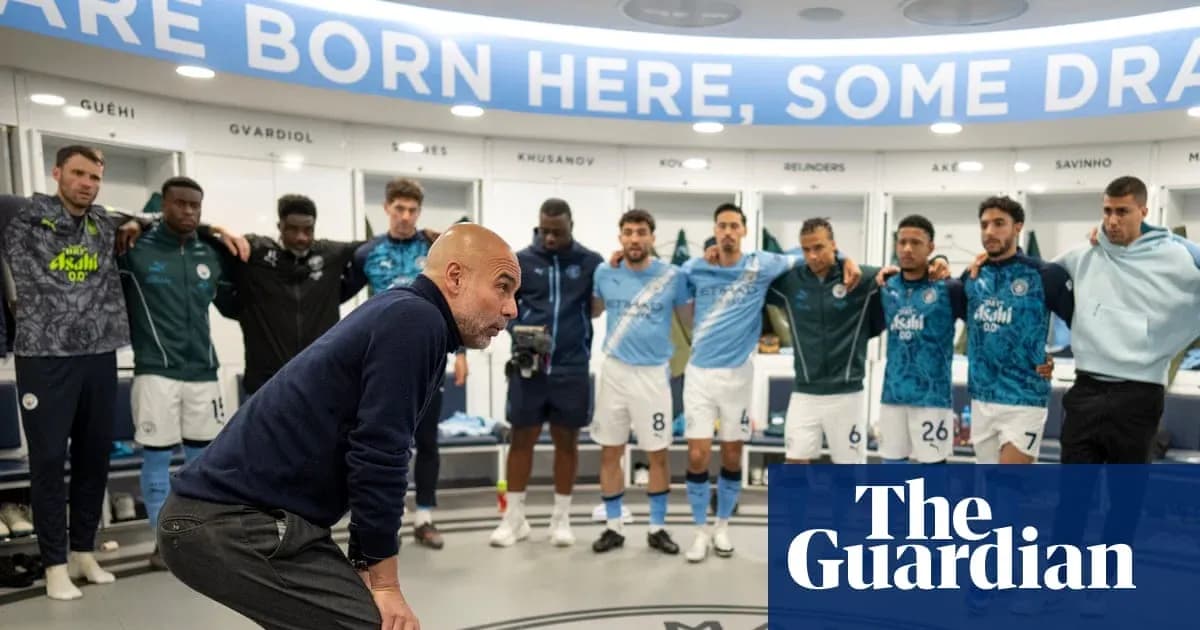
Pep Guardiola's Humanity Exposed in *A Beautiful Obsession* Documentary
Galatasaray Offers Competitive Wages to Attract Bruno Fernandes
Liverpool's Summer Rebuild: More Than Just Barcola and Mbaye
Barcelona's Striker Hunt: Hamza Abdelkarim Emerges as a Contender