
Premier League 2026/27: A Season of Chaos and Opportunity
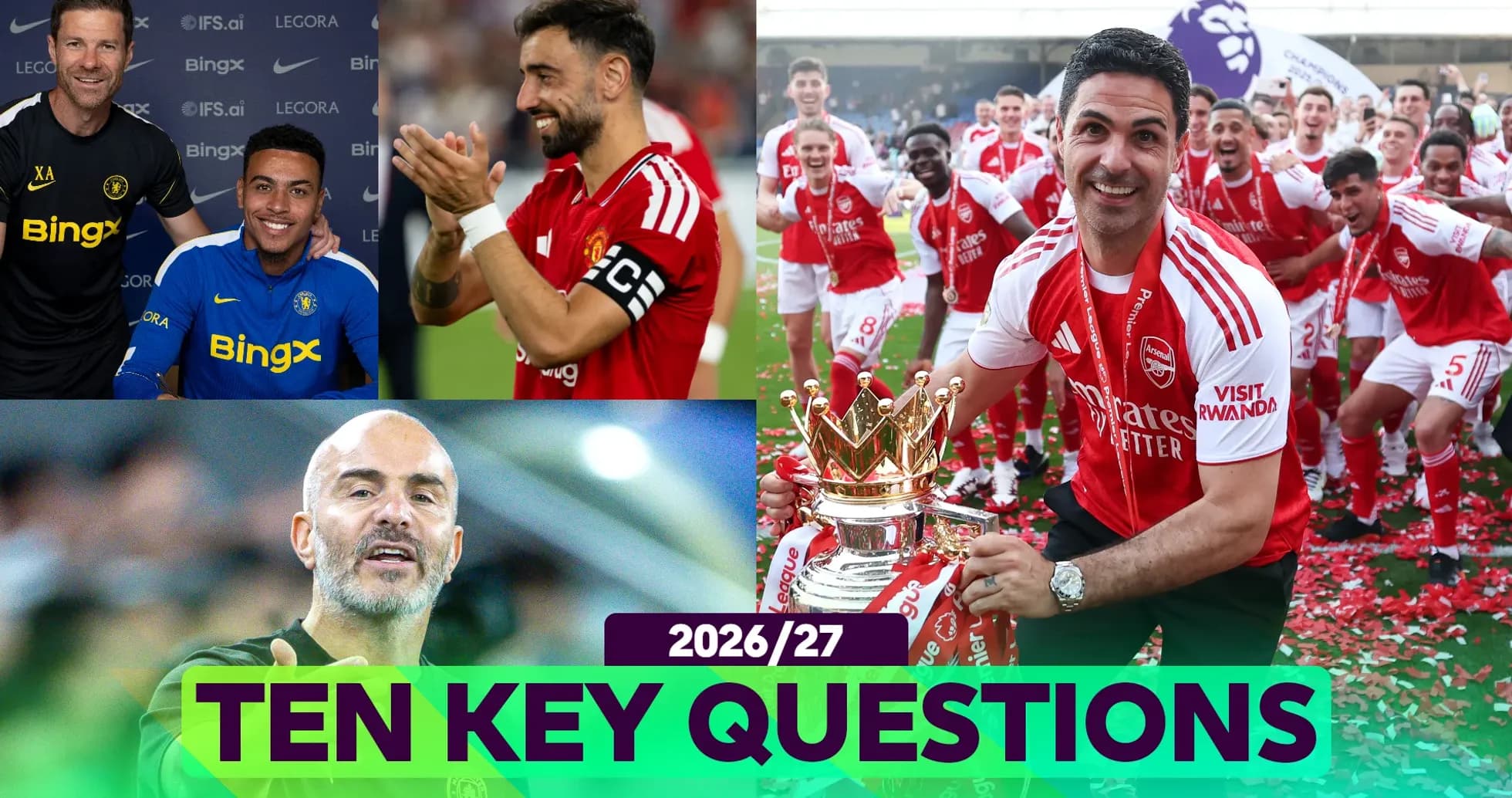
The Premier League is about to restart, and for once the story isn’t just who wins it – it’s who survives the chaos.
Nine new managers. Five of the traditional "Big Six" effectively pressing reset. Europe swallowing up the middle class. Three promoted clubs arriving with money to burn and absolutely no interest in being cannon fodder.
At the centre of it all, one club stands still. And that might be Arsenal’s greatest weapon.
Arteta, experience and a door Guardiola has finally left open
Only three managers have ever defended a Premier League title: Pep Guardiola, Sir Alex Ferguson and Jose Mourinho. That’s the company Mikel Arteta now chases.
Retaining the crown has always been brutal. The churn of fixtures, the tactical arms race, the psychological weight of being hunted. But the 2026/27 landscape is different. This is a year of upheaval.
Arsenal are not part of that upheaval.
They enter the new campaign with a settled squad, a fixed tactical identity and the confidence of champions after a title five years in the making. The monkey is off their back. The pressure, for once, is spread elsewhere.
Across the aisle, Manchester United and Tottenham Hotspur are stepping into their first full seasons under Michael Carrick and Roberto De Zerbi. Liverpool, Chelsea and Manchester City all start again under new managers.
In that storm, Arsenal look calm. Arteta is now the only Premier League title-winning coach in the division. Guardiola’s exit has removed the defining figure of the last decade from the touchline and, with it, the aura of inevitability around City’s dominance.
If ever there was a moment for a team to build a mini-dynasty of their own, this is it.
City after Pep: continuation or cliff edge?
Manchester City stand on a knife-edge. This season could define what their post-Guardiola era looks like for years.
Enzo Maresca inherits not just a job, but a dynasty. Eight league titles. A footballing language built entirely around one man’s ideas. Maresca is tasked with speaking that language fluently enough that nobody notices the accent has changed.
It can go either way.
Arne Slot showed at Liverpool that continuity is possible after a giant departs, carrying the Klopp momentum into a new chapter. But the ghosts of Unai Emery at Arsenal and David Moyes at Manchester United serve as a warning: following a legend can crush you.
City have tried to avoid that fate by appointing from the Guardiola school. Maresca is steeped in Pep’s principles, a possession-obsessed coach whose tactical blueprint mirrors his mentor’s more closely than any outsider could.
The question is whether that similarity is a strength or a trap. Guardiola is gone. Bernardo Silva and John Stones have gone with him. The dressing room has lost not just a manager, but core voices and personalities.
City are still the eight-time champions. But the spell has been broken. Whether Maresca can recast it will shape the title race – and perhaps Arsenal’s chance to rule.
Alonso at Chelsea: a superstar coach in waiting?
If you want fireworks, you look to Stamford Bridge.
Xabi Alonso arrives at Chelsea with the aura of a manager on the rise. An invincible season with Bayer Leverkusen in 2023/24 turned him into one of the most coveted coaches in the world. Now he steps into a Premier League that has just waved goodbye to both Klopp and Guardiola.
The stage is there for someone new to own it.
Chelsea’s situation is tailor-made for a fast start. No European football. No Thursday-Sunday grind. Antonio Conte used that same advantage in 2016/17 to drill his ideas and win the title in his debut season. He joined Jose Mourinho and Carlo Ancelotti in the tiny group of managers who have lifted the Premier League at the first attempt – three of the six did it at Chelsea.
Alonso could join them.
Chelsea’s squad was already stacked with talent. This summer, for the first time in the BlueCo era, they’ve added experience rather than just potential: Danny Welbeck and Jordan Henderson become the first over-30 signings of this ownership.
It’s a symbolic shift. Less scattergun, more structure. Give Alonso those free midweeks on the training pitch, a more balanced dressing room and the tactical sophistication he showed at Leverkusen, and Chelsea suddenly look like a serious problem for everyone else.
The return of chaos football?
Last season, something felt off. Goals didn’t disappear – 2.36 per game is hardly a drought – but the league’s attacking pulse slowed. Open-play Expected Goals dropped sharply from the wild 2023/24 campaign.
Open-play xG per match has fallen from 2.28 in 2023/24 to 1.82 in 2025/26. Coaches leaned into set-pieces. Matches became more controlled, less chaotic.
That might be about to change.
De Zerbi now has a full pre-season at Spurs to hard-wire his high-pressing, high-risk football into a squad built for front-foot play. His Brighton side were one of the most exhilarating teams in the league; Tottenham fans expect something similar, only scaled up.
At Liverpool, Andoni Iraola brings back the "heavy-metal" intensity many at Anfield craved. His Bournemouth team played with an aggression that lit up the league. Now he has a bigger stage and better players.
Alonso’s Leverkusen and Real Madrid teams scored heavily. Bournemouth’s new head coach Marco Rose comes from the RB Leipzig and Borussia Dortmund school of relentless attacking football. Crystal Palace’s Pierre Sage is another coach who wants fast breaks, hard pressing, vertical football.
Pile all of that into one league and the trend is obvious. The Premier League looks ready to tilt back towards open, attacking games – closer to the breathless, end-to-end spectacle of 2023/24.
Can Carrick drag Manchester United back into the title fight?
Manchester United’s story under Michael Carrick started with a jolt: caretaker manager, three days in the job, a 2-0 win over Manchester City. That result lit the fuse on a five-month surge that forced the club to hand him the role permanently.
The numbers since then are stark.
Across his 17 Premier League games in charge – almost half a season – United sat top of the table. Twelve wins, three draws, two defeats. Thirty-nine points. Arsenal, in that same span, took 36. City, 35. No complex tactical breakdown needed; the form table tells the story.
Repeat that over a full campaign and United win their first title since 2013.
Football rarely follows a straight line. Opponents will adjust, injuries will bite, the pressure will grow. But for the first time in a long time, Old Trafford has evidence, not just hope, that its club can live in the same airspace as Arsenal and City.
Carrick doesn’t need to reinvent anything. He just needs to prove last spring wasn’t a hot streak – it was the new normal.
The year of the comeback?
With so many new managers, there is a second storyline bubbling under the surface: redemption.
Fresh eyes mean fresh starts. Players who were frozen out, misused or injured suddenly have a path back.
Phil Foden and Cole Palmer are aiming to rebound from flat seasons that ended with them missing the England World Cup squad. Marcus Rashford and Mason Mount are fighting to reclaim status at Manchester United under a manager who has no loyalty to past hierarchies.
Harvey Elliott, Omar Marmoush and Andy Robertson all endured seasons of limited minutes. They now see openings. Yoane Wissa will hope a change in the dugout unlocks a better run of form.
Levi Colwill and Alexander Isak, both hit by injuries, loom as forgotten stars. If they stay fit, they instantly upgrade their teams.
With nine new managers and so many reputations to repair, this could be the season when careers are rewritten.
Villa, Newcastle and the cost of change
Twelve months ago, Aston Villa and Newcastle United were the continuity stories – stable, well-coached, quietly primed to crash the Champions League places.
That continuity has vanished.
At Newcastle, the transformation is sweeping. Eddie Howe has resigned. Matthias Jaissle steps in, facing the immediate problem of replacing Bruno Guimaraes, Anthony Gordon and Sandro Tonali – arguably the three most influential players in the squad.
In their place: Lukas Hornicek, Bazoumana Toure, Aladji Bamba, Sean Steur and Ewen Jaouen. All arrive for significant fees, all with strong CVs, but none proven in this environment. Jaissle must build a new core on the fly.
Villa’s shift is subtler but just as meaningful. Unai Emery remains, but the squad around him is being reshaped. Youri Tielemans, Morgan Rogers and Lucas Digne have gone. In their place come Alejandro Garnacho, Johan Manzambi and Joao Gomes, signings that speak to a new cycle rather than a simple refresh.
Both clubs still have ambition. Both still have strong coaches. But the smooth, upward curve of last year has been replaced by something riskier, more volatile.
Europe’s double-edged sword
Nine Premier League clubs reached Europe last season. For some, it was a springboard. For others, an anchor.
Aston Villa won the Europa League and still finished fourth. Crystal Palace sacrificed league position – 15th – but banked a UEFA Conference League triumph that will live forever in club history.
Nottingham Forest, Spurs and Newcastle, though, struggled to juggle the extra games and slid into the bottom half.
This year, Brighton & Hove Albion step into the Conference League for the first time and only their second European campaign ever. They will look at Palace’s run and see a template. Palace themselves, now more experienced, should be better prepared for a Europa League schedule.
Bournemouth and Sunderland, both in the Europa League, face the familiar question: do they have the depth? The lure of European nights is irresistible, but the price in the league can be steep.
Outside that group, others smell opportunity. Leeds United, after a strong summer, may feel a top-nine finish is more realistic precisely because so many rivals will be stretched on Thursdays. Brentford, who narrowly missed out last season, again have clear midweeks to absorb Keith Andrews’ meticulous work on the training ground.
Europe will lift some, drain others. The ripple effect could define the entire middle of the table.
Mid-table muscle and a league with no soft centre
Leeds and Brentford are not alone in aiming higher.
Fulham have turned to Alvaro Arbeloa, a former Real Madrid manager, and handed him two signings from his old club. The message is obvious: build on Marco Silva’s work and bridge that single-point gap that kept them out of Europe last season.
Nottingham Forest now have Oliver Glasner, the coach who delivered both the Conference League and FA Cup to Crystal Palace. Even after selling Elliot Anderson to Manchester City, Forest will believe they can replicate their seventh-place finish from two years ago.
Everton, meanwhile, look more stable than at any time since their move to their new stadium. David Moyes brings rare continuity in a season of flux. Hayden Hackney, Christian Norgaard and Brennan Johnson all raise the level of the starting XI.
Put it all together and the league looks brutally strong from top to almost bottom. There are very few obvious weak links. Every "mid-table" club carries a punch.
Are the new boys ready?
Coventry City, Ipswich Town and Hull City enter the division with ambition and busy transfer windows to match.
Sunderland’s aggressive spending last summer paid off spectacularly as they not only stayed up but surged into Europe, ending a two-year run of promoted clubs going straight back down. Leeds joined them in survival. This year’s newcomers have clearly taken note.
All three have leaned towards established internationals from mainland Europe rather than stocking up on Premier League veterans. Ipswich have still added Issa Diop and Sasa Lukic; Hull have brought in Matt Targett and Jack Butland to sprinkle some top-flight know-how. But the broader strategy is bold: quality over familiarity.
Predicting how they’ll cope is a fool’s game. Sunderland and Leeds were widely tipped to struggle in 2025/26 and proved everyone wrong.
Coventry come up as dominant Championship winners, guided by the experience of Frank Lampard. Ipswich return with recent top-flight memories and Gary O’Neil, a coach who has already kept both Bournemouth and Wolverhampton Wanderers up.
Hull face the steepest climb. Opta’s "Expected Points" table had them 23rd out of 24 in the Championship last season based on xG for and against. On paper, they are favourites to finish bottom.
But this is their first Premier League campaign since 2017. Optimism will drown out numbers on opening day. It usually does.
Across the division, from champions to newcomers, there is a rare sense of shared anticipation. Every club can make a convincing case that this season will be better than the last.
The question is simple, and ruthless: in a league this strong, whose belief survives contact with reality?
Related News
Liverpool Targets Young Right-Back Hector Fort from Barcelona
Paul Scholes Critiques Arsenal's Transfer Strategy on Lewis-Skelly
Leeds United Under-21s Kick Off 2026/27 Season Against Stoke City
Liverpool's Late-Window Push: Barcola Takes Priority Over Mbaye
Liverpool Eyes Double Signing from PSG: Barcola and Mbaye
Fikayo Tomori: Liverpool's Last Chance for Defensive Reinforcement