
Real Madrid's Unbeaten Streak Ends: Mbappe's Miss and Controversy Explained
Real Madrid’s unbeaten start under Jose Mourinho is over, and it ended in a storm of debate, slow-motion replays and rulebook references.
On a tense night against Real Betis, Los Verdiblancos struck late, leaving Madrid chasing the game with the clock against them. Mourinho’s side needed two goals in the final ten minutes to turn defeat into victory. They barely got a sniff of one.
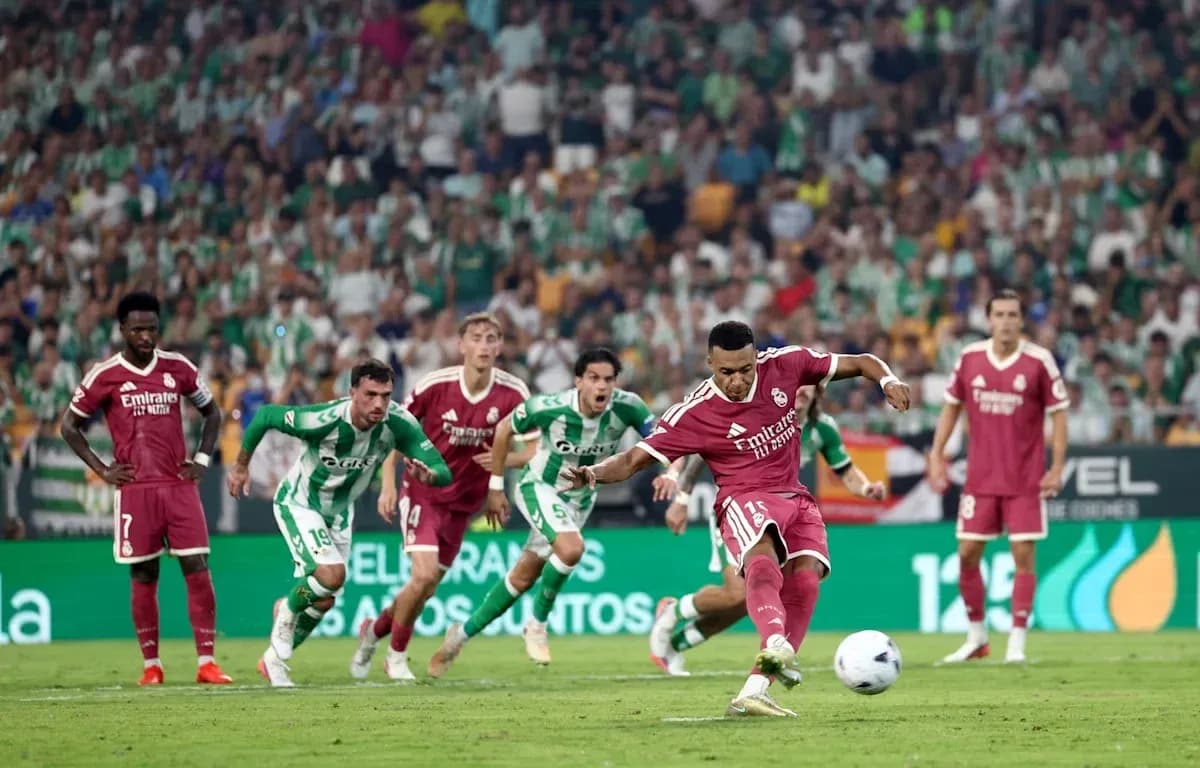
Deep into added time, a lifeline appeared. Vinicius Jr. drove into the box, drew contact, and the referee pointed to the spot. Up stepped Kylian Mbappe, with the match, the streak and the narrative all resting on his right foot.
Alvaro Valles guessed right. A clean, decisive save. The stadium erupted.
Then came the freeze-frame.
Replays showed Marc Bartra appearing to encroach into the area before Mbappe struck the ball. Social media lit up. Madrid fans demanded a retake. Pundits split into camps. Was this a clear infringement or a technicality the officials chose to ignore?
Spain’s refereeing body, the CTA, has now backed the decision on the pitch: no retake, no error.
What the rulebooks actually say
To cut through the noise, the CTA leaned on two key references: the IFAB Laws of the Game and its own CARD manual.
Under IFAB guidance, a penalty must be retaken for defensive encroachment only if the encroaching player directly impacts the taker, plays the ball, or challenges an opponent after the kick. It is not enough simply to be inside the area early.
There is another nuance. When a player is in the air, as Bartra was, their position is judged by where their feet would land if they were touching the ground. That interpretation, though, only applies when the player’s entire body is off the ground.
The CTA’s CARD manual runs along the same lines. It specifies that a retake is required only when the defender’s encroachment has a direct effect: interfering with the taker, going for the ball, or challenging an attacking player.
Presence alone is not the trigger. Influence is.
Why Mbappe’s miss stood
Through that lens, the Mbappe incident becomes clearer for the officials.
For the penalty to be retaken, Bartra’s early step into the box needed to alter the outcome in some tangible way: disturb Mbappe’s strike, compete for the rebound, or make a challenge on a Real Madrid player immediately after the kick.
He did none of that.
Bartra did not touch Mbappe, did not get to the ball first, and did not prevent a Madrid player from attacking the rebound in the immediate phase after the save. His positioning looked ugly in still images, but by the letter of both IFAB and CARD, it did not materially damage Madrid’s chance to profit from the spot-kick.
That distinction is why the CTA has come down firmly on the side of the match officials. In their view, the call to let Valles’ save stand was not just defensible; it was correct.
Real Madrid walk away from Seville with their first defeat of the Mourinho era, a missed penalty, and a sense of grievance that will not fade quickly. The rulebooks, though, are not offering them any comfort.
The question now is how they respond on the pitch, not in the replay room.
Related News
Mattéo Guendouzi Faces Two-Game Champions League Ban After Lyon Incident
Real Madrid's Unbeaten Streak Ends: Mbappe's Miss and Controversy Explained
John Stones Set for Serie A Debut with Inter Against Napoli
Juventus Goalkeeping Battle: Vicario vs Grabara
Alexia Putellas Leads London City Lionesses to Victory
Isak Shines as Liverpool Secures First Win Under Iraola