
Shamrock Rovers Defeat Egnatia Rrogozhinë 3-1 in UEFA Europa League
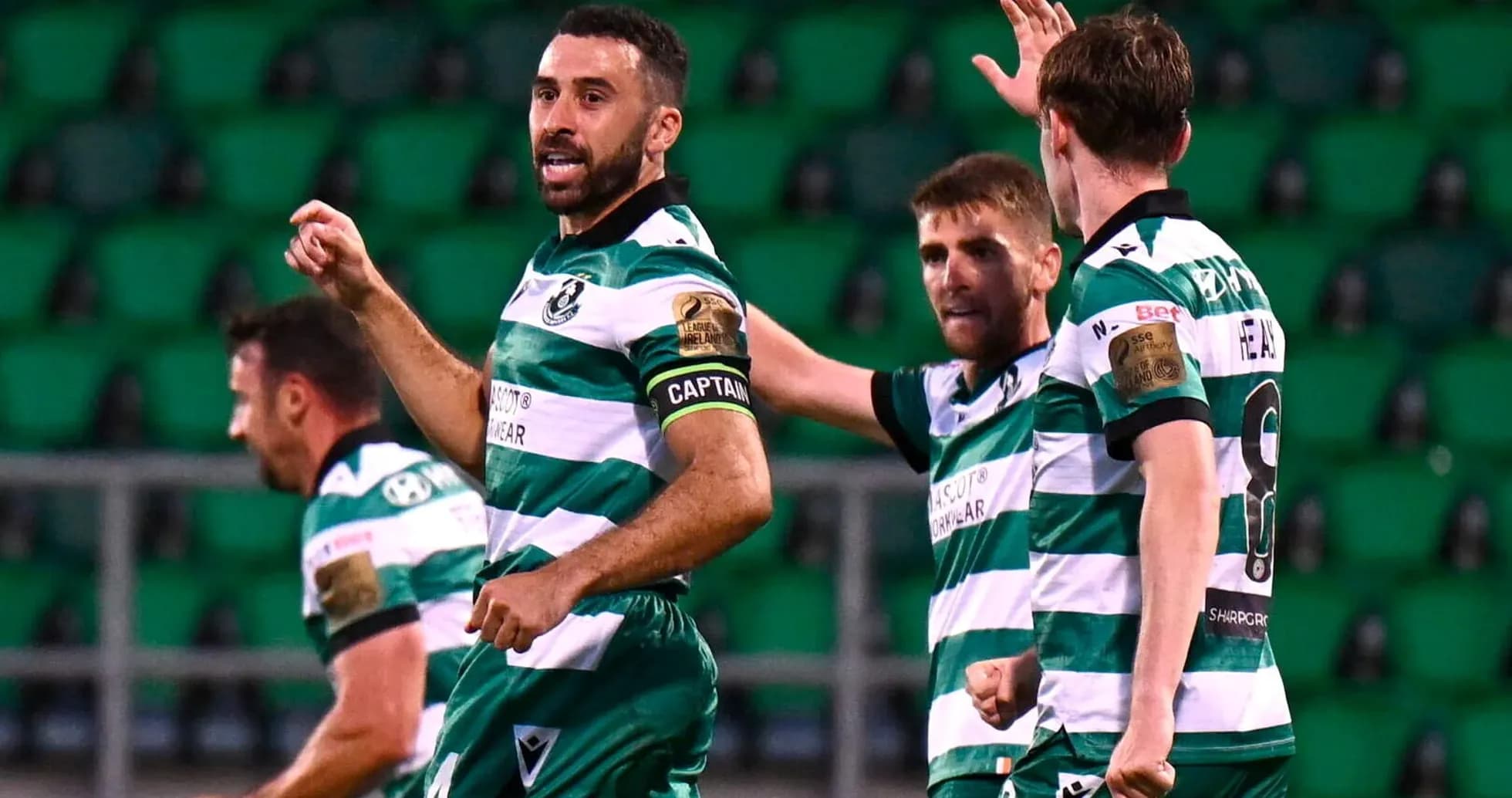
Shamrock Rovers’ 3-1 win over Egnatia Rrogozhinë at Tallaght Stadium in the UEFA Europa League 3rd Qualifying Round was built on structural clarity and better in-game adaptation rather than dominance in the classic statistical sense. With almost all advanced metrics unavailable, the tactical picture has to be read primarily from shapes, substitutions and the sequence of key events. Both sides started in a mirrored 3-5-2, but only Stephen Bradley’s team managed to turn that symmetry into territorial control and, eventually, scoreboard control.
Rovers’ 3-5-2 was constructed to give them width from midfield rather than from the back line. The back three of T. Sobowale, R. Lopes and E. Stevens stayed relatively conservative, anchoring transitions and allowing the five-man midfield to push high. W. Fitzgerald and A. Brennan were the natural width on the flanks, with J. Byrne and D. Watts tasked as the primary playmakers and M. Healy providing balance in central zones. Up front, G. Burke and A. Greene operated with clear role separation: Burke as the more creative, penalty-box arriving forward; Greene as the channel runner to stretch Egnatia’s back three.
First Half
The first-half penalty converted by G. Burke at 29' confirmed Rovers’ intent to attack through central overloads. The three central midfielders plus Burke dropping off created numerical superiority against Egnatia’s own midfield trio, forcing the Albanian side’s wide players G. Jaime and A. Yago to collapse inwards. That in turn opened lanes for Fitzgerald and Brennan to advance, pinning Egnatia’s wing-backs and limiting their counter-attacking threat.
Egnatia’s 3-5-2, on paper, mirrored the home side but functioned differently. Their back three of Z. Aliyev, E. Bitri and E. Sota held a higher line, with G. Jaime stepping aggressively to engage Rovers’ wing-backs. In midfield, Fernando Medeiros, A. Kryeziu and I. Diabate were more vertical than Rovers’ trio, looking to connect quickly with the front pairing of D. Adjessa and the advanced midfielder I. Gruda. The equaliser at 41', scored by G. Jaime after his earlier missed penalty in the same minute, underlined Egnatia’s reliance on their wing-back as a key attacking outlet rather than a purely defensive wide defender.
Second Half
The second half became a test of which coach could better re-balance the same base system. Bradley’s first move came at 46', with J. Mulraney (IN) coming on for A. Brennan (OUT). This subtly shifted Rovers’ right side: Mulraney offers more direct dribbling and inside movements than Brennan, turning the right flank into a more aggressive lane for ball progression. At the same time, Nevil Dede executed a triple change for Egnatia at 46', introducing A. Albanese (IN) for I. Diabate (OUT), K. Loukili (IN) for I. Gruda (OUT), and J. Montenegro (IN) for D. Adjessa (OUT). In one move, Egnatia refreshed almost their entire attacking structure, switching to a more creative, ball-to-feet front line rather than the more direct, running threat of the starters.
This flurry of changes, however, destabilised Egnatia’s defensive cohesion. Just nine minutes into the second half, R. Lopes’ goal at 55' from a J. Byrne assist illustrated how Rovers exploited gaps in Egnatia’s set-piece or box organisation. Byrne’s involvement from midfield again showed his importance as the main conduit between defence and attack. Two minutes later, the own goal by A. Yago at 57' effectively decided the tactical battle: Rovers’ pressure and presence in dangerous areas forced errors from a reconfigured Egnatia back line that had not yet settled into new reference points.
From there, Rovers managed the game through further targeted substitutions. At 58', J. Afolabi (IN) replaced A. Greene (OUT), giving fresh legs up front and a more physical reference to contest long balls and relieve pressure. At 69', Bradley doubled down on control and energy in midfield and attack: D. Mandroiu (IN) for G. Burke (OUT) and N. Razi (IN) for D. Watts (OUT) re-energised the central lanes with players comfortable receiving between lines and carrying the ball. Later, at 77', J. O'Sullivan (IN) for J. Byrne (OUT) completed a gradual refresh of the midfield structure while preserving the same 3-5-2 skeleton.
Egnatia’s later changes were more reactive than strategic. At 69', N. Ajetovikj (IN) for Z. Aliyev (OUT) adjusted the defensive line, and at 81' E. Ndreca (IN) for A. Yago (OUT) effectively removed the player involved in the own goal. By then, though, the game state dictated that Rovers could sit a little deeper in their 5-3-2 defensive shell, with wing-backs dropping and the three central defenders focusing on protecting the box. Without data on shots, possession or passes, the pattern of substitutions and the 3-1 scoreline strongly suggest that Rovers were able to shift from proactive to reactive control, while Egnatia’s multiple attacking reshuffles never produced a sustained, coherent threat.
Discipline also shaped the tactical tone. Egnatia collected two yellow cards, both for “Foul”: first Ildi Gruda at 38', then Alessandro Albanese at 47', immediately after his introduction. Both bookings point to midfielders struggling to contain Rovers’ rotations and being forced into late challenges. Shamrock Rovers received one yellow card, to Dylan Watts at 60' for “Foul”, which fits with a phase where Rovers were protecting a two-goal cushion and more willing to break up play in central areas.
With no reliable numbers for possession, shots, passes, xG or goalkeeper saves, the statistical verdict rests on the hard outcomes: Shamrock Rovers converted their structural superiority in the 3-5-2 into three goals, including one forced own goal, while limiting Egnatia to a single reply. The half-time score of 1-1 reflected an initially balanced contest, but the second-half evolution to 3-1 underlines Rovers’ superior in-game management. Egnatia’s higher card count (two yellows to one) and heavier substitution churn, especially in attacking roles, are consistent with a side chasing the game and never quite finding a stable, effective configuration against Rovers’ increasingly compact, game-state-aware 5-3-2.
Related News
AC Milan vs Benfica: A Clash of Two Philosophies in UEFA Europa League
Five Standout Europa League Players to Watch in 2026/27
AC Milan vs Benfica Europa League Clash: Team Updates, Lineups & Broadcast Info
Omonia Nicosia vs Benfica Predicted Lineups: Team News for UEFA Europa League
Red Bull Salzburg vs Ararat-Armenia Predicted Lineups and Team News
Celje vs Red Bull Salzburg Predicted Lineups and Team News