
Spygate Scandal: Southampton's Play-Off Journey at Risk
Kim Hellberg stood in the bowels of St Mary’s, his side’s season over, his voice steady but his words cutting.
“It breaks my heart,” the Middlesbrough head coach said.
He was not talking about the 2-1 extra-time defeat to Southampton. Not about the missed chances, the tired legs, or the cruel bounce of a ball in May. His heartbreak lay elsewhere – in the belief that the contest had been compromised before a whistle was even blown.
A semi-final tainted
The Spygate scandal that now engulfs Southampton and the English Football League has ripped the narrative away from the pitch and dumped it squarely in the hands of lawyers and an independent disciplinary commission.
Southampton, charged with breaching EFL rules by observing one of Boro’s final training sessions before last Saturday’s first leg at the Riverside, have admitted no defence. They have not denied the allegations. They simply wait.
Hellberg, though, made his feelings clear.
“If we hadn't caught that man that they sent up five hours to drive, you would sit there and say well done [to Southampton] in the tactical aspect of the game and I would go home and feel like I've failed,” he said.
“When that is taken away from you – ‘we're not going to watch every game, we're going to send someone instead and film the sessions and hope they don't get caught’ – it breaks my heart in terms of all the things I believe in.”
A play-off semi-final. One of the most lucrative, high-pressure fixtures in the English game. And now, a stain that may yet redraw the outcome.
A final in doubt
Under normal circumstances, the conversation would have moved on by now. Southampton, victorious over two legs, would be preparing for Hull City in a Wembley showpiece on 23 May. Fans would be booking trains, hotels, days off work. Clubs would be drowning in logistics.
Instead, the Championship play-off final – the game that usually defines a season – is itself under threat.
There is no absolute certainty the match will even take place as planned.
Southampton have asked for a delay to allow them to complete an internal review. The EFL, staring at an immovable Wembley date and an unforgiving calendar, knows time is the one commodity it cannot conjure.
Ticketing windows are tight. Wembley’s schedule is tighter. After the booked final weekend, the stadium is unavailable and players scatter for international duty. There is no room to push this back. This must be settled well before 23 May.
So the season, and potentially the futures of two clubs, moves from the grass to a hearing room.
Saints celebrate in a storm
On the south coast, the mood is oddly split.
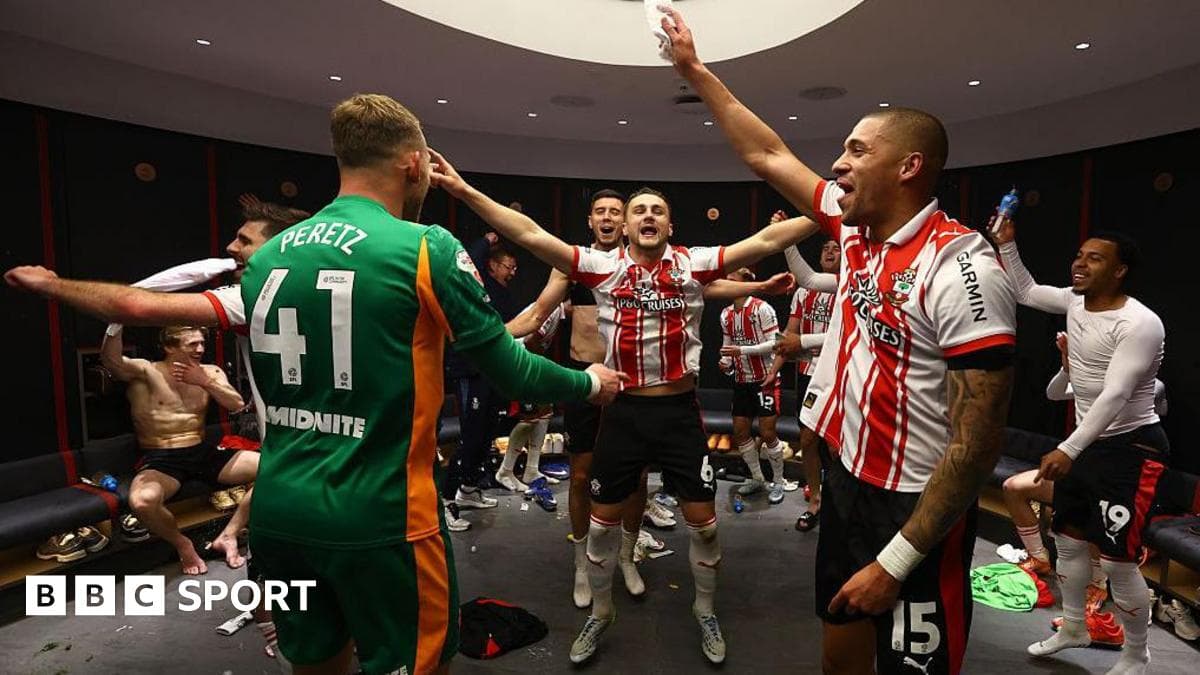
Southampton’s players and staff celebrated reaching the final on Tuesday night, but there was an edge, a restraint. The context hung over everything. Even their reaction the next morning underlined the tension.
On Wednesday, the club launched a play-off final merchandise range on their website. No big fanfare. No social media push. Just a quiet appearance in the online shop.
Tickets for the final are due to go on sale on Thursday morning. Thousands of fans will be asked to pay, plan and dream for a match they may yet be told they cannot attend.
For head coach Tonda Eckert, the message publicly is simple: prepare for Hull. Train, plan, analyse. Act as if the game goes ahead. He has a team to ready, even as lawyers and administrators debate what that game is actually worth.
Boro in limbo
Middlesbrough’s reality is very different.
Their season should be over. Instead, they sit in a strange, anxious limbo, neither in nor out. BBC Sport understands the players will be given a few days off rather than continue full training, but they cannot disappear to Dubai or Ibiza or any of the usual end-of-season bolt-holes.
They must remain on call. Ready, just in case.
From the outset, Boro have made their stance unmistakable: a fine is nowhere near enough. They want a sporting sanction. They want Southampton removed from the play-offs.
For owner Steve Gibson, this is not just about anger. It is about precedent, about what English football is prepared to tolerate. He has already moved.
Gibson has reportedly engaged Nick De Marco, one of the most prominent sports lawyers in the country, a specialist in navigating the opaque corridors of football’s disciplinary systems. De Marco was heavily involved in ensuring Sheffield Wednesday began this season on zero points, overturning what looked like a nailed-on 15-point deduction.
This time, he will argue in favour of a penalty, not against one.
If the independent disciplinary commission does not deliver the outcome Gibson believes is just, history suggests he will not simply walk away. In 2021, Boro launched legal proceedings against Derby County, claiming the Rams’ financial breaches had cost them a play-off place in 2018-19. That dispute ended in a “resolution” understood to have been worth around £2m to Boro.
If Southampton keep their place in the play-offs and perhaps even win promotion, few would be surprised if Gibson again turns to the courts for compensation.
Inside the commission
For now, the EFL can only wait alongside everyone else.
The case has been handed to an independent disciplinary commission, managed by Sport Resolutions. The panel will consist of three members: a chair – usually a judge, KC or QC – flanked by two side members, typically sports lawyers, barristers or experienced mediators.
Appointments hinge on suitability and availability, especially with the clock already ticking. The commission itself will set the timeline. That timetable is never made public.
What is clear is the complexity. Any initial ruling can be appealed by any party with a recognised interest – and that could include Middlesbrough. The appeal decision is final. EFL rules do not allow the case to be taken to the Court of Arbitration for Sport.
All of this has to unfold, and conclude, before the scheduled final. There is no realistic way to rearrange the game. Wembley is booked, the summer is mapped out, and international football waits.
The EFL has asked for an expedited hearing. Southampton, seeking time for their own internal review, have pushed back. Somewhere between urgency and due process, a decision must be made.
No precedent, huge stakes
The most striking element of this case is its novelty.
There is no direct precedent for a club being charged under regulation 127 in a situation of this magnitude. The commission will, in effect, be writing the first line of case law on spying in English domestic football.
Unlike profit and sustainability breaches, there is no sliding scale, no tariff of fines and points deductions. This is new ground.
There is one obvious comparison: Leeds United’s Spygate saga in 2019, when Marcelo Bielsa admitted sending a staff member to watch Derby County train. Leeds were fined £200,000.
But the differences are crucial.
At that time, there was no specific rule banning clubs from observing opposition training sessions. Leeds were punished under regulation E.4, which requires clubs to act in “utmost good faith” towards each other.
The fallout from that episode prompted the EFL to introduce regulation 127: “no club shall directly or indirectly observe (or attempt to observe) another club's training session in the period of 72 hours prior to any match”.
Southampton are charged with breaching both E.4 and 127. They have not tried to contest the facts.
Then there is timing. Bielsa’s infringement came in mid-January, a regular league fixture, not a season-defining knockout tie. Southampton stand accused of spying on opponents in the build-up to a play-off semi-final, with a place at Wembley and potentially the Premier League on the line.
The feeling at Middlesbrough is blunt: if Saints go on to beat Hull and win promotion, the financial rewards of the top flight would dwarf any monetary punishment. A fine, on its own, would barely register.
Hence Boro’s demand: throw Southampton out of the play-offs.
That scenario would almost certainly mean awarding Boro a 3-0 default win for the first leg, flipping the tie to a 4-2 aggregate victory. It would be a dramatic move, rare in English football, but not entirely without precedent. In 2002, West Bromwich Albion were awarded a 3-0 win after their match against Sheffield United was abandoned when the Blades were reduced below the minimum seven players, following three red cards and two injuries.
A more moderate path would be a points deduction. That would allow the commission to impose a sporting sanction without detonating the nuclear option of expulsion. If Southampton are promoted, the EFL cannot itself apply a deduction in the Premier League, but it can recommend to the Premier League board that any penalty is carried over.
The commission must find a punishment that feels fair to this case yet strong enough to deter any club from ever trying something similar, especially before a game of such weight.
Who knew what?
Southampton have remained almost entirely silent in public. The club’s media officer has shut down attempts to question Eckert about the affair. Inside the dressing room and the coaching offices, though, serious questions will not go away.
Who authorised the trip to Rockliffe Park? Who knew, and when? Was there a live stream? Was footage stored, shared, analysed?
Southampton could argue that the individual involved acted alone, a rogue operative who decided on his own to drive north and spy on Middlesbrough’s preparations, 24 hours before the Saints squad flew up.
Hellberg does not buy that.
After Tuesday’s game, he spoke of “someone who makes decisions to go and try to cheat”. His language was deliberate. His anger, controlled but evident.
There is even a wider, global precedent. At the 2024 Olympics women’s football tournament in Paris, Fifa deducted six points from Canada after they were found to have spied on New Zealand using a drone. World football’s governing body also banned three members of Canada’s staff, including the head coach, from all football for a year.
Could the independent disciplinary commission in this case go as far as issuing bans to members of Southampton’s coaching staff? The possibility hovers in the background.
Fans, fairness and the Wild West fear
One argument echoes around the game: what about the fans?
Southampton’s supporters have followed their team through 48 gruelling Championship games. Over that span, the players have earned the right, on the pitch, to fight for promotion. Punishing them for the actions of staff behind the scenes feels, to some, brutally harsh.
But leave this unpunished, or treat it as a minor administrative misstep, and another fear emerges – that English football opens the door to a new Wild West, where clubs push the boundaries of fair play, confident that any gains on the pitch will far outweigh the cost of a cheque later.
Is there any real deterrent if a club can spy before a play-off semi-final, win promotion and then shrug off a fine from the comfort of the Premier League’s financial safety net?
That is the question now facing three people on an independent commission. It is bigger than Middlesbrough, bigger than Southampton, bigger even than this year’s play-offs.
Because whatever they decide in the next few days will not just settle who walks out at Wembley. It will define what English football is prepared to tolerate the next time someone reaches for a camera and a car key, and decides the rules of the game no longer apply.
Related News

Carlos Alcaraz Urges an End to Matches Ending in the Early Hours

Carlos Alcaraz Criticizes Late US Open Finish After 3:30 a.m. Match
Jannik Sinner Set for ATP 500 Return in Beijing with Novak Djokovic Also Competing

Meet Iva Jovic: The American Tennis Prospect Making Waves

Flavio Cobolli Shares Insights on Practice Session with Jannik Sinner Ahead of Comeback

Till vs Romero: Fight Details, Undercard, and Viewing Info for This Weekend