
Sturm Graz vs Fenerbahçe: Tactical Analysis of UEFA Champions League Tie
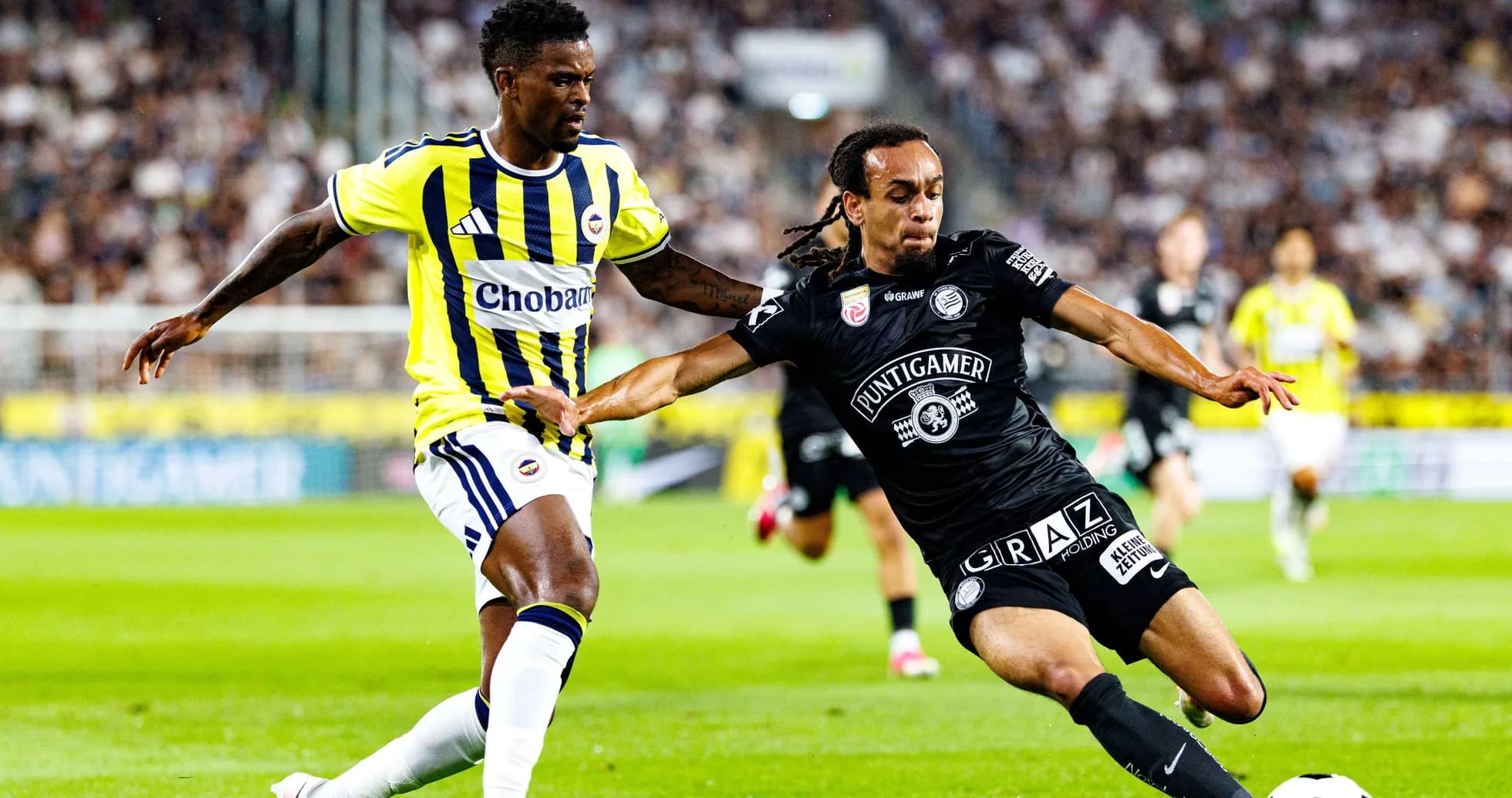
Sturm Graz approached the first leg at Merkur Arena with a clear 4-4-2 structure under Fabio Ingolitsch, looking to impose territorial pressure and volume of attempts rather than pure efficiency. Fenerbahçe, set up by Ismail Kartal in a 4-2-3-1, accepted phases without the ball and trusted the superior quality of their attacking line and double pivot to manage key moments. The result – a 0-1 away win in this UEFA Champions League 3rd Qualifying Round tie – reflects Fenerbahçe’s superior penalty-box clarity rather than overall dominance, in what was a statistically balanced and tactically nuanced contest.
Out of possession, Sturm’s 4-4-2 behaved as an aggressive mid-block. The front pair of A. Kayombo and S. Jatta initially tried to screen Fenerbahçe’s double pivot of N. Kante and M. Guendouzi, forcing build-up wide towards full-backs N. Semedo and Archie Brown. With 50% possession and 383 passes (311 accurate, 81%), Sturm were not outplayed in circulation; instead, they alternated between spells of controlled buildup and more direct phases, looking to exploit the channels behind Fenerbahçe’s full-backs. The wide midfielders J. Hodl and L. Weinhandl were key to this, stepping high to press the Fenerbahçe back line and then quickly attacking space when Sturm regained the ball.
However, the shot profile exposes a key tactical issue: Sturm generated 19 total shots but only 2 on goal, with 9 blocked. Fenerbahçe’s compact 4-2-3-1 defensive shell, anchored by the central pairing of M. Skriniar and N. Ake, consistently protected the central lane. Kante and Guendouzi screened the edge of the box, forcing Sturm into lower-quality attempts from distance (13 shots outside the box versus only 6 inside). The high number of blocked efforts underlines Fenerbahçe’s willingness to defend deep in numbers and step out aggressively at the moment of the shot.
In contrast, Fenerbahçe were more selective but more incisive. They produced 11 shots, 8 from inside the box and 6 on goal, reflecting a game plan built on fewer but better chances. The attacking midfield line of M. Greenwood, M. Asensio and Kerem Aktürkoğlu operated between Sturm’s midfield and defensive lines, pulling the double pivot of S. Seidl and J. Gorenc Stankovic into awkward decisions: step up and leave space behind, or hold the line and allow Fenerbahçe’s creators to receive on the half-turn. Talisca, as the lone forward, often dropped into pockets to overload central areas, drawing centre-backs J. Mitchell and P. Petrovic (before his late substitution) into zones they did not want to defend.
The decisive moment came from a penalty converted by Talisca on 66 minutes, a sequence that encapsulated Fenerbahçe’s approach: patient circulation, vertical access into the final third, and composure in the box. Once ahead, Kartal’s substitutions were clearly game-state driven. M. Muldur (IN) came on for N. Semedo (OUT) at 62', adding fresh legs and defensive stability on the right. Fred (IN) replaced M. Asensio (OUT) at 63', shifting the balance in midfield towards control and ball retention, while O. Aydin (IN) for M. Greenwood (OUT) at the same minute offered energy and counter-threat. Later, I. Yuksek (IN) for N. Kante (OUT) at 73' and V. Muriqi (IN) for Talisca (OUT) at 77' completed the transition from a more creative to a more pragmatic, physically robust structure to protect the 0-1.
Ingolitsch’s response was aggressive and triple-pronged at 61': B. Beganovic (IN) for S. Jatta (OUT), J. Heil (IN) for A. Malic (OUT), and N. Weiper (IN) for A. Kayombo (OUT). This reshaped the front line and right side, injecting fresh running and a more direct threat in behind. R. Fosso (IN) for J. Gorenc Stankovic (OUT) at 70' added another forward-thinking midfielder, and P. Koller (IN) for P. Petrovic (OUT) at 79' was a final attempt to change the dynamic from the back. These changes helped maintain pressure – Sturm finished with 7 corners to Fenerbahçe’s 6 – but could not convert volume into clear chances.
In goal, D. Khudyakov (Sturm Graz) was beaten once from the spot but otherwise held firm, making 5 saves and keeping his side in the tie despite Fenerbahçe’s superior penalty-box efficiency. At the other end, M. Gunok (Fenerbahçe) was rarely exposed, needing only 2 saves to preserve the clean sheet. This discrepancy between Sturm’s shot count and their low on-target and xG-related threat (no xG values are provided, but the profile strongly suggests low shot quality) highlights a structural problem in their final-third occupation: crosses and second balls rather than clean, central finishes.
Discipline also shaped the rhythm. Fenerbahçe collected three yellow cards – Nélson Semedo (40', Foul), Archie Brown (45', Foul) and Kerem Aktürkoğlu (89', Foul) – reflecting their readiness to break Sturm’s transitions and disrupt rhythm, especially from wide areas where Sturm tried to build momentum. Sturm, by contrast, received just one booking, Jeyland Mitchell at 84' for Foul, despite committing 12 fouls to Fenerbahçe’s 13. This underlines Sturm’s generally controlled aggression but also Fenerbahçe’s tactical fouling as a deliberate tool to manage tempo.
Statistically, the match was finely balanced in possession (50%-50%) and passing volume (Sturm 383 passes, Fenerbahçe 397), with near-identical accuracy (Sturm 81%, Fenerbahçe 80%). Corner counts (7-6) and foul numbers (12-13) were similarly tight. The real separation came in penalty-area clarity: Fenerbahçe’s 8 shots inside the box and 6 on goal contrasted with Sturm’s 6 inside, 2 on target, and 9 blocked. Tactically, that translates to Fenerbahçe winning the battle over where the game was played and how dangerous each attack became.
In summary, Sturm Graz’s 4-4-2 delivered pressure, territory and volume but lacked central penetration and composure in the final third. Fenerbahçe’s 4-2-3-1, anchored by a disciplined double pivot and a fluid attacking three behind Talisca, produced fewer but significantly higher-quality situations, managed the lead intelligently through substitutions, and leveraged disciplined – if occasionally cynical – defending to carry a valuable 0-1 advantage out of Merkur Arena.
Related News
Slovan Bratislava Secures 2-0 Victory Over Mjallby AIF
Hapoel Beer Sheva Dominates FK Crvena Zvezda in UEFA Qualifiers

Celje Dominates Ararat-Armenia in UEFA Champions League Qualifier
Lyon Dominates Sparta Praha in 3-0 Victory: Tactical Analysis
Kauno Žalgiris vs Dinamo Zagreb Tactical Analysis
NEC Nijmegen Triumphs 2-1 Over Olympiakos Piraeus in Tactical Battle