
Tony Popovic's Short-Term Coaching Decision for Socceroos
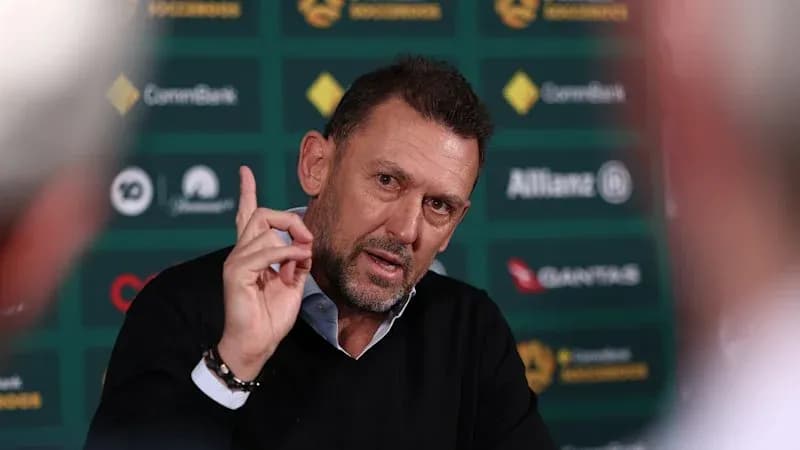
Tony Popovic could have taken the easy road. A four-year deal. Job locked in until the 2030 World Cup. Security, status, the lot.
He walked away from it.
Instead, the Socceroos coach has chosen a short-term extension that runs only until the end of January’s Asian Cup in Saudi Arabia – and says he’ll be perfectly content to leave the job the moment it expires.
“I love coaching the Socceroos,” Popovic said in his first press conference since Australia’s controversial World Cup exit. “It was my choice to go until the Asian Cup. Although I was offered a four-year deal, I decided to go to the Asian Cup … it also gives the FA an opportunity; if they want to go in a different direction, they can.”
He sounded anything but anxious about it.
“I’m very comfortable with the decision that’s been made,” he said. “I’m very comfortable with how I’ve always worked for the future … if I leave a week later, I’ll still be comfortable with that.”
His stance reveals just how far Football Australia was willing to go. Popovic’s extension was actually agreed on the eve of the World Cup, with FA prepared to hand him another full cycle before a ball was kicked in the United States. He declined the safety net and backed a shorter horizon instead.
Building a team he might never coach
If Popovic cared about job security, his World Cup squad would have looked very different.
Fourteen players who featured in the decisive June 2025 qualifiers against Japan and Saudi Arabia didn’t make the World Cup cut. He ripped up a large chunk of that group to fast-track a new core – Lucas Herrington, Nestory Irankunda, Paul Okon-Engstler, Mohamed Toure and others – into the furnace of the game’s biggest stage, long before they peak.
His selection calls produced four of the eight youngest starting XIs at the tournament.
“That needs to happen,” Popovic said. “We need to create a pool of players that in four years, if we are fortunate enough to be at a World Cup … then you want to be in a better position with the starting players and the players that can come on and make a difference.”
He knows he may not be there to reap the benefits at the 2030 or 2034 World Cups. He is coaching as if he will be.
That approach will not change now. Popovic flagged “a few fresh faces” for this month’s friendlies against Brazil in Queensland and promised another youthful squad for the Asian Cup, where he has set a clear benchmark: at least the semi-finals.
Regrets, fury and the USA misstep
The raw exit to Egypt in the round of 32 still stings for fans and pundits. Popovic has heard the anger. He understands it. He does not agree with most of it.
Across an hour in front of the cameras, he mounted a firm defence of his selections and tactics in the United States, and narrowed his true regret down to one moment: the second group match against the USA.
Australia had stunned Turkey 2-0 in their opener. Euphoria surged through the camp and the country. Then came the big showdown with the co-hosts.
Popovic made two headline changes, benching goalscorers Irankunda and Connor Metcalfe for Mathew Leckie and Nishan Veliupillay. The Socceroos were then “outrun, outfought, out-duelled … whatever you want to call it,” as he put it.
Looking back, he thinks he didn’t go far enough.
“Part of me thinks I should have made more changes to the line-up, because I could sense the euphoria [from the Turkey win] and what it took out of a young group leading into the game,” he said. “We looked really fatigued in training. Maybe that’s the one I thought, I should have made more, and I felt that in the first half, after about five or 10 minutes, that we looked flat.”
Irankunda and Metcalfe were restored to the XI for the next match against Paraguay and performed strongly. Popovic pointed to that as proof that freshness mattered more than any perceived slight or tactical overthinking.
Penalties, fine margins and empty tanks
If he could replay the penalty shootout against Egypt, he wouldn’t touch a thing.
Popovic said he would again substitute Maty Ryan on late for Patrick Beach and would still back Harry Souttar and Herrington, the two players who missed, as among his five takers.
No grand mea culpa. No rewriting history.
Where he did concede a structural weakness was in the team’s endurance and depth. The numbers he cited were stark. Across the six months before the World Cup, Australia’s attacking players combined for only 23 full club matches – 10 of those from Ajdin Hrustic alone.
That left the Socceroos trying to press and punch at a World Cup tempo with forwards who simply didn’t have the minutes in their legs.
“When it gets to that 60th or 70th-minute mark ... they are fatigued, they are exhausted, they have nothing left,” Popovic said. “That’s what we had. We knew that before the World Cup, and we knew we’d have to juggle those players through games to try and get the best out of them and to have an impact.”
He chose to juggle, to rotate, to trust youth. He chose a short contract over a long one. He chose the long-term health of the Socceroos over his own safety.
Now the clock ticks towards Saudi Arabia. Popovic has drawn his own finish line. The only question left is whether this young, bruised team can grow fast enough to make that deadline feel premature.
Related News
Ayyoub Bouaddi: Manchester City's Young Midfielder on the Rise

Federico Chiesa Considers January Exit from Liverpool
Xabi Alonso's Chelsea Faces Leeds in Carabao Cup Clash
John Obi Mikel Predicts Adam Wharton Will Join Manchester United
Morgan Rogers' Electric Start Fades in Brighton's Loss to Arsenal
Graeme Souness Critiques Declan Rice's Role: 'Old Man's Football'