
Tottenham's Tactical Triumph Over Brighton in FA WSL Finale
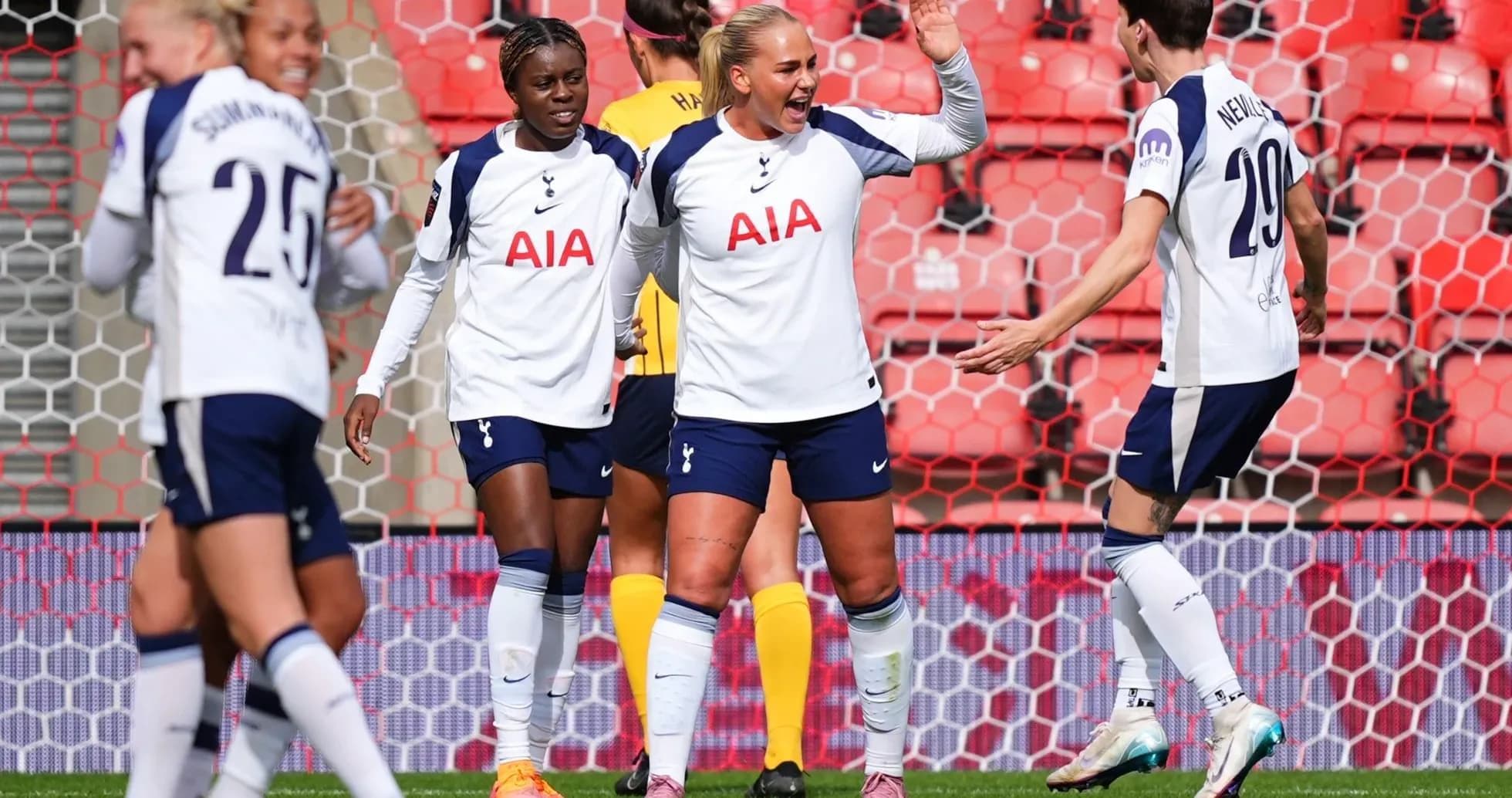
Under the grey May skies at the Amex Stadium, this FA WSL regular-season finale between Brighton W and Tottenham Hotspur W unfolded as a study in margins and mentality. Following this result, Tottenham’s 2–1 away win not only underlined their growth as an attacking force on their travels, but also exposed the fine line Brighton still walk between structure and fragility.
I. The Big Picture – Two Different Trajectories
The table tells a clear story. Overall this campaign, Tottenham finish with 36 points and a goal difference of -3, built on 11 wins from 22 matches. Brighton close on 26 points with a goal difference of -1, reflecting a season spent threading the needle between progress and peril.
The underlying numbers frame this match perfectly. At home, Brighton average 1.5 goals for and 1.4 against, a side that tends to trade chances rather than shut games down. Tottenham, by contrast, are almost two different teams depending on the venue: at home they score 1.0 and concede 1.1 on average, but on their travels they open up, averaging 2.2 goals for and 2.4 against. This 2–1 away win fits that pattern: Spurs’ attacking ambition was rewarded, while their defensive vulnerability flickered but did not fully cost them.
Tactically, both sides are children of the 4-2-3-1 era. Across the season, Brighton have used that shape most often (4 times), while Tottenham have leaned on it in 9 matches. The lineups here – with Madison Haley leading the line for Brighton and Cathinka Cecilie Tandberg starting for Spurs – were consistent with that identity: a single striker, flanked by creators, backed by double pivots.
II. Tactical Voids and the Discipline Underbelly
There were no officially listed absentees, so both coaches essentially had full decks. That made the selection choices more revealing.
For Brighton, Dario Vidosic’s XI leaned heavily on technical security and mobility: S. Baggaley in goal; a back line featuring C. Rule and M. Minami; M. Vanegas offering thrust; and a creative axis of J. Cankovic, K. Seike, F. Kirby and M. Haley. The bench – with O. Tvedten, R. Kafaji and F. Tsunoda among others – was built to change tempo rather than simply hold a lead.
Martin Ho’s Tottenham side, meanwhile, was balanced but combative. L. Kop anchored a defence marshalled by A. Nildén and T. Koga, with D. Spence screening in midfield. Further forward, O. Holdt, M. Hamano, M. Vinberg and Tandberg formed a fluid, pressing front unit. The bench offered contrasting weapons: the penalty-box presence of B. England, the defensive nous of M. Bartrip, and the tempo control of E. Summanen.
Discipline has been a quiet sub-plot for both teams this season. Brighton’s yellow-card timing shows a tendency to fray as the half wears on: 26.32% of their bookings arrive between 31–45 minutes, with another 21.05% from 76–90. Tottenham are even more volatile late: 30.56% of their yellows come in the final quarter-hour, and their only red card in the league has arrived in added time (91–105). That late-game edge was visible here: as Brighton chased, Spurs walked the tightrope between controlled aggression and chaos, but survived without the catastrophic dismissal that has occasionally haunted them.
III. Key Matchups – Hunter vs Shield, Engine Room vs Enforcer
The “Hunter vs Shield” narrative was written across the flanks and half-spaces.
For Brighton, K. Seike has been their sharpest league weapon: in total this campaign she has scored 4 goals, added 1 assist and generated 16 shots with 10 on target. Her role here, drifting inside from wide areas, was to test a Tottenham back line that concedes 2.4 goals on average away. Seike’s duel with A. Nildén – one of the league’s most card-prone defenders with 7 yellows and 27 tackles – was a constant friction point. Nildén’s willingness to step in aggressively, having blocked 6 shots and made 19 interceptions overall, helped Spurs keep Seike from fully dictating the narrative, even if it always felt one mistimed challenge away from disaster.
On the other flank of Brighton’s attack, Madison Haley offered a different threat. Across the season she has 2 goals and 3 assists, with 13 shots (8 on target) and 9 key passes. More importantly, she is a duel machine: 136 duels contested, 67 won, and 34 fouls drawn. Tottenham’s centre-backs and holding midfielders had to live in constant contact with her, knowing that any clumsy touch could be punished. Haley’s season also carried a psychological wrinkle: she has won 1 penalty but missed it, a reminder that Brighton’s margin for error from the spot is not perfect.
For Spurs, the attacking “Hunter” label is shared. B. England’s 5 league goals and 31 shots (16 on target) make her the headline scorer, but she started on the bench here, a late-game weapon rather than the primary spear. Instead, the burden fell on O. Holdt and Tandberg.
Holdt has been Tottenham’s creative heartbeat: 4 goals, 3 assists, 16 key passes and 57 dribble attempts (25 successful) in total. Her ability to receive between the lines and drive at a Brighton side that concedes 1.3 goals on average overall was pivotal. Each time she found space behind Brighton’s double pivot, the home back four were forced into uncomfortable decisions: step out and risk the run in behind, or drop and allow her to dictate.
Alongside her, Tandberg embodied chaos. With 4 goals, 1 penalty scored, and 6 yellow cards, she is both finisher and firestarter. Her 79 duels (33 won) and 11 fouls committed speak to a forward who never allows defenders a comfortable touch. Against a Brighton back line where C. Rule has quietly been a steady presence – 436 passes at 85% accuracy, 16 tackles, 2 blocked shots and 10 interceptions – Tandberg’s pressing and off-ball running were designed to shake that composure.
In the engine room, the battle between creators and enforcers was fierce. D. Spence, Tottenham’s midfield anchor, has 19 tackles, 18 interceptions and 1 red card in total – a classic enforcer profile. Her job was to smother J. Cankovic and F. Kirby, preventing Brighton’s No. 10 spaces from becoming platforms. Spence’s line-breaking passes (522 overall at 86% accuracy) also allowed Spurs to flip quickly from defence to attack, especially once Brighton began to chase the game after falling behind.
IV. Statistical Prognosis and Tactical Verdict
Strip away the emotion and the numbers still justify Tottenham’s edge. On their travels, they score 2.2 and concede 2.4 on average; Brighton at home score 1.5 and concede 1.4. A 2–1 away win sits almost exactly on that axis: Spurs hit near their attacking norm while trimming their usual defensive leakage; Brighton landed below their attacking average and slightly above their defensive one.
From an Expected Goals lens – even without explicit xG figures – the profiles are telling. Tottenham’s away pattern, with 24 goals scored and 26 conceded, suggests open, chance-rich games where their forwards are given repeated looks at goal. Brighton’s total 27 scored and 28 conceded in 22 matches paints a more balanced, lower-variance picture. When such profiles collide, the side more comfortable in chaos usually prevails. Here, that was Tottenham.
The late-game discipline curves matter too. Spurs’ 30.56% share of yellow cards in the 76–90 window hints at a team that plays on the edge when protecting leads. Yet they managed that edge without tipping into self-destruction. Brighton, whose own bookings spike at 31–45 and 76–90, pushed but never quite forced Spurs into the red-zone error that might have flipped the script.
Following this result, the tactical lesson is clear. Brighton’s structure and individual quality – in Seike, Haley, Kirby and Cankovic – give them a platform, but they need sharper conversion and a more ruthless late-game edge. Tottenham, meanwhile, have found a functional balance between risk and reward on their travels. With Holdt orchestrating, Tandberg stretching, and a defensive unit led by Nildén and Spence willing to live on the line, they have become exactly what this match showed: a dangerous away side that can walk into volatile territory and emerge with all three points.
Related News

Charlton Athletic W vs Leicester City WFC: FA WSL Final Round Preview

Leicester City WFC's Crucial FA WSL Final Match Against Charlton Athletic W

Charlton Athletic W vs Leicester City WFC Prediction: Key Insights and Betting Tips

Chelsea W vs Manchester United W: Tactical Analysis and Match Insights

Arsenal Dominates Liverpool in FA WSL Clash

London City Lionesses Secure Comeback Victory Over Aston Villa W