
USMNT's Journey in Qatar: A World Cup to Remember
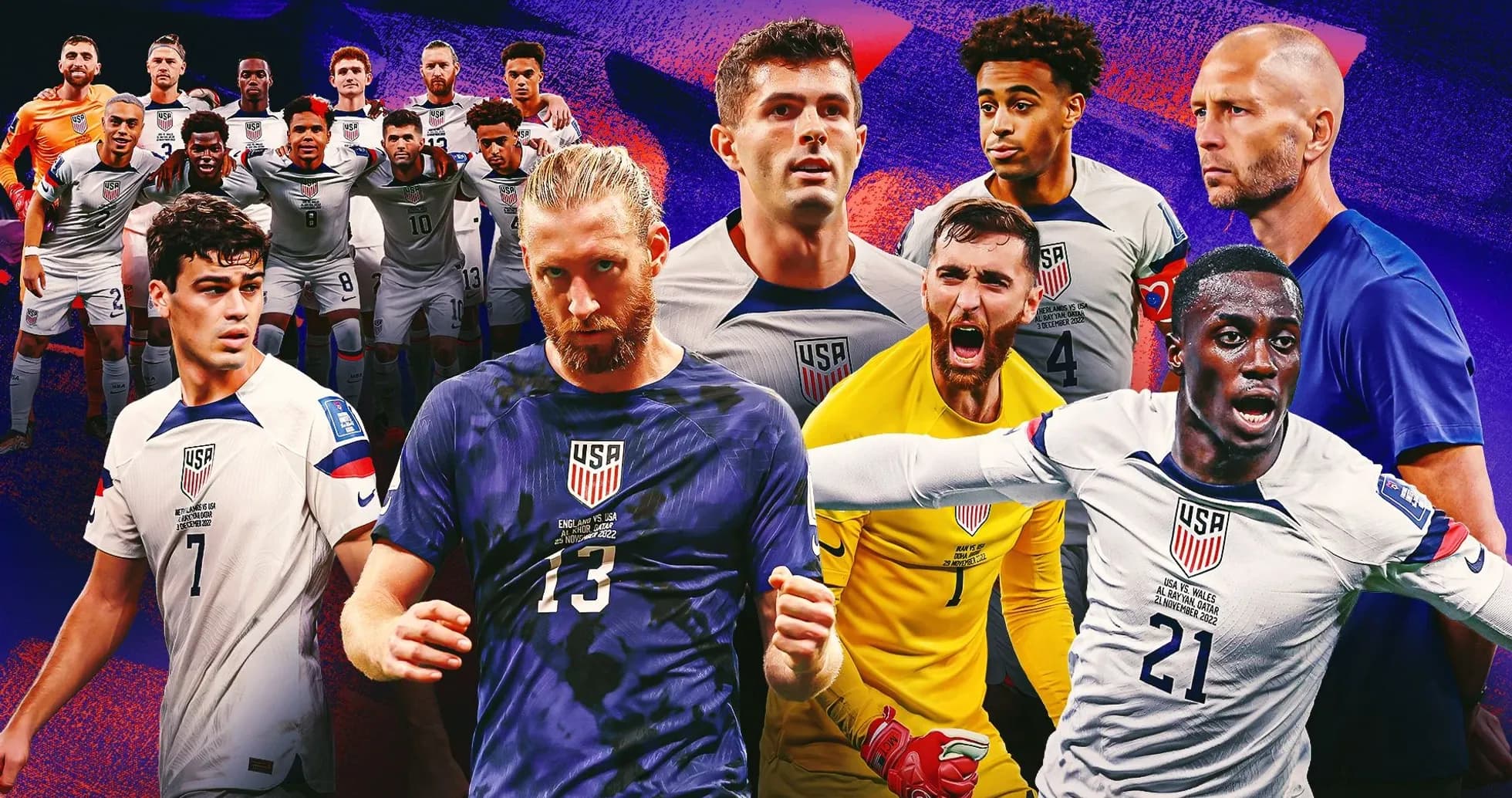
Gregg Berhalter waited until the night before Wales.
He pulled all 26 players into a circle and handed them a number, not a tactic. Not a formation. A place in history.
Walker Zimmerman’s was 152.
“He said, ‘Each one of you guys has been assigned a number specific to you, and it represents what number you are representing the U.S. in a World Cup,’” Zimmerman recalls. “For me, it was 152.”
Back in his room, the jersey was waiting. Name, number, and a tiny piece of American soccer’s still-young World Cup story.
“When you think about it, you're like, ‘152, that's it?’” Zimmerman says. “You realize you're in such an elite group of players who have ever gotten the chance to do it. That, for me, was pretty special.”
For this generation, the number wasn’t just about them. It was about the group that had grown up together, then been handed the job of dragging the USMNT out of the rubble of 2018.
Tyler Adams knew Christian Pulisic and Weston McKennie long before Qatar, long before Champions League nights and captain’s armbands. Tim Weah, Josh Sargent, Sergiño Dest — they had their own shared history, their own youth tournaments and bus rides and dreams.
By the time they walked into the World Cup, they weren’t just teammates. They were chapters of the same story.
“Those are the best memories,” Adams says. “My memories with Weston are always going to be more valuable as a kid. It's the memories of us getting to that stage, even more than where we are now.”
Life in the bubble
Once the ball rolled, everything sped up.
There was no gentle ramp-up, no long camp in a remote resort. Players flew in from Europe and MLS and were dropped straight into the highest-pressure environment of their lives.
“It’s so quick,” Tim Ream says. The schedule in Qatar was compressed, the days warped by late kickoffs. “You're in such a bubble at the time. The games are late, so it's weird because you're playing at 10 PM. We're staying up until three in the morning, we're all over the place. Breakfast is at 12, lunch at four, then training.”
Bodies tried to adjust. Minds tried to slow everything down.
Sargent leaned on his mental coach. “It's going to be a stressful time, you're going to be nervous,” he told himself, “but make sure that, while you're there, take some deep breaths and be grateful and take it all in.”
The games didn’t allow for much reflection. Wales. England. Iran. Three group matches in eight days, all layered on top of training, recovery, meetings, and those long, strange nights in a city living on World Cup time.
“Looking back now,” Haji Wright says, “the World Cup was like a fever dream. It went by so fast.”
For some, it went by without a single minute on the pitch.
Joe Scally was one of five USMNT players who never got off the bench. The noise still reached him.
“A World Cup is a World Cup,” he says. “There's nothing better in sports than a World Cup, so to be there was an awesome experience. Of course, it was different for me than for a couple of other guys. It also lit a fire underneath me.”
He watched the anthems, the packed stadiums, the world’s eyes fixed on the field, and he wanted in. He was part of it, but not in the way every player dreams.
“Of course, I was a part of it,” he says, “but not on the field.”
Three goals, three very different memories
Before Qatar, only 22 American men had scored at a World Cup. Three more joined that small club in 2022, each in a moment that still sits differently in their minds.
Weah went first.
Against Wales, with the U.S. finally back on the World Cup stage after missing 2018, it was Weah who broke the silence. Pulisic drove through midfield, slipped him in, and Weah finished with the calm of someone who had rehearsed it a thousand times in his head.
“Leading up to that World Cup, I dreamt of scoring,” Weah says. “I literally always dreamt of that one moment at a World Cup, how it would feel, how I would celebrate. For it to become a reality, it was… man, it was amazing.”
Just playing in a World Cup was one dream. Scoring in it was another level.
Then came Pulisic.
The U.S. entered the final group game against Iran knowing a draw wouldn’t be enough. The tension around that match stretched far beyond football. Inside the stadium, it narrowed to a single truth: win, or go home.
Pulisic charged into the box in the first half, met Dest’s header across goal, and forced the ball over the line — colliding full-speed with goalkeeper Alireza Beiranvand in the process. The U.S. had its lead. Its star had his World Cup goal. And he had a pelvic injury that sent him to the hospital.
The iconic image that could have defined his World Cup — the run to the corner, the pile-on, the roar — never came.
“It would have been, and it was, a huge moment,” Pulisic told GOAL in 2024. “Normally I would have been… I would have been excited. I would have had a pretty cool celebration with the team. You could see the team wanted to run over and celebrate, but it was like, I just didn't have that.”
Instead, his celebration was a grimace in the goalmouth, a stretcher, a FaceTime from a hospital bed after his teammates finished the job.
He doesn’t dwell on what might have been.
“I wouldn't have changed it for the world,” he says. “I hope to have many big moments. I want to go in and I want to win these tournaments. At the end of the day, people will talk about that and that's what they'll remember.”
Wright’s goal came with a different kind of sting.
Against the Netherlands in the Round of 16, his flicked finish — more instinct than intention — looped into the far corner and briefly dragged the U.S. back into the tie. For a few seconds, belief surged.
“It felt crazy,” Wright says. “After it went in, I kind of felt like the momentum might change a little bit and felt we might get another opportunity.”
They didn’t. The U.S. lost 3–1, outclassed in key moments by a savvier Dutch side. Wright walked off as a World Cup goalscorer on the same night his dream ended.
“I don't really have a memory of the moment of it because it was a happy and a sad moment,” he says. “Being a World Cup goalscorer is amazing. Being knocked out of that same game, though? The emotions that I felt? That's what I remember.”
The noise back home, and the quiet in between
Time has softened the edges. Social media keeps the goals alive, reappearing in clips and compilations every few weeks. In Qatar, the players didn’t fully grasp what those moments meant back home.
“We were just seeing the reactions online,” Weah says. “Seeing the fans back home when I scored or when Christian scored, it was amazing… just to see the impact that we have and the representation that we have in our country.”
Those were the loud memories. The ones that live forever on replay.
The ones the players talk about most now, though, are quieter. The walks back onto empty fields after games. The late nights in hotel lounges. The moments where they tried to slow down a tournament that refused to stop.
DeAndre Yedlin, the lone holdover from 2014, understood better than anyone how quickly a World Cup can rush past you. In Qatar, he became the guide, the veteran who knew the value of perspective.
After every match, he led a group of players back onto the pitch. No fans. No cameras. Just teammates, the stadium lights, and the chance to breathe.
“It feels like adversity gets multiplied by 10 because there's always a camera on you, always a microscope on you, and everybody has an opinion,” Yedlin told GOAL in 2024. “I think it's important to find that space and peace.”
For him, it came with a simple realization: “We're literally just entertaining people. That can bring inspiration, that can bring hope… but at the end of the day, that's what it is. For me, it's always just about keeping that perspective.”
Others tried to do the same in their own way.
Sargent avoided his phone and tried to lock in on the group. “I just tried to fully embrace it,” he says. “I feel like I can remember every single detail.”
Ream remembers the opposite. “I can see glimpses of it,” he says. “I was so insanely focused. It's like tunnel vision. There's a whole lot that you forget.”
Doha, the call to prayer, and a man-made island
Qatar itself left a mark.
The call to prayer cut through the Doha air several times a day. Traditional souqs sat a short drive from glittering new stadiums. The entire city seemed to hum to the rhythm of the tournament.
“I enjoyed every bit of it,” Matt Turner says. “Honestly, it was so cool to be in a culture I've never experienced before. The call to prayer was going on and, to me, it was peaceful and it was thoughtful… It was special because we were in this foreign land all together.”
The team’s base was The Pearl, a man-made island where the Marsa Malaz Kempinski became something more than a hotel. It became home.
Yunus Musah felt it so strongly that he went back the following summer, just to walk the halls again.
“Everything was like a throwback,” he said in 2025. “The smell! I could smell it again. The room, the view. I would just walk around, and it felt like I was experiencing all of those moments from the World Cup all over again. For me personally, the World Cup was the best experience ever. I loved it so much.”
At the heart of that experience sat one room: the Players’ Lounge.
Tyler Adams calls it “our own little sanctuary.” Big screens showing every match. Ping-pong tables. Pool. Video games. Food. Endless conversations. It was where the team lived when they weren’t training or playing.
“We had so much downtime with one another that it really just allowed us to connect,” Adams says. “Gregg made it a priority that team camaraderie and the time we spent together was valued and sacred.”
Competition never stopped, it just changed form.
“Sean Johnson and DeAndre Yedlin had their crazy style of pool that they were playing,” Zimmerman laughs. “It was basically snooker. They barely hit the ball and just tried to make you lose by scratching.”
Cristian Roldan tried to avoid his room altogether.
“I remember being around the boys in the Players' Lounge and making sure I didn't spend any time in my room and didn't take any moment for granted,” he says. “Whether it was training, hanging out in the lounge, or just watching my family enjoy it.”
The family section
The World Cup doesn’t belong only to the 26 players. It belongs to the people who carried them there.
Zimmerman remembers it vividly before the opener against Wales. Anthem playing, flags waving, nerves buzzing — and his eyes searching for one corner of the stadium.
The family section.
“Everyone's story is tied up with what that group of supporters has done to get us into this spot,” he says. “All of the sacrifices that those people made… That, for me, was a special moment: just seeing the family contingent being so proud of us.”
Those reunions — in the stands, in the hotel, in those small windows between games — became some of the most treasured snapshots.
“For me, the only times that really do stick out, obviously aside from the games, were the times where we had those few hours of downtime and the families could come over,” Ream says. “Those were the only moments where you felt you could actually sit back and breathe and really think, 'Okay, I'm going to take a mental picture of this and remember this.'”
The tournament didn’t just bind teammates. It pulled their families together, too.
“We were all really close already,” Weah says, “but having that period of time to connect and meet everyone's family, share our lives together, that was amazing. It's something I'll never forget… Even when you're old and gray, you'll remember those moments.”
Life has moved since then. Some players are fathers now. Some have watched their kids grow into an age where they can understand what “World Cup” actually means. Others have gotten married, expanded their circles, shifted their priorities.
For Roldan, it’s sharpened his.
His daughter is nearly two. The idea of her seeing him on that stage, not just on a bench, drives him harder than any external pressure.
“I've had this late surge because I've had my daughter around,” he says. “She doesn't care if I win or lose. Part of my motivation to extend my career and continue to play at a high level is that I want her to watch me play. I want her to watch daddy play.”
Sebastian Berhalter felt Qatar from a different vantage point altogether. He wasn’t in the squad. He was in the stands, watching his father coach the USMNT at a World Cup.
“It's the one time I got to feel like an ultra,” he says. “Seeing your dad coach against some of the best teams in the world was something I'll never forget.”
Gio Reyna and the World Cup that hurt
Not every memory is warm.
For Gio Reyna, Qatar became something heavier than a dream fulfilled. He arrived with injury concerns, expecting to play a major role. When it became clear he wouldn’t, frustration boiled over.
What followed is now part of modern USMNT lore: Reyna’s limited minutes, questions about his training attitude, and, after the tournament, the Reyna family informing U.S. Soccer of a decades-old domestic violence incident involving Gregg Berhalter. A private rift became a public crisis.
It went far beyond tactics or substitutions.
In the years since, everyone involved has tried to move on. Berhalter returned in 2023 before being replaced by Mauricio Pochettino. Reyna stayed in the player pool. The scars remain, but so does the opportunity.
Looking back, Reyna sees a young team — and a younger version of himself — learning on the job.
“I think just individually and collectively, we were all very, very young and maybe a little bit inexperienced at the time,” he says. “In the end, we came up against a Holland team that was a little bit more experienced, a little bit better, a little bit more savvy with the game.”
He talks now about the collective, about doing whatever it takes to help the team, about the weight of playing for an entire country. Especially when that country is the host.
“This one is in our home country, too,” he says of 2026. “It would be a dream come true just to be there.”
Reyna left Qatar with a lesson: a World Cup doesn’t just reward. It exposes. It shows you who you are when the world is watching.
The ones who never got there
Some players carry a different kind of unfinished business from 2022.
Miles Robinson was almost a lock for Qatar. A rock in qualifying, he looked destined to start at center-back. Then his Achilles went in May. World Cup gone.
He had months to process it. When the tournament finally kicked off, he made a choice.
“Man, I was outside watching that sh*t,” he told GOAL with a smile. “We were partying, watching, cheering on my guys. I really wanted to experience that real-life energy because that's who I am.”
Chris Richards didn’t get the same runway. A hamstring injury at Crystal Palace hit just weeks before the squad announcement. It was always going to be tight. In the end, it wasn’t enough.
He rehabbed in London while his friends stepped into the spotlight.
“I'm in London watching the boys kill it at the World Cup,” he remembers. “I was so, so happy for them, but for myself, it was lonely. I didn't want anything to do with soccer. It felt like it just got ripped away from me right before it.”
Mark McKenzie’s pain was different. No injury, no scan, no rehab schedule. Just a call that didn’t go his way.
“Missing out on the 22 World Cup? It ripped me apart, bro,” he says. “It was gutwrenching because I was so close. When you get that call that you're not going, that you weren't selected, it's a punch to the stomach.”
Time has given him perspective. “Maybe I put too much onus on this,” he says now. “So much that I lost who I was, lost focus on the small areas of my game or my life that I need to improve.”
From prelude to main event
Since Qatar, the landscape has shifted. Berhalter’s tenure ended in 2024 after a Copa América exit. Pochettino now holds the whistle and the power to decide which 26 names will be called this summer.
The stakes are different this time.
In 2022, the USMNT was returning to the World Cup after a painful absence. It was a proving ground, a first taste for a young core. In 2026, the tournament comes to American soil. The U.S. is not just competing. It is hosting.
That changes everything — expectations, pressure, opportunity.
Tyler Adams felt the aftershock of Qatar as soon as he came home. A quiet walk through New York City stopped being quiet.
“People all of a sudden knew who I was walking back home in the streets of New York City,” he says. “It's a city that I never imagined I'd get recognized in.”
He was also preparing for fatherhood, juggling a changing public profile with a changing personal life. “It didn't become a challenge,” he says, “but it was just something I had to figure out and navigate.”
The entire squad will have to navigate something similar this time, only bigger. A World Cup in a country where soccer is still growing, not fully grown. A chance to pull a new generation into the sport — or lose them.
“It's an amazing feeling, but also a responsibility at the same time,” McKennie says. He thinks of the kids watching now the way he once watched his heroes. “Hopefully, people see that there is a pathway out there for them. It may not look exactly like mine or Christian's or Chris Richards’, but the ultimate thing is to believe in yourself and bet on yourself always.”
Chasing the feeling
Soon, 26 more players will get their numbers. Some will be veterans of that fever dream in Qatar. Others will be wide-eyed first-timers. Some will start. Some won’t play a single minute. All of them will be changed.
That’s what the 2022 group understands now. For them, that winter in Qatar is a bond that doesn’t break. For some, it was the peak. For others, just the beginning. Either way, it sits there, glowing in the rearview mirror.
“I can understand how people call it emotionally draining,” Wright says. “After it was over, it felt like soccer had changed me, in a way, and now you find yourself chasing that same feeling. It's hard to get that feeling again outside of a World Cup. It all just feels like yesterday. Now, the next one's already here.”
Turner feels it too.
“I had some amazing experiences,” he says. “That's why I need to get back there, because I really want that feeling again.”
The numbers will climb. 152 will become 180, 190, more. New names will join the list of American World Cup goalscorers. New families will cry in new stadiums. New players will walk back onto empty fields after the final whistle and try to freeze time.
The question now is simple, and enormous.
What will this group do with a World Cup of their own?
Related News
Carlos Alcaraz Calls for Change After Laver Cup Court Conditions

Alexander Zverev Secures Laver Cup Victory for Team Europe with Straight-Set Win Over Learner Tien
Novak Djokovic Shares Fitness Update Before China Open Return After US Open Upset
Shubman Gill's Captaincy Record Across All Formats: Tests, ODIs, T20Is, and IPL
Kuldeep Yadav Named Player of the Match Over Virat Kohli Despite Century in IND vs WI 1st ODI
India Advances to Asian Games 2026 Cricket Semi-Finals After Rain Washout Against Afghanistan