
Argentina Triumphs Over England in World Cup Semi-Final
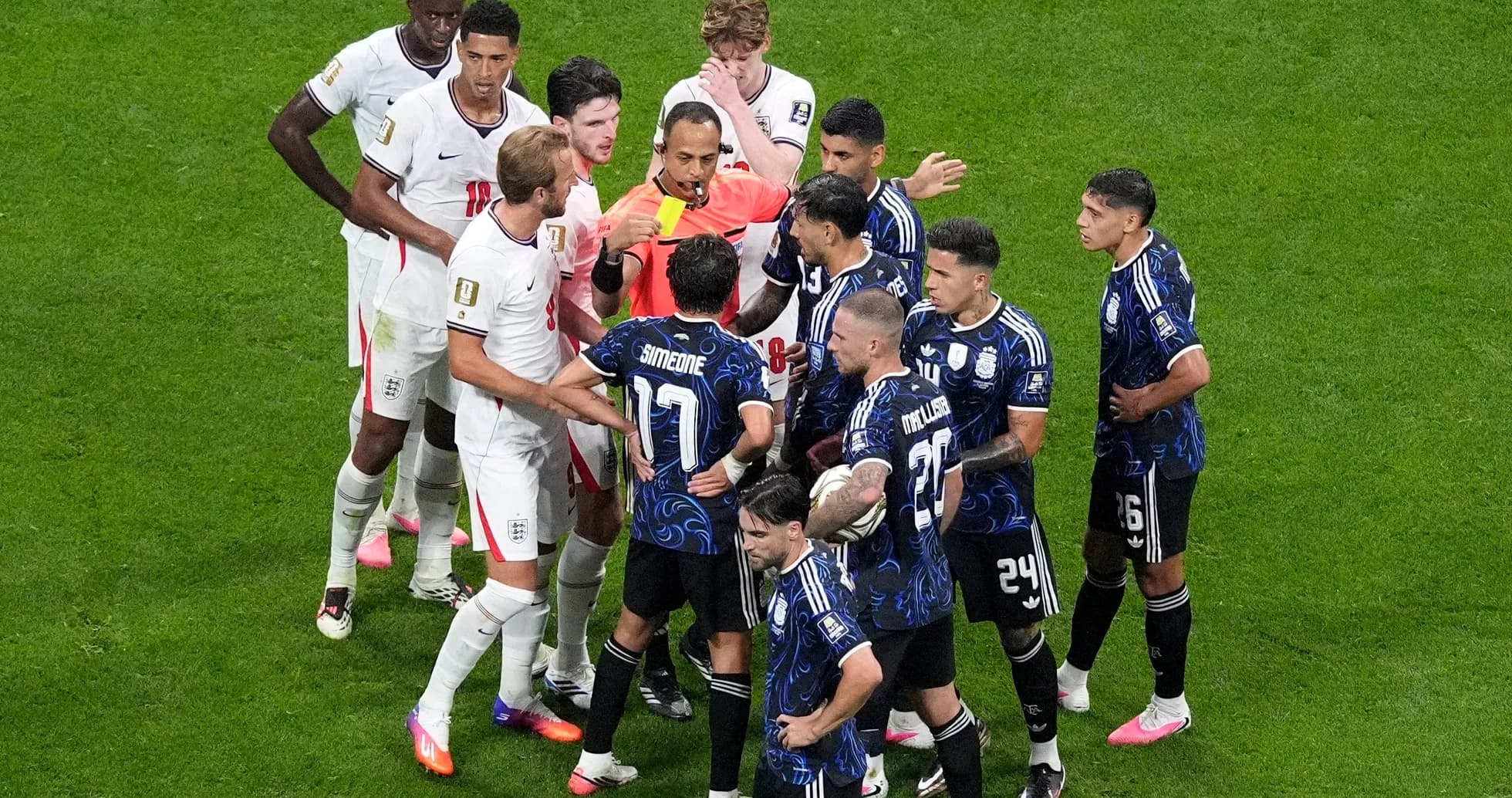
Under the closed roof of Mercedes-Benz Stadium, the semi-final between England and Argentina unfolded like a clash of footballing ideologies as much as footballing generations. Ninety minutes later, the scoreboard read England 1–2 Argentina, and the story of the night felt entirely in keeping with the tournament arcs both sides had carved on their way to the World Cup’s sharp end.
I. The Big Picture – Two perfect arcs collide
Heading into this game, both teams had travelled near-flawless paths. England had topped Group L with 7 points and a goal difference of 4, built on 6 goals scored and 2 conceded in 3 group matches. Across the whole campaign they had played 7 fixtures in total, winning 5, drawing 1 and losing just 1. Their attacking output was balanced: 14 goals in total, split evenly between home and on their travels, with averages of 1.8 at home, 2.3 away and 2.0 overall. Defensively, they had conceded 8 in total, with averages of 1.3 at home, 1.0 away and 1.1 overall.
Argentina arrived even more ruthless. They had taken 9 points from 3 in Group J, with a goal difference of 7 (8 scored, 1 conceded), and their broader campaign was immaculate: 7 wins from 7, no draws, no defeats. They had scored 19 goals in total – 14 at home, 5 on their travels – with averages of 2.8 at home, 2.5 away and 2.7 overall. At the other end, they had conceded 7 in total, with a defensive average locked at 1.0 at home, on their travels and overall. It was a machine-like efficiency that framed this semi-final as a meeting between a rising, flexible England and a relentless, battle-hardened Argentina.
II. Tactical Voids and Discipline – Edges in the margins
The only confirmed absentee was England defender J. Quansah, missing through suspension via sports court. His absence forced Thomas Tuchel to lean fully into a back four of R. James, J. Stones, M. Guehi and D. Spence in a 4-2-3-1, with D. Rice and E. Anderson anchoring. Quansah’s red-card history mattered: he had already seen 1 red and 1 yellow in just 117 minutes this tournament, and his removal from the rotation nudged England toward a more technically secure but slightly less imposing defensive unit.
Discipline had been a subtle theme in England’s campaign. Their yellow-card timing showed a particular spike in the 31–45 and 61–75 minute ranges, each accounting for 25.00% of their cautions. It hinted at a team that often ramped up aggression either side of half-time. Red cards were rare but significant: their only dismissal had come between 46–60 minutes, a reminder that their intensity after the break could spill over.
Argentina’s card profile was stranger, almost back-loaded. Their yellows were concentrated late: 11.11% between 31–45, another 11.11% from 46–60, then a sharp escalation in extra time, with 44.44% of their yellows arriving between 91–105 minutes and 22.22% between 106–120. In regulation, they were relatively controlled; in extended chaos, they embraced the dark arts. That pattern underlined a side comfortable living on the edge when legs and minds tire.
III. Key Matchups – Hunter vs Shield, Engine Room vs Orchestrator
The headline duel was always going to be L. Messi against England’s defensive structure. Messi entered this semi-final as the tournament’s leading scorer: 8 goals and 4 assists in 7 appearances, with a rating of 9.07 and 28 shots, 18 on target. His 35 dribble attempts with 24 successful, plus 26 key passes, painted the picture of a one-man creative hub.
Tuchel’s response was layered rather than man-to-man. J. Stones and M. Guehi formed the central shield, but the true “shield” was D. Rice. Rice’s campaign had been defined by quiet authority: 240 completed passes at 91% accuracy, 15 key passes from deep, and a disciplinary line that walked the edge – 2 yellows but no reds. His job was to close Messi’s lanes between the lines, supported by E. Anderson as the second pivot and the compactness of the back four.
Around Messi, Argentina’s 4-1-4-1 was built to suffocate and then spring. L. Paredes sat as the single pivot, with E. Fernandez and A. Mac Allister offering vertical thrust and control. J. Alvarez, nominally a midfielder in this shape, functioned as a hybrid runner, while G. Simeone added another aggressive presence between lines. It was a structure designed to overload England’s double pivot and drag Rice away from his preferred screening zones.
On the other side, England’s “hunter” threats came from J. Bellingham and H. Kane. Both had 6 goals each in this World Cup, with Bellingham adding 1 assist and Kane matching that. Bellingham’s 84 duels with 44 won, and 21 dribbles attempted with 13 successful, made him the roaming disruptor between midfield and attack. Kane’s profile was more surgical: 18 shots, 12 on target, plus 5 key passes and 2 penalties scored. He was both finisher and facilitator.
Tuchel’s 4-2-3-1 placed Bellingham as the central 10, flanked by A. Gordon and M. Rogers behind Kane. Gordon, with 3 assists and 1 goal, offered verticality and crossing threat from the left, while his 25 dribble attempts spoke to a willingness to isolate full-backs. Against an Argentine back line of N. Tagliafico, L. Martinez, C. Romero and N. Molina, England sought to stretch horizontally, forcing Messi and his midfield to defend longer distances.
IV. Statistical Prognosis and Tactical Verdict
On paper, the statistical balance tilted slightly toward Argentina. Their overall scoring average of 2.7 goals per game, combined with a defensive average of 1.0 conceded, suggested a side that consistently outstrips opponents by roughly 1.7 goals per match. England’s profile – 2.0 scored and 1.1 conceded overall – pointed to a narrower margin of superiority.
In a semi-final context, those edges matter. Argentina’s ability to maintain a perfect record across 7 fixtures, despite a fragile penalty record (3 penalties taken, only 1 scored and 2 missed, a 33.33% conversion), indicated resilience in open play that did not depend on spot-kicks. Messi’s own penalty line – 0 scored and 2 missed in this tournament – underlined that even their talisman had not needed dead balls to dominate.
England’s penalty record, by contrast, was pristine: 2 penalties in total, both scored, 100.00% conversion. Kane’s composure from the spot was a built-in advantage in tight knockout margins. Yet the semi-final narrative suggested that relying on marginal gains from penalties would never be enough against a side as relentless as Argentina.
Tactically, the decisive intersection lay in how Argentina’s high offensive ceiling met England’s occasionally porous defensive moments. With England conceding an average of 1.3 at home and 1.0 on their travels, they were solid but not impermeable. Argentina’s front unit, orchestrated by Messi and underpinned by Paredes, Fernandez and Mac Allister, repeatedly targeted the spaces either side of Rice, especially when England’s full-backs advanced.
In the end, a 2–1 scoreline felt like the statistical expectation compressed into 90 minutes. Argentina’s superior attacking rhythm, combined with Messi’s all-encompassing influence and a midfield that outnumbered England’s double pivot, edged a contest between two elite campaigns. England’s evolution under Tuchel, powered by Bellingham’s drive, Kane’s finishing and Gordon’s emergence as a creative outlet, brought them to the brink. Argentina’s completeness – from their 7-match winning streak to their capacity to bend games to Messi’s tempo – carried them one step further, into the World Cup final.
Related News

Estevao Opens Up on World Cup Heartbreak and His Unexpected Return to Brazil Under Ancelotti

Thomas Tuchel Shares Unusual Regret After England's 10-Man World Cup Victory Over Mexico

South Korea Names Robert Moreno as Interim Coach After World Cup Exit

Jude Bellingham Returns to Form at Real Madrid Following World Cup Success

Chloe Kelly, Beth Mead and 13 Lionesses Target Big WSL Seasons Ahead of England's 2027 World Cup Campaign

Barcelona Cancels World Cup Tribute for Spain Stars Amid Political Tensions