
Bradley Barcola's Crossroads: From Rising Star to Rotation Piece
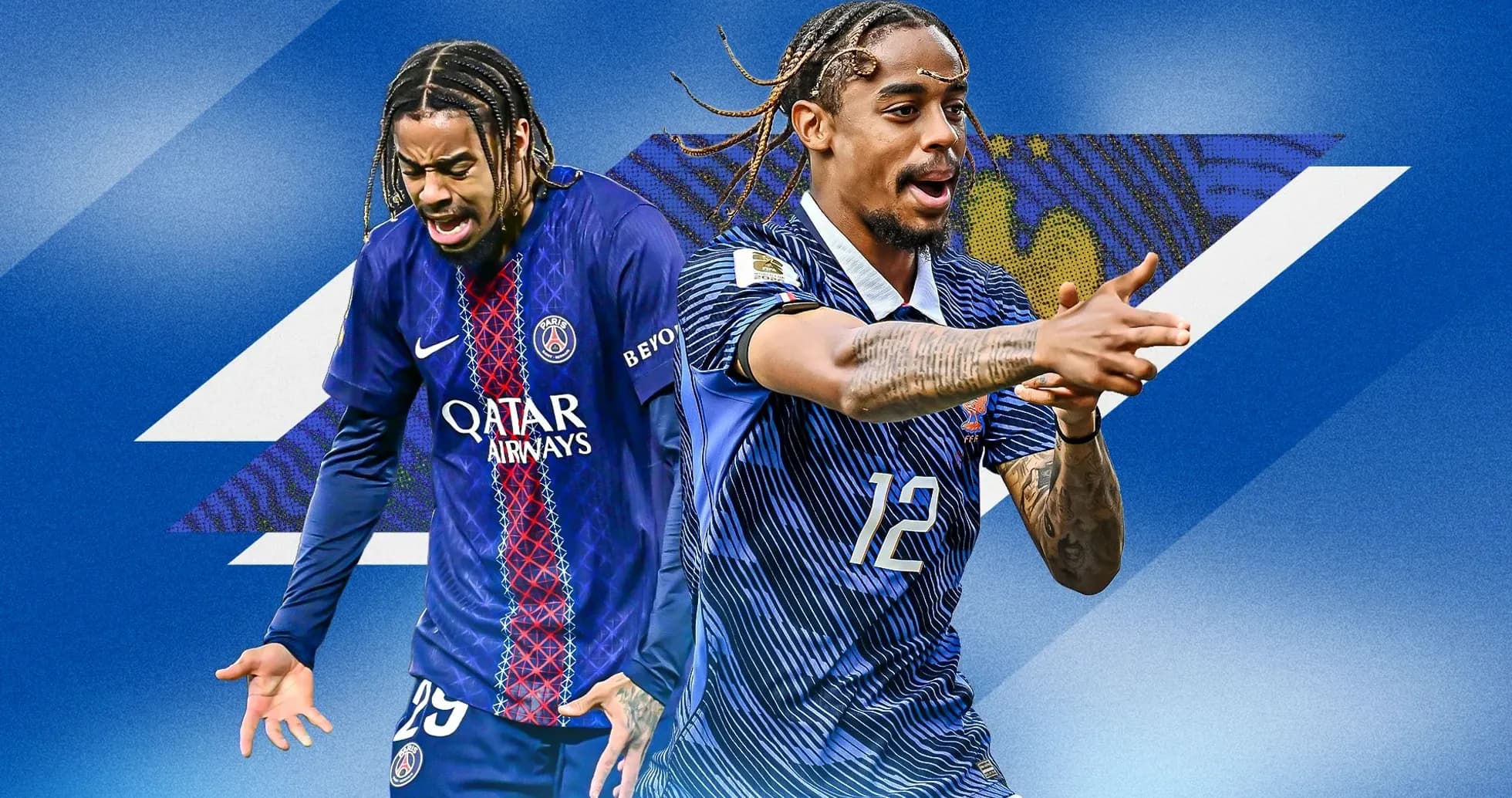
Bradley Barcola was supposed to be past this stage by now.
Nearly three years on from his move from Lyon to Paris, the plan was clear enough: grow in the shadow of Kylian Mbappé, then step into the spotlight as PSG’s next great wide forward. A guaranteed starter. A pillar of the project. Instead, he finds himself trapped between roles – too good to ignore, never quite trusted enough to be the main man.
At 23, his career is at a crossroads, and the World Cup is only amplifying the tension.
From rising star to rotation piece
Barcola’s first full campaign in Paris hinted at something special. Fourteen goal contributions in his debut season, flashes of daring on the left flank and the feeling that, once Mbappé walked away, the path would open in front of him.
PSG had other ideas.
In the summer of 2024, with Mbappé gone, they doubled down on that left side. Desire Doue arrived as another young, high-ceiling winger. Then, in January 2025, came the blockbuster: Khvicha Kvaratskhelia, one of the most devastating wide players in Europe.
Barcola responded the only way a top player can. By producing. His 2024-25 numbers were outrageous – 21 goals and 21 assists – the kind of output that usually cements a place in any starting XI. Yet when the season reached its sharpest edge, he kept finding himself on the periphery.
He was overlooked for the biggest nights, including the Champions League final against Inter. When he did start, he rarely finished. Ninety minutes became a luxury, not a norm.
The pattern hardened in 2025-26. His influence dipped, the raw numbers slashed almost in half: 13 goals, seven assists. Luis Enrique made a point of managing minutes in Ligue 1, keeping his key men fresh for Europe. The message was clear in the games that really mattered. Barcola did not start in the Champions League quarter-finals, semi-finals or final in another triumphant campaign. He watched the big league fixtures against Lyon and Monaco from the bench as an unused substitute.
A player who should have been central had become a specialist: important, but not indispensable.
France role mirrors PSG frustrations
The same story now plays out in the blue of France.
On talent alone, Barcola had every reason to believe he could become Didier Deschamps’ first-choice option on the left wing. Instead, his international career has developed in fits and starts, and this World Cup has followed the same jagged line.
He did not start the opener against Senegal, a heavyweight African side. Deschamps turned to him from the bench – and Barcola answered. Two minutes after coming on, he scored the decisive goal, a ruthless cameo that swung the match and seemed to force the manager’s hand.
He earned a start against Iraq on matchday two. This was the chance to plant his flag. He didn’t take it. The performance lacked the same edge and, by the final group game against Norway, he was back among the substitutes.
Again, he was better chasing the game than starting it. With 25 minutes left, Barcola came on and delivered a precise cross for Doue’s late header, adding gloss to the scoreline and reminding everyone of his quality in the final third.
Deschamps rewarded him once more, restoring him to the XI for the last-32 tie with Sweden. Barcola repaid that call with a crisp second-half finish, capitalising on a virtuoso display from Michael Olise. The sense returned: maybe this was the moment he finally locked down his place.
He kept his spot for the round of 16 against Paraguay, an ill-tempered 1-0 grind. This time, he disappeared. Anonymous in a scrappy contest, he did little to strengthen his case. With Morocco looming in the quarter-finals, his starting status is again under threat.
Impactful as a substitute. Unconvincing as the guaranteed starter he wants to be. The tension follows him from club to country.
Contract standstill and a shifting PSG stance
All of this unfolds with a storm gathering back in Paris.
Barcola’s contract at PSG runs until 2028, but talks over an extension have stalled. The issue is not money. It is status. He wants clarity on where he sits in the hierarchy at the Parc des Princes, and right now the answers don’t reassure him.
Earlier in the summer, PSG’s position seemed unshakeable. He was not for sale. Internally, they valued him at a level far beyond the £116 million Manchester City paid Nottingham Forest for Elliot Anderson, according to The Athletic. The message was that Barcola was part of the core, a player they would not casually cash in on.
Then the tone changed.
On his YouTube channel this week, transfer specialist Fabrizio Romano captured the shift. “Until last week, Barcola was untouchable; now I see him linked to several clubs. The reality is that Barcola is not untouchable. Barcola has serious possibilities to leave Paris in the summer transfer window.”
Something had moved behind the scenes.
Diomande, the market opportunity and the price of ambition
That something has a name: Diomande.
The RB Leipzig and Ivory Coast forward has exploded into one of the breakout stars of the 2025-26 season, and PSG see a rare chance to pounce. Liverpool were widely reported to be leading the race, working on a deal around €100m. Then came the twist.
The 19-year-old, by all accounts, prefers Paris. He believes that Luis Enrique’s project offers the best route to trophies – and, in time, the Ballon d’Or.
Leipzig, aware of the demand and the potential, have set the bar high. Diomande is believed to be valued at around €130m, a fee that stretches even PSG’s resources and forces hard decisions elsewhere in the squad.
Goncalo Ramos has already gone to AC Milan. Lee Kang-in is on his way to Atletico Madrid. That may not be enough. To push through a deal of this scale, PSG will almost certainly need to move another major asset – and they may be looking at a player who already fears his minutes will shrink even further if Diomande walks through the door.
Barcola, once branded untouchable, suddenly looks like the logical sacrifice.
Liverpool’s opening – and Barcola’s escape route
If Diomande heads to Paris, Liverpool’s supposed defeat in one chase could become an opportunity in another.
The Premier League club are rebuilding their attack in the wake of Mohamed Salah’s departure. Victor Munoz has arrived, and new manager Andoni Iraola must handle the development of prodigy Rio Ngumoha carefully, with the teenager not turning 18 until the end of August.
They need a star ready now. Someone who can start every week, carry responsibility, and ease the shock of losing Salah. Someone proven in the Champions League, not just promising in the Bundesliga.
Barcola fits that profile.
At Anfield, he would walk into the role he cannot secure in Paris: certain starter, central figure, trusted from the first whistle. His direct running, creativity and work rate suit Iraola’s aggressive, high-energy style. Liverpool, for their part, would be landing a player with several years of top-level European experience, rather than gambling on the rawer, less tested Diomande.
For PSG, a sale at a premium fee would help fund their new attacking centrepiece. For Barcola, it would be the fresh start he increasingly seems to need. For Liverpool, it would be the kind of statement signing their supporters expect in a summer of transition.
Everyone, on paper, gets what they want.
“Honestly, I don’t know”
Barcola himself has stopped pretending that everything is settled.
“Right now, I’m really focused on the World Cup,” he said at a France press conference before the Paraguay game. “But regarding what happens afterward, honestly, I don’t know at the moment.”
It was a simple admission, but a telling one. No insistence that he will stay. No declaration of loyalty to PSG’s project. Just uncertainty.
As Diomande edges closer to Paris and the competition for attacking places intensifies, the logic hardens. If Barcola stays, he risks another season as a luxury option, a player trusted to change games from the bench rather than shape them from the start.
For a 23-year-old with his numbers, his ambition and his profile, that is not a role. It is a warning.
He left Lyon to become a star in Paris. To do that now, he may have to leave Paris behind.
Related News
Anthony Joshua Names Murat Gassiev as Next Opponent if He Defeats Tyson Fury
UFC 332: Start Time and Fight Highlights for Natalia Silva vs. Wang Cong
Court McGee Opens Up About Choosing UFC 332 as His Final MMA Fight
WBC Orders Lightweight Title Unification: William Zepeda vs Jadier Herrera
BCCI Pension List: Monthly Payments to Retired Indian Cricketers in 2025
Why Fury vs Joshua Is Set for Cardiff, and Dua Lipa’s Unexpected Role