
Brazil vs Norway: Tactical Analysis of Round of 16 Clash
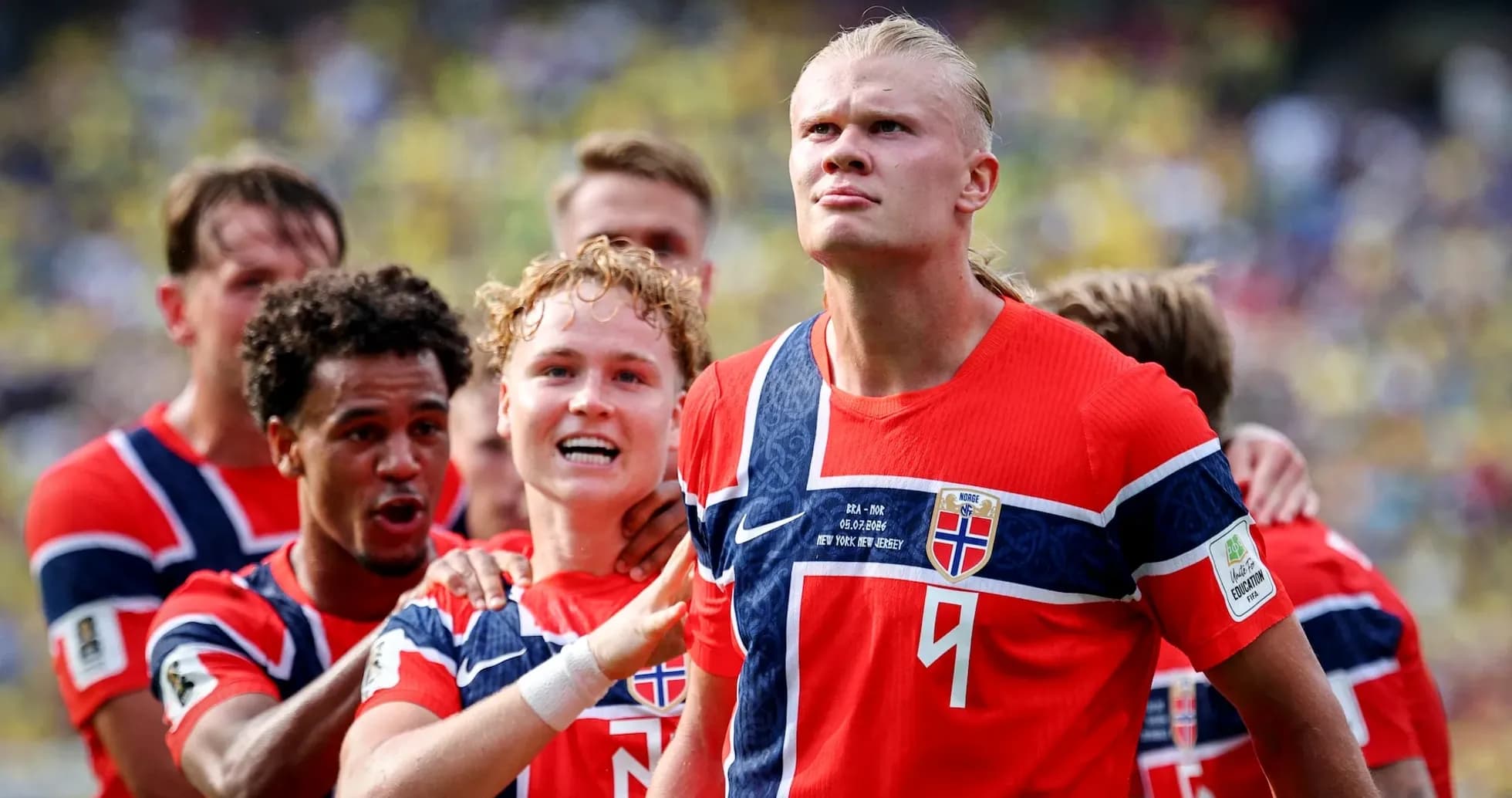
Brazil’s Round of 16 exit at MetLife Stadium was defined by a stark clash of game models: Brazil’s vertical, transition-heavy approach against Norway’s methodical, possession-dominant structure. Across 90 minutes, Norway’s 66% of the ball and 680 total passes to Brazil’s 329 framed a contest where Brazil tried to compress the game into moments, while Norway aimed to control it through circulation and territorial control.
Without a listed formation, Brazil’s structure must be inferred from roles. With Casemiro, Bruno Guimarães and Rayan all starting, Carlo Ancelotti clearly built a three-man midfield behind a front line of Vinícius Júnior and Matheus Cunha, with Gabriel Martinelli wide and the full-backs Danilo and Douglas Santos providing width. The plan was to defend in a mid-block, then break quickly into space once possession was regained. That is reflected in the shot profile: 14 total shots, 10 from inside the box, and a very high xG of 2.73. Brazil created enough volume and quality to win the tie, but lacked clinical edge, notably from the spot early on.
Norway, by contrast, were built around control and progression. The midfield trio of Martin Ødegaard, Sander Berge and Patrick Berg, supported by ball-playing defenders Kristoffer Ajer and Torbjørn Heggem, produced 680 passes at 91% accuracy (617 accurate), constantly recycling possession to move Brazil side to side. Their 9 total shots and xG of 0.84 underline that this was not a barrage, but a game of carefully engineered moments – and Erling Haaland’s ruthless finishing turned those few moments into a decisive edge.
Opening Phase
The opening phase showed Brazil’s pressing trigger strategy. The VAR-confirmed penalty at 12’ came from Brazil’s willingness to attack Norway’s first phase, with Matheus Cunha central to the action. However, Bruno Guimarães’ missed penalty at 14’ became the tactical hinge of the night: Norway were given a warning about Brazil’s threat in transition, and from that point their possession became more risk-averse in deep zones, with the double pivot dropping closer to the centre-backs to avoid being stripped in bad areas.
Out of possession, Norway’s 6 fouls versus Brazil’s 7 illustrate how both sides largely avoided chaotic pressing. Norway preferred a compact 4-5-1 block with Haaland as the reference point up front, trusting their structure more than disruptive fouling. Brazil, with fewer passes and less of the ball, used Casemiro as a screening pivot, trying to cut off passes into Haaland’s feet and force play wide, where Danilo and Douglas Santos could engage.
Second Half Adjustments
The second half was defined by adjustments. At 46’, Stale Solbakken made a double change: Andreas Schjelderup (IN) came on for Antonio Nusa (OUT), and Oscar Bobb (IN) came on for Alexander Sørloth (OUT). This shifted Norway’s attacking dynamics, adding more technical ball security between the lines and better support for Haaland. Schjelderup’s influence became decisive later, assisting both of Haaland’s goals.
Ancelotti’s response was more reactive and, crucially, more aggressive. At 58’, Endrick (IN) came on for Matheus Cunha (OUT), adding a more direct, penalty-box-oriented presence. Later, at 68’, Danilo Santos (IN) came on for Rayan (OUT) and Neymar (IN) came on for Gabriel Martinelli (OUT), pushing Brazil into a more attacking, risk-taking shape. Neymar’s introduction was clearly designed to unlock Norway’s compact block through individual creativity and to assume penalty responsibility after the earlier miss.
Norway’s opener at 80’ – Erling Haaland finishing from an Andreas Schjelderup assist – showcased their game plan at its most efficient: patient possession, then a vertical punch once Brazil’s midfield line was stretched. Brazil’s structure, now tilted forward with more attackers, left more space between the lines; Norway exploited that with a simple but precise progression into Haaland’s channel.
Brazil’s late-game approach became almost siege-like. Despite only 34% possession, they continued to generate high-quality looks, reflected in 4 shots on target and 4 blocked shots – Norway were often forced into last-ditch defending around the box. The penalty converted by Neymar at 90+9’ was the culmination of sustained pressure, Brazil committing numbers forward and Norway increasingly defending deeper.
Yet the key tactical moment came just before that, at 90’, when Haaland again struck from a Schjelderup assist. With Brazil fully committed to chasing the equaliser, their rest defence was thin: full-backs high, midfield stretched, centre-backs more exposed. Norway punished this with a classic transition: a direct, efficient attack that found Haaland in space to restore the lead at 2-1, turning Brazil’s attacking gamble into a structural vulnerability.
Discipline also played into the rhythm of the closing stages. Neymar’s yellow card at 90+6’ — “Foul” — reflected both his increased defensive involvement and Brazil’s urgency in trying to regain the ball quickly after going behind again. It symbolised how Brazil’s tactical plan had shifted from controlled transitions to emotional, high-risk chasing.
From a statistical lens, the contrast between process and outcome is stark. Brazil’s 2.73 xG versus Norway’s 0.84 suggests that, in terms of chance quality, Ancelotti’s side executed their attacking blueprint reasonably well. But Norway’s efficiency, combined with their superior pass volume and accuracy, allowed them to dictate where the game was played and when it became stretched. Both goalkeepers were central within their teams’ tactical identities: Alisson (Brazil) made 3 saves, reflecting Norway’s lower shot volume but high conversion, while Ørjan Nyland (Norway) made 4 saves, underpinning a performance in which Norway’s defensive block and his interventions together held off a Brazil side that, on another night, might have scored three or four.
In the end, this Round of 16 tie was decided not by who controlled the ball, but by who controlled the decisive spaces. Norway’s structure and Haaland’s finishing turned a lower-volume attack into a 2-1 win, while Brazil’s high xG and attacking substitutions could not compensate for the defensive imbalances they created in pursuit of a comeback.
Related News
Brazil's First Post-World Cup Friendly: What Should the Lineup Be?
Estevao Opens Up on World Cup Heartbreak and His Unexpected Return to Brazil Under Ancelotti
Thomas Tuchel Shares Unusual Regret After England's 10-Man World Cup Victory Over Mexico
South Korea Names Robert Moreno as Interim Coach After World Cup Exit

Jude Bellingham Returns to Form at Real Madrid Following World Cup Success

Chloe Kelly, Beth Mead and 13 Lionesses Target Big WSL Seasons Ahead of England's 2027 World Cup Campaign