
Colombia Dominates Ghana in World Cup Round of 32 Match
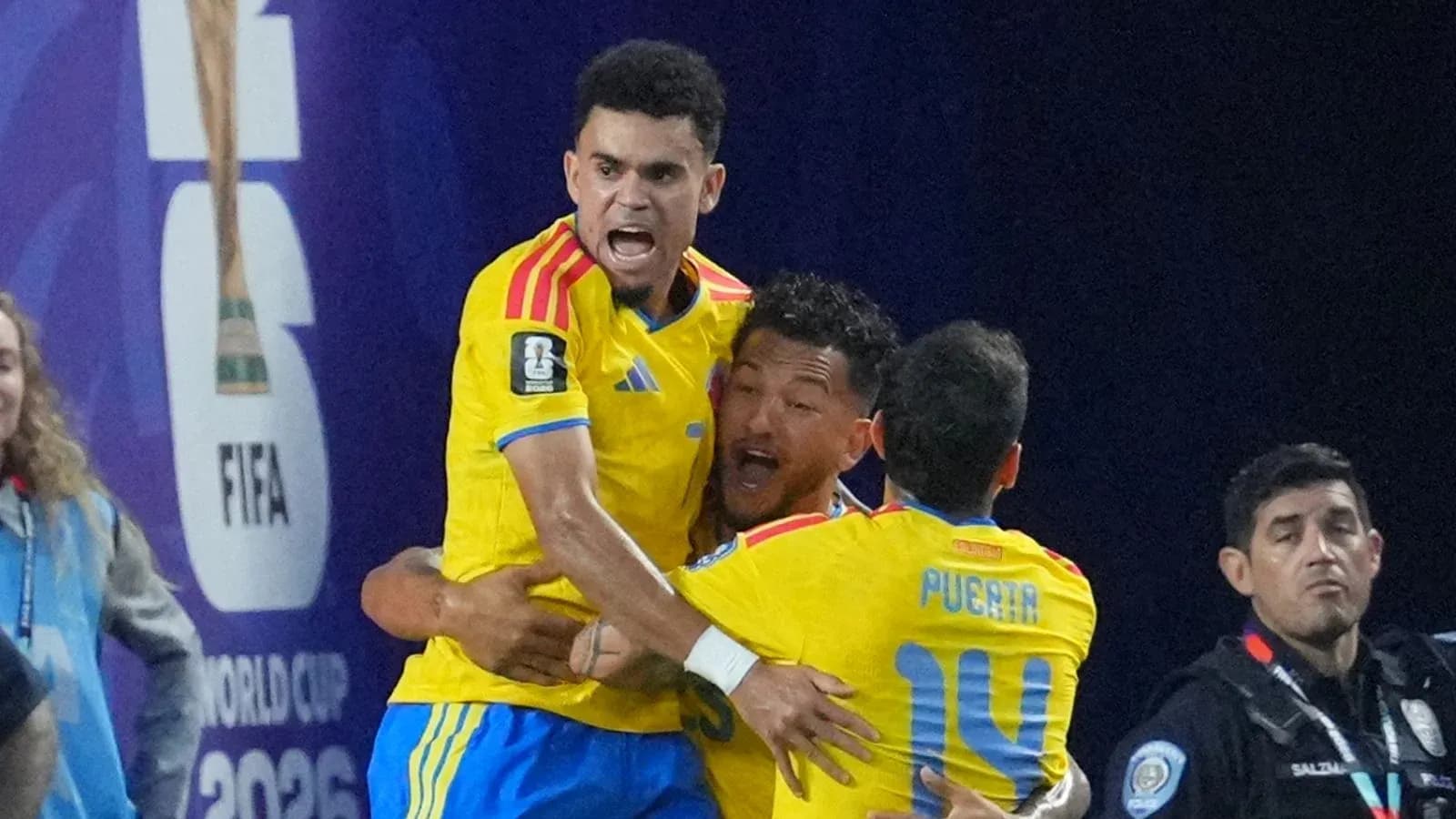
Colombia’s 1-0 win over Ghana at Arrowhead Stadium in this World Cup Round of 32 tie was a textbook example of territorial control and structure overwhelming a deep defensive block. The scoreline was narrow, but the underlying dynamics were decisive: 61% possession, a 20–8 shot advantage, and an xG of 2.18 to 0.26 underline how Nestor Lorenzo’s side dictated almost every aspect of the contest while Carlos Queiroz’s Ghana were forced into a reactive, low-margin game plan.
Colombia lined up in a 4-3-3 that behaved like a high-possession 2-3-5 in settled attacks. Full-backs Daniel Muñoz and Johan Mojica pushed high and wide, pinning Ghana’s wingers and creating a five-lane front line with Jhon Arias and Luis Díaz tucking inside around Jhon Córdoba. In front of the centre-backs Davinson Sánchez and Jhon Lucumí, Jefferson Lerma and Gustavo Puerta formed a stable double pivot, with James Rodríguez operating higher as the primary connector and final-third passer.
Ghana’s 4-1-4-1 under Carlos Queiroz was conservative from the outset. Thomas Partey anchored in front of the back four, with Kwasi Sibo and Caleb Yirenkyi tasked with shuttling laterally to close Colombia’s interior lanes. Antoine Semenyo and Iñaki Williams started as wide midfielders rather than true wingers, dropping deep to form a flat midfield line of four in long defensive phases, leaving Jordan Ayew isolated up front. The structure aimed to congest the central corridor and force Colombia to circulate in front of the block.
Colombia’s dominance of the ball (586 passes, 91% completion) was not sterile. They produced 12 shots inside the box and 8 on target, repeatedly finding overloads on both flanks. The early substitution at 8 minutes, with Luis Javier Suárez (IN) coming on for Jhon Córdoba (OUT), changed the profile of the number 9 position. Suárez’s more mobile, channel-oriented movement opened diagonal lanes for James Rodríguez to find him and helped drag Ghana’s centre-backs Derrick Luckassen and Jerome Opoku away from their compact starting positions.
The opening and only goal at 14 minutes encapsulated Colombia’s positional superiority and Ghana’s struggle to adjust to that early change. Jhon Arias arrived from midfield into the half-space, timing his run beyond Ghana’s line as Colombia circulated possession from side to side. With Suárez already on the pitch and involved as the assister, Arias attacked the gap between full-back and centre-back and finished clinically. The pattern highlighted a recurring issue for Ghana: their wide midfielders were pinned so deep that their full-backs Marvin Senaya and Gideon Mensah were frequently left in 1v2 situations against a winger plus an underlapping midfielder.
Queiroz reacted early, replacing Senaya with Alidu Seidu at 13 minutes, clearly seeking more defensive aggression on the right. Later, at 62 minutes, he introduced Abdul Fatawu Issahaku (IN) for Iñaki Williams (OUT) and Elisha Owusu (IN) for Kwasi Sibo (OUT), looking for more vertical threat and fresher legs in midfield. At 79 minutes, Ernest Nuamah (IN) came on for Jordan Ayew (OUT) and Prince Kwabena Adu (IN) for Caleb Yirenkyi (OUT), turning the front line into a more transitional, pace-based unit. Despite these changes, Ghana never solved the progression problem: 376 passes at 83% accuracy, but only 2 shots inside the box and 0 on target, show that they rarely converted possession into genuine penalty-area presence.
Colombia’s in-possession structure was complemented by aggressive counter-pressing. When attacks broke down, Lerma and Puerta stepped forward immediately to suffocate Ghana’s first pass out, often forcing the ball back toward Partey or into hurried clearances. The 14 fouls committed by Colombia came largely from this front-foot defensive posture, a trade-off Lorenzo appeared comfortable with given Ghana’s limited set-piece threat on the night.
Out of possession, Colombia’s 4-3-3 flattened into a compact 4-1-4-1, with Puerta or Lerma screening passes into Partey. This prevented Ghana from building centrally and forced them wide, where Mojica and Muñoz could be aggressive in duels, knowing Sánchez and Lucumí were secure behind them. The fact that Colombia allowed 8 total shots but none on goal speaks to the quality of their block and pressing triggers: Ghana were largely restricted to speculative efforts from distance or heavily pressured attempts.
In goal, Camilo Vargas (Colombia) did not register a save, a reflection not of passivity but of the defensive unit in front of him eliminating clear sights of goal. At the other end, Lawrence Ati Zigi (Ghana) was central to keeping the scoreline respectable, making 7 saves and repeatedly bailing out a stretched back line. Ghana’s 5 blocked shots also underline the emergency defending required to stay within one goal.
Discipline played a subtle tactical role. Jhon Arias’s early yellow card for “Tripping” at 12 minutes could have constrained his defensive aggression, but Lorenzo mitigated the risk by substituting him at 73 minutes, with Juan Fernando Quintero (IN) providing fresh control and ball retention in the right half-space. Richard Ríos, who had come on for James Rodríguez at 46 minutes (Ríos IN, Rodríguez OUT), later picked up a yellow for “Tripping” at 78 minutes, yet his presence had already shifted Colombia into a more conservative, game-management posture in midfield.
For Ghana, yellow cards to Caleb Yirenkyi (“Holding”, 49’), Abdul Fatawu Issahaku (“Unsportsmanlike conduct”, 66’), and Alidu Seidu (“Tripping”, 76’) reflected the strain of repeated defensive fire-fighting. The cautions to Yirenkyi and Seidu, both in wide or half-space zones, were symptomatic of Colombia’s ability to isolate and attack Ghana’s flanks, forcing last-ditch interventions.
A key tactical flashpoint came at 56 minutes, when a potential goal by Luis Díaz was disallowed by VAR for offside. The sequence again showed Colombia’s capacity to get runners beyond the last line, and although the decision kept Ghana in the game, it did not materially shift the tactical balance: Colombia continued to generate chances and maintain territorial control.
The statistical verdict reinforces the eye test. Colombia’s xG of 2.18 versus Ghana’s 0.26, combined with an 8–0 shots-on-goal disparity, illustrates a match where the scoreboard flattered the trailing side. Colombia’s 586 passes, 532 accurate (91%), underpinned their ability to recycle possession and patiently probe Ghana’s block, while Ghana’s 376 passes, 312 accurate (83%), were too often lateral or backward under pressure. Colombia’s 3 corner kicks to Ghana’s 2 and their 4 blocked shots to Ghana’s 5 further frame a game in which Colombia spent more time in advanced zones and Ghana spent more time scrambling in their own third.
In tactical terms, this was a controlled, structurally coherent Round of 32 performance from Colombia: a dominant possession platform, well-timed substitutions to manage risk and maintain control, and a defensive scheme that completely neutralized Ghana’s attacking threat, even if the margin of victory remained slender.
Related News
Brazil's First Post-World Cup Friendly: What Should the Lineup Be?
Harry Kane Calls England’s World Cup Exit to Argentina His Deepest International Pain
Estevao Opens Up on World Cup Heartbreak and His Unexpected Return to Brazil Under Ancelotti
Thomas Tuchel Shares Unusual Regret After England's 10-Man World Cup Victory Over Mexico
South Korea Names Robert Moreno as Interim Coach After World Cup Exit
Jude Bellingham Returns to Form at Real Madrid Following World Cup Success