
Cunha: The New Face of Brazil’s World Cup Attack
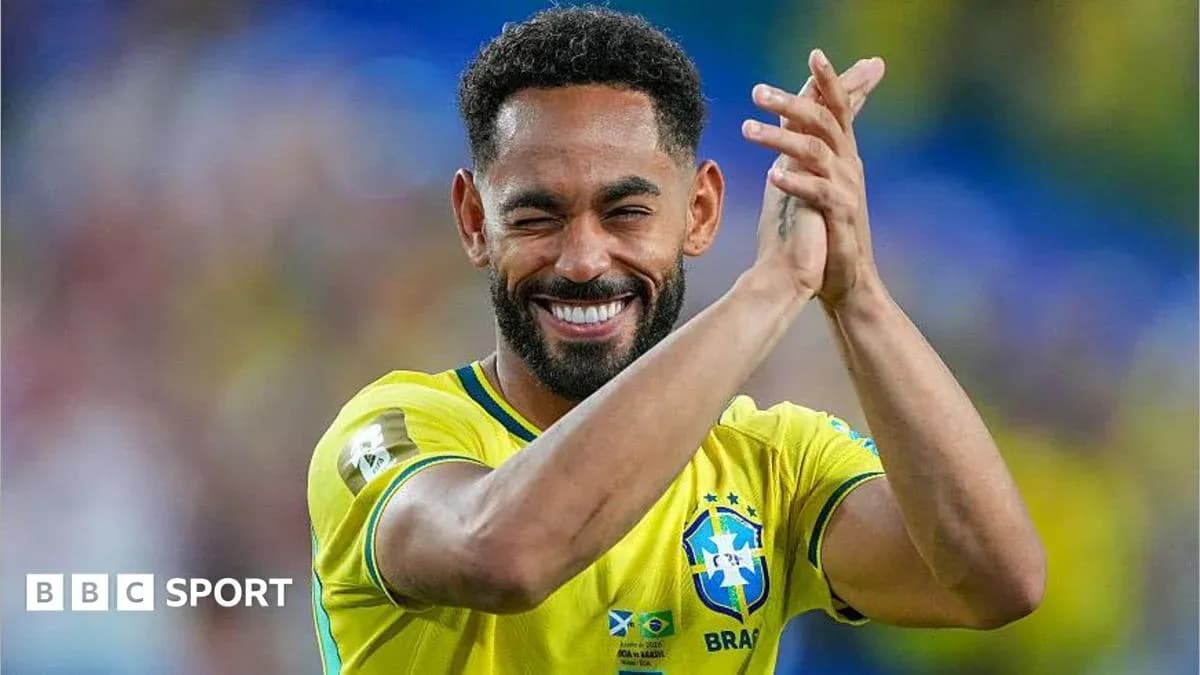
Brazil’s World Cup machine is starting to hum – and, crucially, so is its centre-forward.
Carlo Ancelotti appears to have settled on his strongest XI, and you can see the effect in every step of Brazil’s group campaign: sharper combinations, quicker reactions, a team gaining rhythm and conviction at exactly the point a tournament starts to harden. The knockout rounds are coming. So are Japan, a slick, dangerous last‑32 opponent. Brazil look ready for them.
At the heart of this rise sits a striker who doesn’t quite fit the old Brazilian mould, but might just define this new version of the Seleção.
Cunha, the “nine-and-a-half” changing Brazil’s attack
For decades, Brazil’s number nine shirt has carried a specific image: a penalty-box predator, a ruthless finisher who lives between the posts. Ronaldo, Adriano, Romario – names that still echo whenever a World Cup rolls around.
Matheus Cunha is not that.
He calls to mind a different blueprint, one more familiar to those who watched Roberto Firmino at Liverpool. Cunha roams. He drops deep. He toys with the defender assigned to mark him, dragging him into areas he doesn’t want to go and forcing constant decisions: follow and leave space behind, or hold the line and let Cunha operate between the lines.
Either choice can be fatal.
If the centre-back steps out, Vinicius Jr and Rayan suddenly have grass to attack on the flanks. If he holds his position, Cunha has time to receive, turn, slide passes into runners – or simply shoot. He already has three goals at this tournament, enough to underline that he is far more than a link man.
He isn’t a classic playmaker. He isn’t a classic striker. He is the hybrid in between – a “nine-and-a-half” – and that nuance is giving Brazil something they have rarely possessed in that central role.
Just as importantly, Cunha embraces the ugly work. He initiates the press, sets the trigger, and at times almost becomes an auxiliary number six in front of the midfield line when Brazil defend from the front. The balance of the entire attack shifts around his movement, and it suits him. It suits this team.
From uncertainty up front to a clear focal point
Not long ago, Brazil walked into this World Cup with a rare doubt: who was the starting number nine?
Even as the final warm-up games rolled by – right up to the meeting with Scotland – there was no definitive answer. Ancelotti rotated through options: Cunha, Igor Thiago, Endrick, Joao Pedro, Richarlison. None of them had nailed the shirt to the dressing-room wall.
Then football’s old accomplice intervened: injury.
Raphinha, a wonderfully gifted, restless attacker who can float as a 10 or operate on either wing, started the tournament centrally behind Igor Thiago against Morocco. His hamstring problem in that match changed everything. On came Rayan, a more orthodox right-sided presence, someone who naturally holds his width.
Suddenly, the picture sharpened. Vinicius Jr on one side, Rayan on the other, Cunha in the middle – alone in the zones he loves, free to drift, drop, and dictate. The pitch opened up for him. The system tilted in his favour.
Igor Thiago still has a role. If Brazil are chasing a game or need more physicality, he offers the classic option: a striker who plants himself on the centre-backs, pins them, occupies the box and demands crosses. That variety matters over a long tournament.
Yet as the group stage closed, the noise back home grew louder in one direction. More and more Brazilians now see Cunha as the solution. Opponents will have studied him by now, will think they understand his patterns. The problem for them is that intelligence is hard to map on a tactics board. Cunha reads situations quickly, adjusts angles, and makes his markers doubt themselves all over again.
Ancelotti’s Brazil: control without obsession
This evolution flows from the man on the bench. Ancelotti’s reputation has long been built on his calm authority and ability to handle big personalities, but his tactical work with Brazil deserves equal billing.
This is not a side obsessed with sterile domination of the ball. Brazil no longer feel the need to post 70% possession to prove who they are. At times, they hand the ball over deliberately, then use positioning and pressing to spring the trap.
It was clear against Scotland. Brazil allowed the Scots to have it, but quietly shepherded them into zones where the press would bite. The first goal came from that plan; the second, chalked off harshly, followed the same pattern. Those weren’t accidents. Brazil had scored similar goals in warm-up matches against Panama and Egypt. This is a rehearsed weapon, not a lucky punch.
They ceded possession, but not control. When the moment was right, the press snapped shut. The trap worked exactly as drawn.
This flexibility cuts against the endless debate over “identity” – whether a team must be defined as a possession monster or a counter-punching unit. Under Ancelotti, Brazil refuse to be boxed in. The approach bends to the opposition and the state of the game, not to a slogan. With players as adaptable as this squad, why would it be any other way?
A different kind of Brazil – and a sturdier one
Look at the shape of this side and you see a break from tradition.
This is the first World Cup in a generation where Brazil’s full-backs are not constantly flying beyond the wingers. No Roberto Carlos, Cafu, Maicon, Marcelo or Dani Alves surging up both flanks at every opportunity. The names on the teamsheet now – Douglas Santos, Roger Ibanez or Danilo when he features – bring a more conservative profile.
That restraint has a purpose. With the full-backs holding a little deeper, Vinicius Jr can stay higher, conserve energy, and be fresher when Brazil spring forward. The back four, in turn, looks more secure. There is less chaos, fewer wild transitions, more control of space.
Midfield has also been recalibrated. In the opener against Morocco, Casemiro stood alone as the sole shield in front of the defence and looked exposed. The criticism came quickly, but the problem lay in the structure, not in a 34-year-old being asked to cover impossible ground.
Ancelotti adjusted. Brazil moved from a 4‑2‑3‑1 to a 4‑3‑3. Now, when Bruno Guimaraes surges forward, Casemiro has Lucas Paqueta alongside him to share the defensive load. The gaps that appeared against Morocco closed up against Haiti and Scotland. That extra layer of protection will be vital against Japan, a far more fluid, incisive attacking side than either of those two.
The numbers back up the eye test: one goal conceded, seven scored across the group stage. A team that once relied on sheer attacking chaos now looks measured, compact, and still dangerous.
A nation’s mood flips – and the real test begins
Before the first ball was kicked, tension gripped Brazil. The uncertainty at number nine, the tactical tweaks, the sense of a new era without the old attacking full-backs – it all fed anxiety. After the opener, worry deepened.
Three games later, the mood has flipped. The public are smiling again. They see a side evolving in real time, guided by one of the game’s shrewdest managers and powered by a forward who doesn’t fit the old template but fits this team perfectly.
Momentum in a World Cup is a fragile thing. Brazil have found some. Japan will try to break it.
If Cunha and this new-look Seleção keep growing at this rate, who stops them?
Related News

Anthony Joshua Names Murat Gassiev as Next Opponent if He Defeats Tyson Fury

UFC 332: Start Time and Fight Highlights for Natalia Silva vs. Wang Cong
Court McGee Opens Up About Choosing UFC 332 as His Final MMA Fight
WBC Orders Lightweight Title Unification: William Zepeda vs Jadier Herrera
BCCI Pension List: Monthly Payments to Retired Indian Cricketers in 2025

Why Fury vs Joshua Is Set for Cardiff, and Dua Lipa’s Unexpected Role