
Declan Rice: England's Key Player Facing Fitness Concerns
Aaron Cresswell calls Declan Rice a “freak of nature”. It sounds like a throwaway line from an old team‑mate, the kind of dressing-room compliment that gets recycled every tournament. Until you look at the numbers.
Since the start of the 2020‑21 season, Rice has played 360 games for club and country. Three hundred and sixty. West Ham’s European marathons, England’s endless cycles of qualifiers and tournaments, Arsenal’s tilt at the Premier League and Champions League. Whenever there has been a big game, Rice has been in the middle of it, legs pumping, lungs burning, never seemingly close to empty.
On Wednesday in Yokohama, he finally looked human.
A midfield anchor running on fumes
England’s 4-2 win over Croatia should have been a statement start to their World Cup. Instead, for long spells, it felt like a warning. The scoreline was wild, the defending even wilder, and at the heart of the chaos stood a 27‑year‑old who has spent the past six years making chaos look tidy.
Rice’s 63rd appearance of the 2025‑26 season was one of his most uncomfortable. The structure around him creaked. The space between him and Elliot Anderson yawned open in the first half, inviting Luka Modric and company to stroll into areas England had no intention of leaving unguarded. Rice dropped too deep, then got dragged out of position, and for once he could not simply cover every blade of grass by force of will.
Thomas Tuchel will argue that the tactical issues are solvable before Ghana on Tuesday. Shapes can be tweaked. Distances can be tightened. Lines can be pushed up. What is harder to fix is a body that has been pushed to the brink for half a decade.
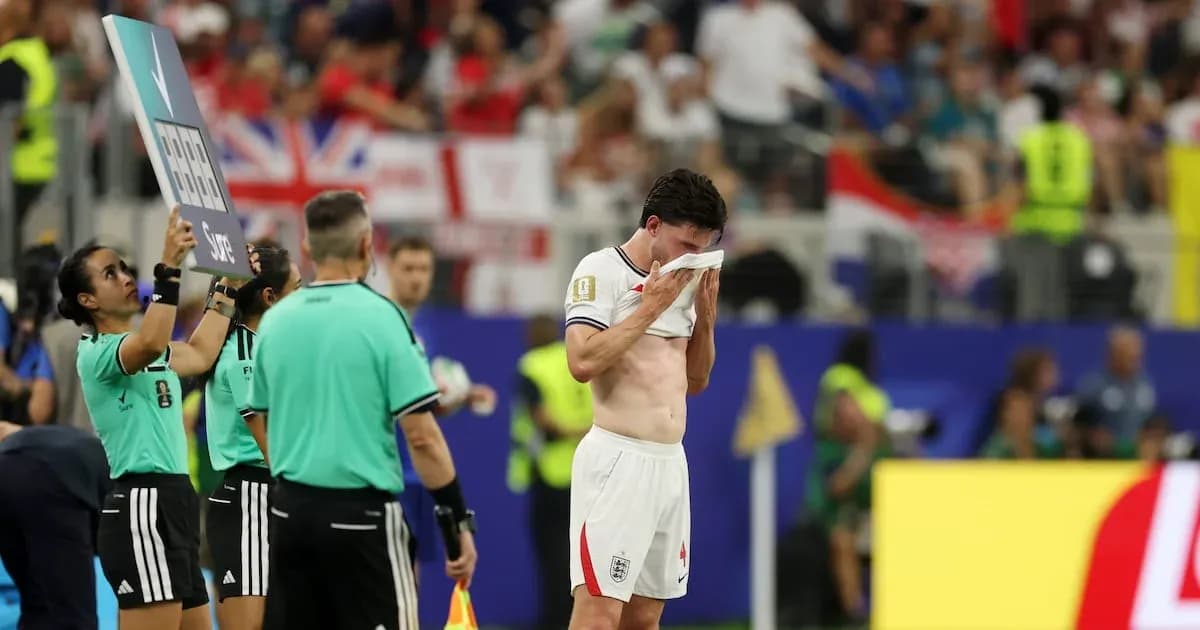
So when Rice signalled trouble and trudged off on 72 minutes, with England clinging to a 3-2 lead, it jarred. This is the man you normally see closing games, not leaving them. The man who wins the second balls, heads away the last cross, drags his team through the final 20 minutes. To see him replaced in that moment felt like an alarm going off.
Tuchel later explained that Rice had discomfort in his lower back and upper hamstring. Precautionary, he insisted. Rice himself was quick to declare that he will be ready for Ghana. England will want to believe him. They also know they cannot afford self‑deception.
What if precaution turns into problem?
No like-for-like, no easy answers
Tuchel’s assessment of Rice’s display was telling. “Declan had some unusual ball losses,” he said, carefully choosing a phrase that amounted to a diplomatic shrug. Rice at anything below full capacity is a different player. England at anything below full‑throttle Rice are a different team.
For six years, they have rarely looked convincing without him. There is no natural understudy in this squad, no clone waiting in the wings.
Kobbie Mainoo is a joy on the ball, brave in possession and inventive under pressure, but he does not yet bring Rice’s physical dominance or his set‑piece threat. Jordan Henderson is an option, but at 36 he was not summoned when the tempo rose against Croatia. If Tuchel did not trust him then, when will he?
The first reshuffle when Rice went off saw Jude Bellingham drop deeper. The idea lasted eight fraught minutes. Croatia almost punished it, and the balance of the team tilted dangerously. Bellingham’s genius lies in driving forward, not patrolling in front of his centre-backs.
Only when Djed Spence entered and Bellingham made way did something more coherent emerge. Reece James stepped out of right back and into midfield, into a role that has quietly become part of his repertoire at Chelsea.
It might prove to be England’s emergency blueprint.
Reece James, the unexpected 6
James is widely regarded as one of the best right backs in the world, a modern full back who can defend, deliver and dominate his flank. But under Enzo Maresca’s 18 months at Chelsea, his job description changed.
Maresca moved him into midfield. At first, the idea drew scepticism – not least from Tuchel himself, who had previously coached James at Chelsea and publicly insisted he saw him as a right back for England. Then came the performances.
James had played in midfield before, on loan at Wigan in 2018‑19, but this was different: a permanent shift in high‑stakes matches. He excelled in last year’s Club World Cup final, when Chelsea beat Paris Saint‑Germain and Maresca’s gamble looked inspired. He followed it up by running a Champions League midfield against Barcelona in a 3-0 win last November, partnering Moisés Caicedo with authority. Five days later, he dominated Rice when Arsenal came to Stamford Bridge.
That was not a one‑off. It was a body of evidence.
“Reece James can play in the 6 because he does on a high level for Chelsea,” Tuchel said when he named his World Cup squad, using that as part of his justification for leaving Adam Wharton and Alex Scott at home. Versatility, he argued, would be crucial.
Now that theory is being tested.
James brings power, intelligence and a full passing range. He can tackle, he can switch play, he can step out with the ball. If Rice’s minutes have to be rationed, James is the most credible way to keep England’s midfield from collapsing in on itself.
Tuchel has cover at right back if he moves James inside. Spence, Ezri Konsa and Jarell Quansah can all operate on the flank. One possible configuration would see Konsa tucking in almost as a third centre back alongside John Stones and Marc Guéhi, allowing Nico O’Reilly to surge from left back and give England thrust on the opposite side.
On paper, it works. On grass, another problem looms.
The gamble on fragile bodies
James’s own fitness record is a red flag. Hamstring injuries have stalked his career, the most recent in March keeping him out for almost two months. Chelsea have had to manage his workload with care. England must do the same.
Tino Livramento’s calf injury, which forced Tuchel to draft in Trevoh Chalobah as a replacement, has already stripped away one layer of protection at full back. James is first choice on the right, but he cannot start every game and cannot reasonably be expected to carry the full burden of Rice’s role as well.
This is the tension that nagged at Tuchel as the World Cup drew closer. The decision to fly early to Florida for a pre‑tournament camp in the sun was built around conditioning and recovery. Bodies needed to be hardened, legs freshened.
Rice arrived late, having driven Arsenal all the way to the Champions League final. Another big game, another 90 minutes. Another notch on the odometer.
He keeps pushing himself to the limit. At some point, the bill arrives.
If England go all the way to the final and Rice plays every match without a proper rest, he will finish the season on 70 appearances for club and country. Seventy. For a player asked to cover more ground than almost anyone else on the pitch, the demands border on brutal.
Tuchel has to decide how much more he can ask. And if he dares to ask less, he must be sure that the plan without Rice – whether built around James, Mainoo, or a hybrid of both – can withstand the weight of a World Cup knockout game.
England have their “freak of nature”. The question now is whether they can protect him long enough to find out how far he can really take them.
Related News

UFC 332: Start Time and Fight Highlights for Natalia Silva vs. Wang Cong

Court McGee Opens Up About Choosing UFC 332 as His Final MMA Fight
WBC Orders Lightweight Title Unification: William Zepeda vs Jadier Herrera

BCCI Pension List: Monthly Payments to Retired Indian Cricketers in 2025

Why Fury vs Joshua Is Set for Cardiff, and Dua Lipa’s Unexpected Role
Kei Nishikori Reflects on His Japan Open Debut Nearly Two Decades Before Retirement