
Erling Haaland Leads Norway to Historic Win Over Brazil
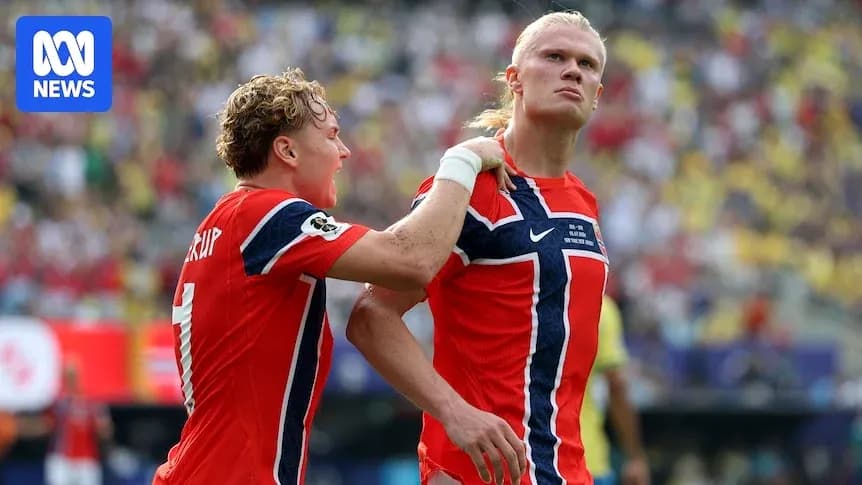
Erling Haaland barely smiles. Not properly. Not the way others do when they realise they’ve just dragged a nation somewhere it has never been before.
He gives you that slight curl of the lip, the glint in the eye, the hint of teeth. Just enough to tell you he knows exactly what he’s done. Just enough to let everyone else lose control while he stays ice cold at the centre of the storm.
Around him at MetLife Stadium, Norway dissolved into chaos. Ørjan Nyland roared himself hoarse, veins bulging after another huge save. Teammates flew into wild embraces, bodies colliding, piggybacks forming in front of a disbelieving wall of red. In the stands, there were tears – real ones – rolling down faces that had only ever dreamed of nights like this.
Haaland simply stood there, chest out, that familiar half‑grin creeping across his face after each of his two late goals in a 2-1 win over Brazil that launched Norway into the quarter-finals. Again, he had taken his country by the scruff of the neck and hauled it to another level.
"I peaked a couple of times in this tournament, but every now and then I get a new peak," he said afterwards. "If I get a chance or two, it usually turns into a goal. I don't know how I do it, but that's how I am. It's about being focused."
On a night when Brazilian history and Norwegian hope collided, focus was everything.
Norway wait, then strike
Norway came to New Jersey with a plan and the discipline to suffer for it. They kept the ball, they kept their shape, and for long stretches they kept their nerve, even as the game seemed to be drifting away from them.
They dominated possession but did almost nothing with it for most of the evening. Shots on goal were rare. Genuine chances, almost non-existent. Yet there was no panic on the touchline, no rash gambles from a team that understood its greatest asset better than anyone.
With Haaland on the pitch, they could afford to wait.
Brazil, by contrast, threatened in flashes. They broke with pace, with that familiar swagger, Vinicius Jr often leading the charge, slaloming into space and trying to ignite a side that still carries the weight of five stars on its chest. But the final act kept failing them. Crosses were cut out, shots were blocked, runs mistimed.
The five-time champions looked dangerous until it truly mattered.
Haaland, for an hour and more, barely featured. Brazil wrapped him in yellow, two defenders at his back, sometimes three, closing passing lanes, cutting off service. He had only three touches in the box. The much-hyped duel with Gabriel seemed to be tilting Brazil’s way.
Then the game changed in an instant.
In the 79th minute, Andreas Schjelderup finally found the delivery Norway had been waiting for. He arced a cross into the area and Haaland, Norway’s Viking king, rose to meet it. One clean header, one brutal finish, and the entire stadium felt the shift.
Brazil staggered. Norway smelled blood.
Ten minutes later, Haaland found something even more ruthless. At last in a pocket of space outside the box, he drove low and true, the ball skidding past the goalkeeper and into the corner. Two chances. Two goals. Seven for the tournament, drawing him level in the golden boot race with Lionel Messi and Kylian Mbappé, despite sitting out Norway’s final group game against France.
Norway, a nation more used to winter sports than World Cup dreams, had just booked a first-ever place in the quarter-finals.
Martin Ødegaard has usually led the Viking row with the fans after each win, orchestrating the ritual with the captain’s authority. Not this time. This moment belonged to Haaland. Drum in hand, he hammered away in front of the Norwegian end, that carefully contained emotion finally ripping free as he and his teammates absorbed what they had done.
With the talent in this squad, a last-eight finish always felt like an ambitious but realistic target. Beyond that, the territory becomes something else entirely – the stuff of Norwegian fantasy. Yet watching this organised, cool-headed team move through the tournament with a game plan built around one devastating strength, fantasy no longer feels impossible.
"It's one of the most insane days in Norwegian history," Haaland said. "I think this will inspire many young people, just as I was inspired when I was young."
Coach Ståle Solbakken did not hold back either. "This is the greatest night in Norwegian football history," he said.
For a country that has waited this long for a night like this, no one argued.
Brazil’s fall and Neymar’s farewell
On the other side, history cut in a very different direction.
Brazil, the nation that once defined tournament inevitability, is out before the quarter-finals for the first time since 1990. The aura has been fading for years; in New Jersey it felt like something finally snapped.
The most jarring image came after the final whistle. Neymar, Brazil’s all-time leading goalscorer, stood on the same turf where his international career had begun and called time on it.
"I tried. It started here at MetLife Stadium, and I finished here. It is now over," the 34-year-old said.
His tournament had been a struggle from the outset. A nagging calf injury restricted him to limited minutes across two games, and the player who once bent entire tournaments to his will was reduced to a late penalty, deep into stoppage time, when this contest was already lost.
The decisive moments had come much earlier. Bruno Guimarães saw a first-half penalty saved, a miss that could have ripped the match open in Brazil’s favour. Instead, it became another marker in a longer story of decline.
The five-time champions have looked increasingly like a fallen giant, more Germany than juggernaut, leaning on the weight of their past without the structure or edge to match it on the pitch.
Carlo Ancelotti arrived a year ago as the supposed saviour, the serial winner tasked with restoring order and fear. He reached back to familiar names, calling on some aging stars whose reputations still loom large but whose peak years are gone. Vinicius Jr, electric and relentless, tried to drag them forward almost alone. The supporting cast could not keep up.
"It’s inexplicable," defender Marquinhos said. "We have to take responsibility for this so that future generations can build on it."
It has been 24 years since Brazil last lifted the World Cup. With each passing cycle, the gap between memory and reality widens. Unless something fundamental shifts – in planning, in player development, in courage to move on from past idols – nights like this will become less of a shock and more of a pattern.
Norway, carried by the cold-eyed ruthlessness of a striker who barely needs to smile to break hearts, marches into the last eight. Brazil heads home, again, staring at its reflection and wondering how much longer its history can carry a team that no longer plays like a superpower.
Related News
Anthony Joshua Names Murat Gassiev as Next Opponent if He Defeats Tyson Fury

UFC 332: Start Time and Fight Highlights for Natalia Silva vs. Wang Cong
Court McGee Opens Up About Choosing UFC 332 as His Final MMA Fight
WBC Orders Lightweight Title Unification: William Zepeda vs Jadier Herrera
BCCI Pension List: Monthly Payments to Retired Indian Cricketers in 2025
Why Fury vs Joshua Is Set for Cardiff, and Dua Lipa’s Unexpected Role