
Harry Kane's Signature Performance Against DRC
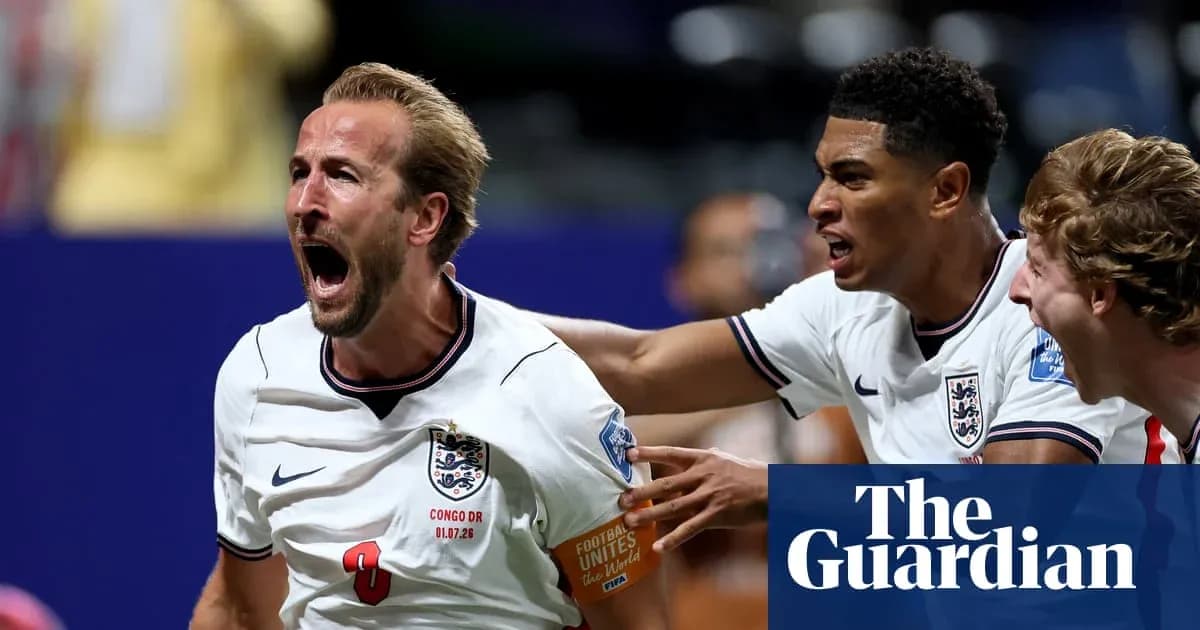
Thierry Henry leaned into the replay and winced. Not at the defending. At the technique.
“Striking with the inside of the foot, almost wrapping the ball while the body is off-balance… If I did that now, I’d break my back,” he said on Fox, half admiring, half incredulous.
When one of the greatest finishers of his generation sounds like that, you listen. Harry Kane’s second goal against the Democratic Republic of the Congo was not just a late winner. It was a piece of finishing that only belongs to the very top tier of forwards, the kind that makes other greats shake their heads.
Kane didn’t just swing a leg. He rotated his entire frame, used his arms to whip extra force through the strike, accepted that he’d probably end up on the turf. Body off-balance, mind completely still. Ball lashed, game turned, tournament saved.
At 84 England goals and counting, this was the night he reminded everyone why the country keeps coming back to the same question: where, exactly, does Harry Kane sit in the nation’s footballing pantheon?
A modern great, playing at full power
Strip away the noise and the numbers are brutal. The goals against the DRC were Kane’s 83rd and 84th in 118 caps. He has five from England’s first four games at this World Cup, right in the hunt for another Golden Boot. Gary Lineker’s World Cup goalscoring mark? Gone. Passed.
This is not a striker hanging on to old habits. This is a player who has kept adding layers, year after year. The longer Kane’s career runs, the sharper he looks.
He has 72 goals for club and country this season. Seventy-two. He has covered 43,433 metres at this World Cup, more than any other England player. So much for the idea that he was slowing down. The Bayern Munich forward is in the Ballon d’Or conversation and looks like he belongs there.
“It’s probably the best I’ve felt in my career,” Kane said. That doesn’t sound like a man fighting his body. It sounds like one who has finally bent it fully to his will.
He talked about a conscious decision at the start of the season: get fitter, recover smarter, squeeze every marginal gain. The winter break in Germany has helped. So has Bayern’s ability to rotate him out of the firing line in the Bundesliga. The result is what we saw against the DRC – a centre-forward at peak physical power, still ruthless in the 90th minute.
Signature night on the international stage
For all his records, there has always been a caveat attached to Kane’s England career. The missing masterpiece. The defining performance deep in a tournament that could sit alongside the great English stories.
Bobby Moore lifted the World Cup in 1966. Sir Bobby Charlton won the Ballon d’Or that same year. Their legacies are gilded by a single, shimmering triumph.
Kane’s previous tournaments have never quite delivered that same late-stage crescendo. He arrived at some short of full fitness. He drifted out of others. He was quiet in the Euro 2020 final. In Qatar, his missed penalty against France in the quarter-final became the enduring image, his own moment of heartbreak on the biggest stage.
The debate resurfaced after the Euro 2024 final defeat to Spain, when he was substituted and dismissed in some quarters as a fading force. That narrative did not survive Atlanta.
Against the DRC, Kane dragged England through a performance that, in truth, was ragged and anxious. He equalised with a clever header, then smashed in that outrageous second to flip the tie and secure a last-16 meeting with Mexico. It was not just decisive. It felt like a signature international display, the kind that shifts how a career is framed.
On the Stick to Football podcast this week, Gary Neville, Roy Keane, Ian Wright and Jill Scott tossed Kane’s name into the same bracket as Moore and Charlton when discussing England’s greatest ever. A few years ago that might have sounded fanciful. It doesn’t now.
He is, at the very least, in the top 10. You can argue the order. You cannot argue the scale of his impact.
The complete centre-forward
The raw finishing has always been there. What separates this version of Kane is how much more he does.
No striker in the modern game drops off the front line and threads passes between defenders quite like him. His ability to act as a No 9 and a No 10 in the same move has become central to England’s entire attacking structure.
Working in tandem with Jude Bellingham, he has become the team’s brain and its blade. Bellingham roams, surges, breaks lines. Kane knits, guides, then appears in the box at the exact moment the move needs him.
The rest of the team? Far less settled. The wingers have flickered without truly catching fire. The midfield looks leggy. The defence has creaked. Right-back has turned into an injury riddle.
England are a flawed side being held together by a world-class spine. At the top of it stands their captain.
The numbers Kane pores over after every game – distance covered, sprints, involvement – are not vanity metrics. They are the evidence of a player who refuses to stand still, in any sense. “I’m willing to run more and do whatever it takes to help the team,” he said. The data backs him up.
Leadership in the open
Kane has always been a quiet leader, more example than orator. That has started to change.
After the win over the DRC, he pulled his team-mates into a huddle on the pitch in Atlanta and delivered an on-field address. Cameras everywhere, emotions raw.
“It’s something I don’t normally like to do in a public situation,” he admitted. He worried it might look staged. It didn’t. It looked like a captain understanding the moment.
He spoke about wanting his team to savour it, to avoid drifting past the significance. The memory of the Panama game – a big World Cup win that England barely celebrated – has stuck with him. “It’s easy as an England player sometimes to take things for granted,” he said.
That is the other shift with Kane. The goals are familiar. The voice, more public, more assertive, is newer. He sounds like a man who understands that leadership is not just about how you move in the penalty area, but how you move a dressing room.
Anger, channelled
Even on his great night, there was a flash of anger. Kane is still smarting about the first-half penalty that never was, when he collided with DRC goalkeeper Lionel Mpasi.
To his mind, it was clear. He reached the ball first. He felt a push in the back. The keeper rushed out, initiated the contact. Kane went over, tried to protect himself, and watched as the referee waved play on and VAR stayed silent.
“It’s a clear penalty,” he insisted. If he had kept his leg planted, he argued, he would have risked “serious, serious injury”. If it had been a defender rather than a goalkeeper making that challenge, he said, nobody would have hesitated to give a foul.
He was “really surprised” the decision went against him, and even more surprised that VAR did not intervene. The fury was real. The response was better. He parked it, recalibrated and took the game away from the DRC anyway.
That, in its own way, is another mark of where he is now. The younger Kane might have brooded. This one scores twice.
Azteca, altitude and the next test
Mexico now wait in Mexico City, with the Azteca Stadium ready to turn itself into a wall of noise and altitude turning every breath into an extra effort.
“There is not much we could do with altitude training,” Kane said. England did 10 days of heat work in Florida to prepare for the conditions, but replicating the air of Mexico City was almost impossible without basing themselves there and compromising the rest of the tournament. The staff judged it not worth the trade-off.
So they will walk into the thin air and chaos as they are: as professional athletes used to dealing with adversity, armed with “little tips” and marginal strategies to cope, but ultimately reliant on mentality and resilience.
“If we get through it,” Kane said, “then all of those things will make the win feel even more special.”
Kyle Walker, watching on as a former England right-back now, liked something else about the DRC win – the ugliness. The sense that this was a team grinding, not gliding.
Kane agreed. “You very rarely see the team come out of the gates hot and then sustain that all the way through to the end,” he said. Tournament football is about adaptation, about finding ways to win when your ideal version of yourself refuses to appear. Sometimes you dominate. Sometimes you survive.
Against Mexico, England will meet a side playing at home, playing for pride, playing for a place in the next round of the World Cup. They may have to suffer. They may have to win the hard way.
Kane, though, sounds ready. He talks about peaking at the right time, about building rhythm through the tournament. He has done it his entire life, from youth football to the Premier League to the Bundesliga. Obstacles have never disappeared for him. He has simply learned how to move around them.
Now comes another one: a ferocious Azteca, a rampant Mexico, the weight of history and expectation on his shoulders. If this really is the best he has ever felt, this might be the moment he turns greatness on paper into greatness etched into England’s collective memory.
Related News

Anthony Joshua Names Murat Gassiev as Next Opponent if He Defeats Tyson Fury

UFC 332: Start Time and Fight Highlights for Natalia Silva vs. Wang Cong
Court McGee Opens Up About Choosing UFC 332 as His Final MMA Fight
WBC Orders Lightweight Title Unification: William Zepeda vs Jadier Herrera
BCCI Pension List: Monthly Payments to Retired Indian Cricketers in 2025
Why Fury vs Joshua Is Set for Cardiff, and Dua Lipa’s Unexpected Role