
Huntsville City Defeats Carolina Core 3–0: A Tactical Analysis
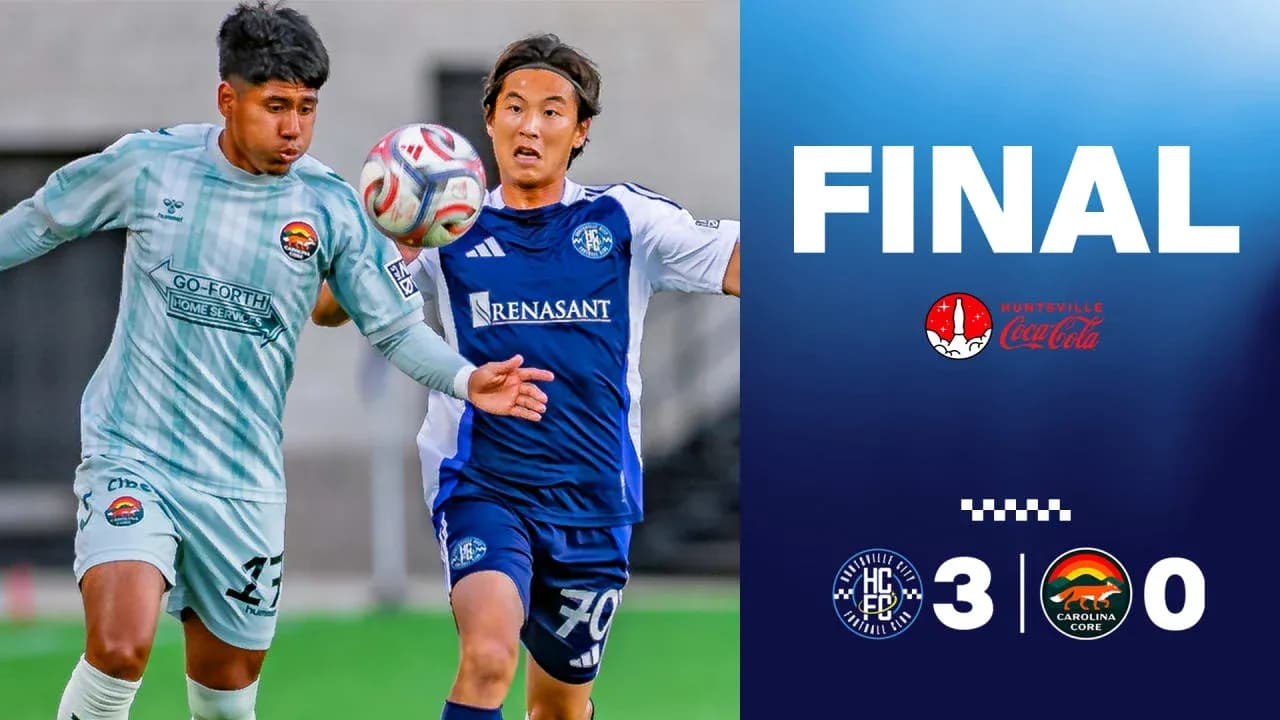
Under the lights at Joe W. Davis Stadium, Huntsville City’s 3–0 victory over Carolina Core felt less like a routine group-stage result and more like a statement about where these two MLS Next Pro projects are heading. Following this result, the numbers that already hinted at a gap between the sides now look like a chasm in terms of identity, confidence and tactical cohesion.
Huntsville arrived with momentum and a clear seasonal DNA: high-event football, tilted toward attack. Overall this campaign they have scored 18 goals and conceded 17 in 8 matches, an open profile underlined by an average of 2.3 goals for and 2.1 against per game. At home they have been particularly sharp, averaging 2.0 goals scored and only 1.0 conceded. That blend of firepower and relative home control has carried them to 15 points from 8 games and a goal difference of +1 in both the Central Division and Eastern Conference standings.
Carolina Core, by contrast, came in as a side still searching for a foothold. Overall they have taken just 5 points from 9 matches, with 11 goals scored and 22 conceded for a goal difference of -11. On their travels the picture is even starker: 0 wins, 0 draws and 5 losses, with only 4 goals scored and 13 conceded, an away average of 0.8 goals for and 2.6 against. This was a fragile team walking into one of the more volatile attacks in the league.
The 3–0 scoreline echoed Huntsville’s biggest home win of the season (they have a 3–0 home high in their seasonal record), and it fit perfectly with the trends: Huntsville leaning into their attacking instincts, Carolina extending a pattern of away collapses.
Tactical Voids and Discipline
With no official list of absentees provided, the tactical voids were less about missing names and more about structural gaps. Carolina’s issues have been systemic all season: they have yet to keep a clean sheet in total, and they have failed to score twice, both times away. The lack of a dependable defensive spine or a consistent attacking reference point meant that coach Donovan Ricketts was always likely to be reactive rather than proactive.
Huntsville, guided by Chris O’Neal, could instead build on a relatively balanced statistical base. They have kept 2 clean sheets overall and failed to score only once. That reliability gave O’Neal the freedom to select an aggressive, technically oriented XI without overloading on pure destroyers.
Disciplinary trends shaped the risk profile. Huntsville’s yellow-card distribution this season shows a clear pattern of intensity spiking after the interval: 27.78% of their yellows arrive between 46–60 minutes, with a combined 44.44% coming in the 76–90 and 91–105 ranges. They push late and hard, but notably they have no red cards in any time band. It is controlled aggression.
Carolina, on the other hand, live closer to the disciplinary edge. Their yellow cards are spread across the match, with 23.33% between 46–60 minutes and 20.00% in both the 16–30 and 76–90 windows, and they already have 1 red card in total, shown in the 46–60 range. That profile suggests a team that can be baited into rash decisions when pressed after half-time, a vulnerability Huntsville’s tempo was always likely to target.
Key Matchups
Hunter vs Shield
Without individual scoring data, the “hunter” is Huntsville’s collective attack rather than a single finisher. The front unit of L. Eke, M. Ekk and J. Van Deventer, supported by the creative currents of M. Veliz and N. Pariano, formed a fluid, interchanging band of attackers. Their season-long numbers back the eye test: overall Huntsville score 2.4 goals on their travels and 2.0 at home, indicating that this is not a system dependent on one venue or one star, but on repeated patterns of chance creation.
The “shield” Carolina tried to erect in front of N. Holliday was built around the defensive core of N. Martinez, S. Yepes Valle and N. Evers, with J. Caiza screening. Yet the season data was unforgiving: 22 goals conceded overall, with 13 of those on their travels, and their heaviest away defeat a 4–1 loss. Huntsville’s 3–0 win slotted neatly into that pattern, exposing Carolina’s inability to protect the box for 90 minutes.
Engine Room
The central battle revolved around Huntsville’s midfield axis of M. Veliz and N. Pariano against Carolina’s mix of T. Zeegers, M. Diakite and R. Aguirre. Huntsville’s season-long averages—2.3 goals for and 2.1 against overall—tell of a midfield willing to commit numbers forward and live with the risk. Carolina’s 1.2 goals for and 2.4 against overall paint a different picture: a midfield often chasing, seldom dictating.
Veliz and Pariano provided the connective tissue, linking the back line of J. Gaines, N. Prince and L. Christiano to the front three with vertical passes and third-man runs. Their ability to sustain pressure, especially after half-time when Huntsville historically pick up bookings and intensity, forced Carolina’s midfield to defend facing their own goal. That, in turn, left Zeegers and Diakite with too much ground to cover and too little time on the ball to launch transitions toward A. Tattevin and D. Diaz.
Statistical Prognosis and Tactical Verdict
If we read this match as a datapoint within the broader season, the prognosis for both sides is clear.
For Huntsville City, the underlying numbers support the eye-catching scoreline. Overall they win 5 of 8 fixtures with no draws, and their goal difference of +1 in the standings is beginning to trend upward after this clean 3–0. Their home averages—2.0 scored, 1.0 conceded—combined with 2 clean sheets overall suggest a side evolving from pure chaos merchants into a more controlled, playoff-calibre outfit. Their perfect penalty record this season (1 taken, 1 scored, 100.00%) underlines a composure in decisive moments.
For Carolina Core, the data remains alarming. Overall they have lost 8 of 9 matches, with no draws and only 1 win. Their away record—5 defeats from 5, 4 goals scored and 13 conceded—now has another heavy loss layered on top of it. With no penalties won and none scored in total, they lack easy sources of goals, and their inability to post a single clean sheet this campaign leaves them perpetually needing to outscore opponents they rarely contain.
From an xG and defensive-solidity perspective—using the goals and averages as proxies—Huntsville’s attack is trending toward playoff-ready efficiency, while Carolina’s defensive structure is more relegation-battle than knockout-round. If this were a 1/8 final tomorrow, the tactical preview would be brutal: Huntsville’s fluid front line and surging second-half intensity against a Carolina defense that concedes an average of 2.6 goals on their travels is a mismatch.
The story at Joe W. Davis Stadium confirmed what the season’s numbers had been whispering: Huntsville City are building a fearless, front-foot identity fit for the sharp end of MLS Next Pro, while Carolina Core must first learn how to suffer without collapsing before they can think about anything more ambitious.
Related News

MLS Winners and Losers: Cavan Sullivan’s USMNT Rise, St. Louis City SC’s Smart Moves, and Chicago Fire’s Hugo Cuypers Gap

MLS Winners and Losers: Portland Timbers' Historic Hat-Trick, Josh Sargent Shines, and Cavan Sullivan's Rising Star
Tacoma Defiance Injury List: Players Out and Return Dates vs Colorado Rapids II
Carolina Core injury list: Players out, potential return dates
Tacoma Defiance vs Colorado Rapids II Predicted Lineups and Team News
Orlando City II vs Huntsville City Predicted Lineups and Team News