
Iran's World Cup Journey: Tension and Expectations in Los Angeles
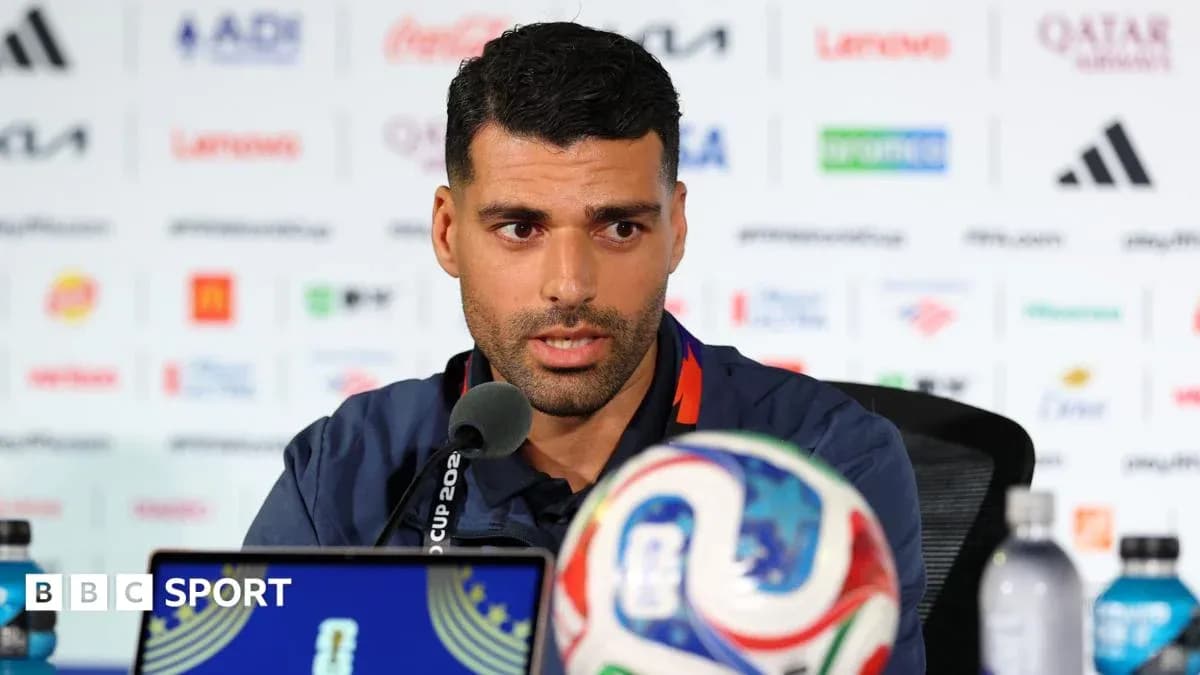
Iran arrive at this World Cup carrying something far heavier than form or expectation. They walk into Los Angeles with a war barely paused, a fanbase divided by oceans and ideology, and a tournament that threatens to turn every pass into a political act.
Until this week, the host nation, the United States, had been at war with Iran. On Sunday, an agreement to halt hostilities and reopen the Strait of Hormuz finally emerged. It calmed nerves, but it did not clear the air. The tension simply changed shape.
You can hear it in Mehdi Taremi’s voice.
“This kind of tension undermines the joy of the World Cup,” the striker said. “I felt the tension from the first moment we arrived. The tension started even before we got here.”
He is not exaggerating. Iran’s preparation has been a long detour.
Their base camp was supposed to be in Tucson, Arizona. Instead, after months of wrangling over visas, security and a spiralling political climate, they uprooted and shifted to Tijuana, just across the Mexican border. A national team reduced to border hopping before a ball is kicked.
Amir Ghalenoei, the head coach, knows exactly what that has cost him.
“Without any doubt, this kind of behaviour has impacted the spirit of football,” he told the BBC. “Football is supposed to bring nations and cultures together. It is about bringing joy. These conditions have affected our focus, but I have tried to make sure the players concentrate on strategy and performance.”
They arrived late. They had little time to adjust. The margins at a World Cup are brutal; Iran have chosen to live with chaos.
“But I know how committed these players are to performing,” Ghalenoei added, clinging to the one constant he can trust: the dressing room.
Now they land in a city that mirrors their contradictions.
Los Angeles wears its nickname proudly: “Tehrangeles”. It is home to one of the largest Iranian diasporas in the world, a sprawling community built by those who left after the revolution and those who followed later, often in protest, often in exile.
On Monday at SoFi Stadium, Iran will open their World Cup campaign against New Zealand. The stands will be full of Iranian-Americans. Many will bring flags and songs. Many will also bring placards.
They are not all coming to cheer.
Fifa’s decision to ban the pre-revolutionary Lion and Sun flag – a symbol that carries deep emotional weight for many Iranians abroad – has lit a fresh fuse. For some in the diaspora, that flag is not just a relic. It is a statement against the current regime.
“You don't come to Los Angeles and tell us we can't fly the Lion and Sun flag,” said activist Arezo Rashidian, one of the organisers of demonstrations planned outside the stadium. “This is the largest Iranian community outside Iran. Many of us came here after the revolution. We're opposing Fifa's ban and standing in solidarity with the people of Iran.”
That solidarity cuts in several directions. Many in the diaspora are openly hostile to Iran’s rulers and see the national team, fairly or not, as an arm of the Islamic Republic.
“It's unfortunate that the regime turns athletes into mouthpieces,” Rashidian said. “We want athletes to remain athletes.”
Yet even she plans to go inside and watch.
“We understand the pressure they're under,” she said. “We'll carry our colours. We'll cheer for Iran – the country – held captive by the Islamic Republic.”
That line captures the fault line running through this World Cup for Iran: the team as both symbol and hostage, embraced and rejected, cheered and challenged, sometimes by the same people in the same stadium.
Outside SoFi, protesters will raise their voices. Inside, the players insist they will lower their heads and play.
“As players of the national team, we play for every single Iranian, whether in the diaspora or in Iran,” Taremi said. “In every country people have different opinions. We are here to unite people and bring joy. Everyone is entitled to their opinion. We don't get involved in politics.”
It is a noble stance, almost a plea. But this squad know better than most that football does not exist in a vacuum.
“There is no winning for Iran's team,” said investigative football journalist Samindra Kunti. “Given the circumstances, the political pressure, the location of the matches and the diaspora in Los Angeles, they're under enormous pressure. It's impossible to avoid the politics. Everything becomes a reminder of their situation.”
The pressure comes from all sides: from Tehran, where the regime watches; from Washington, where the host nation has only just stepped back from conflict; from the streets of Los Angeles, where a restless diaspora refuses to be quiet.
This is the backdrop as Iran walk out to face New Zealand. Ninety minutes of football, framed by years of history and weeks of crisis.
For most teams, the World Cup begins when the whistle blows.
For Iran, it began long before they reached the tunnel.
Related News
Max Verstappen Responds to George Russell’s Call for Cooling Vest Rule Change Ahead of Bahrain GP
Anthony Joshua Took a Massive Pay Cut to Ensure Fury Fight Happens in the UK

Tyson Fury Plans to Invite Donald Trump for Anthony Joshua Fight
Why Cristiano Ronaldo Is Missing Portugal’s Match Against Norway
France vs Belgium: Nations League Clash Preview and Lineups
Cesc Fabregas Opens Up on Como Journey from Serie B Unknown to Champions League Contender