
Kylian Mbappe: The Star Under Fire at Real Madrid
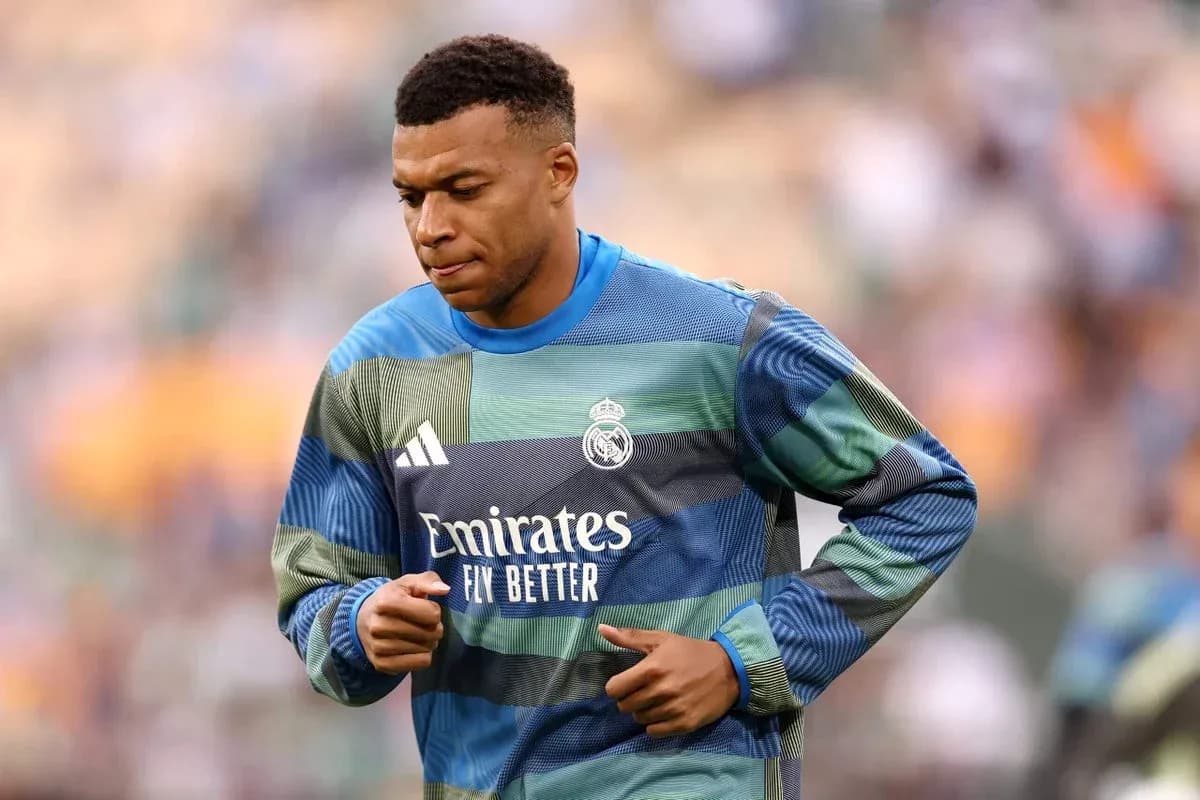
As Real Madrid’s players leave the dressing room and step into the Bernabeu tunnel, they walk past a sentence that now feels less like a slogan and more like an accusation.
“No player is as good as all of you together.”
Alfredo Di Stefano’s words were meant as a celebration of collective greatness. Today, they hang over a fractured dressing room, a fanbase turning on its idols, and a club wrestling with the cost — sporting and emotional — of finally getting Kylian Mbappe.
The question echoing around Madrid now is a blunt one: has the journey been worth it?
A superstar under fire
This was not how it was supposed to look.
When Mbappe finally arrived on a free transfer from Paris Saint-Germain in June 2024, complete with a huge signing fee and even bigger expectations, Madrid had just completed a La Liga and Champions League double. Jude Bellingham and Vinicius Junior were electric, the Bernabeu reborn, the 15th European Cup in the cabinet.
Mbappe was meant to be the final piece. Instead, the whole puzzle looks skewed.
Madrid are drifting towards the end of a second straight season without a major trophy. The stands have turned sour. Vinicius, Bellingham, Mbappe — even Florentino Perez himself, the architect of the modern galactico era — have all been whistled at the Bernabeu.
The tension is not just in the seats. It has spilled into the grass and the walls of Valdebebas. Aurelien Tchouameni and Federico Valverde came to blows in training last week, a flashpoint that exposed a dressing room already on edge.
Within that storm, Mbappe has become the lightning rod.
The numbers say one thing. The noise says another.
Goals without peace
On paper, the Frenchman has delivered exactly what Madrid thought they were buying.
Since his arrival, Mbappe has been the club’s leading scorer in both La Liga and the Champions League, with 77 goals in those competitions. He claimed the Golden Boot in 2024–25. In this season’s Champions League, he hit 15 — a tally that leaves him on course to finish as the competition’s top scorer and within touching distance of Cristiano Ronaldo’s record of 17 from 2013–14.
Against Bayern Munich in the quarter-finals, as Madrid crashed out, Mbappe was one of the few who hit the expected level, scoring twice over the two legs.
He has not just scored often; he has scored above expectation. The quality of his chances suggests one tally, his finishing has produced seven goals more than that.
He dominates Madrid’s shot map. He has almost twice as many goals as any team-mate since he signed. The attack flows towards him and through him.
Yet, when Madrid played their first home game after that Bayern elimination, the Bernabeu booed him.
Not just a murmur. Not a scattered grumble. A clear, pointed reaction.
Since then, criticism has swelled around everything he does. A row with a member of the coaching staff before the game at Real Betis on April 24. A trip to Italy with his partner during injury recovery that irritated people inside the club.
His camp responded with a statement insisting the backlash came from “over-interpretation” of a recovery process “strictly supervised by the club”, and insisted it did not reflect his “commitment and daily work for the team”.
The goals keep coming. The doubts keep growing.
The case against: balance, chemistry, and the cost of a star
Inside the coaching staff, the concerns started long before the boos.
When Mbappe’s signing was being finalised two years ago, a member of Carlo Ancelotti’s staff pointed to one thing: his off-the-ball numbers. The lack of defensive work jumped off the page.
Even then, with Madrid fresh from another Champions League triumph, the staff worried about balance. How do you fit Mbappe into a side already built around Vinicius and Bellingham without breaking something?
Those fears have not gone away. They have been confirmed.
Across his La Liga and Champions League minutes, Mbappe posts the lowest figures in the squad for tackles, interceptions and ball recoveries per 90. When you look at ‘true’ tackle attempts — every time a player actually engages, whether they win it, lose it, or give away a foul — he ranks 461st out of 461 outfield players in La Liga this season. Around 0.6 per game.
There are nights when he works. Clasicos. Big Champions League ties. But in the grind of a season, he is the Madrid player who offers least in defence.
That is not unheard of for a superstar forward. The problem is what happens when you stack him with other attacking egos and profiles who also need freedom. Vinicius Jr. Bellingham. Rodrygo. All of them want the ball, want space, want to be decisive.
Then there is the left flank.
Mbappe and Vinicius have not clicked as a natural partnership. Their chemistry has been sporadic, their positions overlapping, their instincts colliding. Both drift left in the build-up, both want to attack the same channels. The touchmaps tell the story: two dominant left-sided forwards trying to occupy one lane.
There have been flashes of brilliance between them, but not the sustained, almost telepathic link Madrid once enjoyed between Vinicius and Rodrygo.
It raises an awkward question for those who built this squad: who thought two ball-dominant left-sided stars was a long-term solution?
The numbers on the scoreboard are not as flattering as Mbappe’s personal haul. Madrid scored 87 league goals in 2023–24, in a season without a clear No 9, when Bellingham often operated as a false nine and Joselu came from the bench as a classic target man. Last season, with Mbappe, they scored 78 in La Liga. This year, with three games left, they sit on 70.
Mbappe scores. The team, as a whole, does not score more.
And the question lingers over the future: how do you build around him now? How do you integrate new high-potential forwards if one player’s positional needs and defensive profile reshape everything?
Then comes the most delicate area: the dressing room.
Mbappe was supposed to be a leader, someone who would drag the team through difficult moments. Yet he arrived after years of failed pursuits, after saying “no” to Madrid in 2022 in a way that left scars among fans and some at the club.
At his unveiling in July 2024, Perez spoke of the “great effort” Mbappe had made to finally come. From the outside, that effort is hard to see when he is the highest-paid player in the squad and still has not delivered a Champions League title in white.
Leadership is not just about goals. It is about presence, timing, and how you carry yourself when the storm hits. On that front, the jury remains out.
The case for: a generational talent, and a familiar story
Strip away the noise and Mbappe remains what he has been for years: one of the best players in the world.
He is 27, at his peak, and still capable of bending major tournaments to his will. He won the World Cup at 19 in 2018. In 2022, he became only the second man after Geoff Hurst to score a hat-trick in a World Cup final, dragging France to the brink before losing to Lionel Messi’s Argentina.
He thrives when he is the undisputed protagonist. That has been clear with France. It was also visible at Madrid when Xabi Alonso, in his brief spell in charge, tilted the system towards him in the first half of this season. Given responsibility and priority ahead of Vinicius, Mbappe looked looser, sharper, more consistent.
There is room for him to grow, especially without the ball. The defensive numbers are not set in stone. With trust, clarity and the right structure, there is a belief among some at the club that he can give more in that phase — or that the team can be built to absorb his shortcomings.
In a dressing room that has lost Toni Kroos, Karim Benzema and Luka Modric in recent years, Madrid are short of players who can decide games at the very highest level. Mbappe does that. By sheer talent, he is a leader.
Off the pitch, he has also shown he can handle the microphone. He speaks well in interviews and in mixed zones. When Vinicius accused Benfica winger Gianluca Prestianni of racist abuse during their Champions League play-off first leg in February, Mbappe stepped forward with a clear, articulate defence of his team-mate. UEFA later handed Prestianni a six-game ban for homophobic, rather than racist, conduct, and the Brazilian’s allegation remained denied, but Mbappe’s stance reinforced his position inside the squad.
Madrid have been here before with a superstar forward and a complicated adaptation.
Cristiano Ronaldo arrived in 2009 as the most expensive player in history. In his first two seasons, Madrid won only a Copa del Rey. The Champions League drought dragged on. It took five years for him to lift the trophy in white, in Lisbon in 2014 against Atletico Madrid.
Along the way, there were uneasy moments. In September 2012, after scoring twice against Granada, Ronaldo refused to celebrate and later said: “I’m sad and the people at the club know it.” The reaction was intense. The relationship with the club felt strained.
Then came the payoff: four Champions League titles, a mountain of goals, and an exit in 2018 as Madrid’s all-time leading scorer.
The lesson from that saga is not that every star should be indulged without question. It is that the road to building around a generational forward can be long, tense and messy — and still end in dominance.
What comes next?
Di Stefano’s quote still waits in the tunnel, a reminder that no player stands above the team.
Right now, Madrid are trapped between that ideal and the reality of modern football, where superstars tilt everything — tactics, wages, dressing-room dynamics, even the mood of 80,000 people on a Wednesday night.
Mbappe has given Madrid goals, moments and headlines. He has also forced them to confront uncomfortable truths about their structure, their planning and their patience.
The club bet big that he would be the centrepiece of their next great era. With three years left on his contract, the real test is only just beginning.
Do they bend further to him, or ask him to bend more to them?
Related News
Carlos Alcaraz Urges an End to Matches Ending in the Early Hours
Carlos Alcaraz Criticizes Late US Open Finish After 3:30 a.m. Match
Jannik Sinner Set for ATP 500 Return in Beijing with Novak Djokovic Also Competing
Meet Iva Jovic: The American Tennis Prospect Making Waves
Flavio Cobolli Shares Insights on Practice Session with Jannik Sinner Ahead of Comeback
Till vs Romero: Fight Details, Undercard, and Viewing Info for This Weekend