
Messi vs Salah: World Cup Quarterfinals Showdown
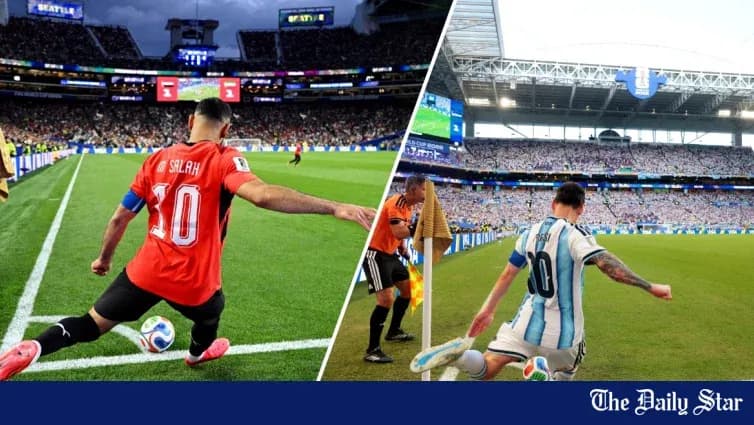
Two left-footed geniuses. Two exhausted teams. One ticket to the World Cup quarterfinals.
On Tuesday night in Atlanta, Lionel Messi and Mohamed Salah step into the spotlight at Mercedes-Benz Stadium, dragging tired legs and heavy expectations into a last-16 tie that feels as much about endurance as it does about brilliance.
Argentina’s veneer cracks
Argentina arrive as defending champions, but the shine dulled on Friday. What had looked like a smooth, almost serene campaign jolted into anxiety against World Cup debutants Cape Verde, who refused to play the role of grateful guests.
It took extra time and, ultimately, a cruel twist for the holders to survive. Diony Borges’ 111th-minute own goal finally settled a wild 3-2 contest, ending a night in which Cape Verde fired 16 shots at Argentina and rattled the confidence of a side that had previously cruised through the group stage.
For the first time this tournament, Lionel Scaloni’s team looked vulnerable. They struggled to control the tempo, struggled to press, struggled to look like the machine that has rolled through so many knockout nights.
Messi did not hide from that reality. He admitted he was tired and lamented Argentina’s failure to press high up the pitch. That admission cuts deep, because this Argentina lean on him more than ever. At 38, he has still supplied seven of their 11 goals – a staggering share for a squad of this quality, even if that tally includes an own goal in the team total.
The alarm bells are not just tactical. They are physical.
Facundo Medina limped off with severe cramp. Enzo Fernández also seized up. Nicolás González played on through an ankle issue after Argentina had burned all their substitutions. The next day’s recovery session painted an uneasy picture: Nahuel Molina, Fernández and Medina all unable to complete the work, with only Medina’s problem firmly dismissed as simple cramp.
Scaloni does have options. Nicolás Tagliafico stands ready at left-back if Medina is not risked. The bigger concern is González, whose ankle sprain threatens to strip Argentina of one of their key outlets just as the schedule tightens and the games grow nastier.
This is not the serene march of a champion. It is a grind.
Egypt smell opportunity
On the other side, Egypt arrive with their own bruises and their own belief.
The Pharaohs needed every second of 120 minutes against Australia, then the composure of a 4-2 penalty shootout win after a 1-1 draw, to reach the last 16 for the first time in 92 years. That statistic alone tells you the scale of the occasion for them.
They will have watched Cape Verde’s fearless performance with keen interest. The blueprint is clear: organisation, courage, and a refusal to be overawed by the shirt in front of you.
Egypt’s identity is well defined. Compact, disciplined, hard to break down. Then, when the ball is turned over, the release: Salah and Omar Marmoush sprinting into space, hunting the counter-attack.
The question is whether Salah’s body can match his mind. He entered the Australia match with a hamstring concern and, across another draining 120 minutes, there were moments when he seemed reluctant to hit full speed. For a player whose game is built on those decisive accelerations, that hesitation matters.
Yet even at less than full throttle, his presence bends games. Defenders drop deeper. Midfields shuffle across. One misstep, one mistimed challenge, and he punishes you. Against an Argentina side that just went to the brink against Cape Verde, that threat grows louder.
Masters of extra time
If this turns into another long night, history leans Argentina’s way.
No nation has turned extra time into an art form quite like them. Across all World Cups, they have won 10 of their 12 matches that went beyond 90 minutes, with four decided in extra time and six on penalties. They know how to suffer. They know how to wait for their moment. They know how to survive.
That experience could weigh heavily on an Egypt team stepping into uncharted territory at this stage of the competition. But momentum in tournaments has a strange logic. One upset, one moment of chaos, and the bracket can tilt.
The prize is clear enough. The winners will head to Kansas City on July 11 to face Switzerland or Colombia, a quarterfinal that suddenly looks wide open for whoever emerges from Atlanta with their legs – and their nerve – still intact.
So it comes down to this: Messi, carrying a nation and the strain of another long tournament, against Salah, chasing history with a hamstring that may or may not obey him.
Two left feet. One night. Which of them still has enough left?
Related News

Anthony Joshua Names Murat Gassiev as Next Opponent if He Defeats Tyson Fury

UFC 332: Start Time and Fight Highlights for Natalia Silva vs. Wang Cong
Court McGee Opens Up About Choosing UFC 332 as His Final MMA Fight
WBC Orders Lightweight Title Unification: William Zepeda vs Jadier Herrera
BCCI Pension List: Monthly Payments to Retired Indian Cricketers in 2025
Why Fury vs Joshua Is Set for Cardiff, and Dua Lipa’s Unexpected Role