
Mexico vs England: Tactical Analysis of a 3-2 World Cup Clash
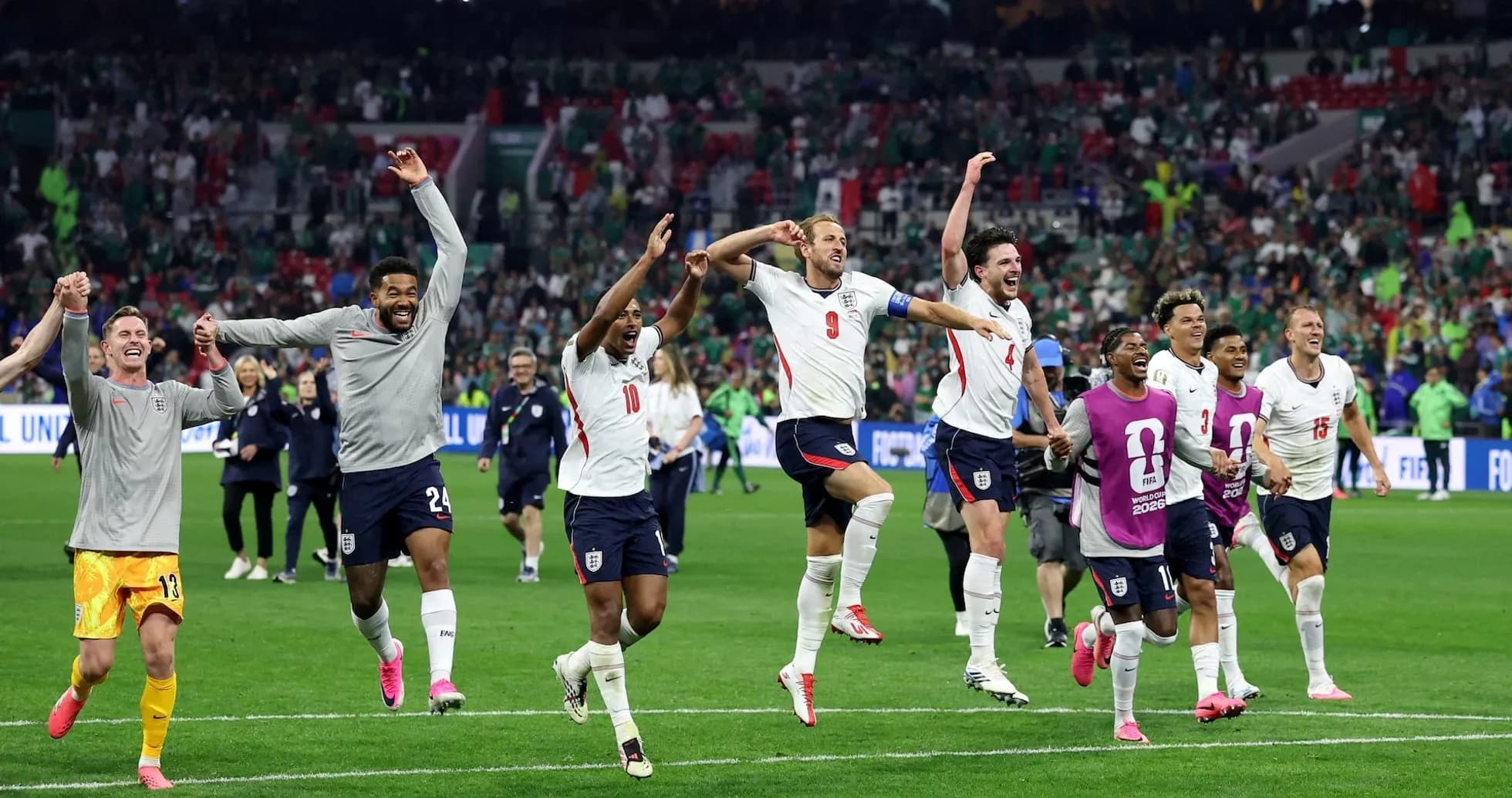
Mexico’s 3-2 defeat to England at Estadio Azteca in this World Cup Round of 16 tie was defined by a clash of clear, contrasting game plans: Mexico’s ball-dominant 4-3-3 against England’s compact, transition-focused 4-2-3-1. Despite controlling territory and rhythm, Mexico were repeatedly punished in defensive transition and set-piece moments, while England maximised efficiency before surviving a long siege with ten men.
Javier Aguirre’s Mexico built from a classic 4-3-3: Raúl Rangel in goal behind a back four of Jorge Sánchez, César Montes, Johan Vásquez and Jesús Gallardo. The midfield triangle of Gilberto Mora, Erik Lira and Luis Romo was tasked with controlling central spaces and feeding a mobile front three of Roberto Alvarado, Raúl Jiménez and Julián Quiñones. The structure delivered control – 67% possession, 455 passes with 92% accuracy – and a steady flow of chances (20 total shots, 12 inside the box), but left them exposed to England’s direct threats whenever their rest defence was imbalanced.
Thomas Tuchel’s England lined up in a 4-2-3-1 with Jordan Pickford in goal, a back four of Jarell Quansah, Ezri Konsa, Marc Guéhi and Nico O’Reilly, Declan Rice and Elliot Anderson as the double pivot, and an aggressive band of three – Bukayo Saka, Jude Bellingham, Anthony Gordon – behind Harry Kane. England were comfortable ceding the ball (33% possession, 244 passes at 80% accuracy) and funnelling Mexico into wide areas, trusting their central compactness and then breaking at speed through Bellingham and the wide attackers.
The first half showed the extremes of that trade-off. Mexico’s structure gave them volume rather than clarity: 12 shots before the break but often from crowded zones, reflected in a modest xG of 1.87 overall despite 20 attempts. Their 7 blocked shots underline how frequently England’s back four and double pivot were in position to get bodies in front. England, by contrast, were ruthlessly vertical. With Rice anchoring and screening, Bellingham operated between Mexico’s midfield and defence, exploiting the space when Mora and Lira were dragged wide or high. The two quick goals at 36' and 38' from Bellingham were the tactical consequence of that: England drawing Mexico forward, then attacking the half-spaces with direct combinations, using Kane as a reference point and Saka’s wide positioning to stretch the back line.
Quiñones’ goal at 42' came from Mexico’s insistence on keeping width and numbers in the final third. With the front three pinning England’s back four, the advanced eights (particularly Romo) stepped higher to overload the edge of the box. When England’s first defensive line was finally pierced, Mexico’s forwards could attack the box against a retreating line. That 2-1 score at half-time matched the pattern: Mexico on the ball, England more dangerous per possession.
The second half was reshaped by personnel and discipline. Aguirre’s early change at 46' – Edson Álvarez (IN) came on for César Montes (OUT) – signalled a shift toward more control and physicality in midfield, with Álvarez stepping into the pivot and Lira able to push slightly higher in certain phases. However, England’s red card for Jarell Quansah at 54' (Serious foul) forced Tuchel into a structural recalibration: Bukayo Saka (OUT) sacrificed for John Stones (IN) at 57', moving England towards a deeper, more conservative block with added central protection.
Remarkably, England still found a way to extend their lead to 3-1 via Kane’s penalty at 60'. Tactically, this underlined their continued ability to create high-value moments from limited possession – their xG of 1.55 from only 6 shots (5 on target) shows how clean their chances were, often arriving from quick, direct attacks or set plays rather than low-percentage efforts.
Mexico’s response was to double down on attacking profiles. At 61', Santiago Giménez (IN) replaced Gilberto Mora (OUT), and Brian Gutiérrez (IN) came on for Luis Romo (OUT), tilting the 4-3-3 into something closer to a 4-2-4 in possession, with two forwards and aggressive wide players. Later, Jorge Sánchez (OUT) made way for Álvaro Fidalgo (IN) at 79', and goal-scorer Quiñones (OUT) for Guillermo Martínez (IN) at 81', adding another penalty-box presence and a more technical right-sided option. The cumulative effect was a siege: Mexico finished with 12 shots inside the box and 12 corners, repeatedly pinning England deep and attacking second balls.
Jiménez’s penalty at 69' to make it 3-2 rewarded this territorial dominance and the constant occupation of England’s box. From that point, the game became a sustained attack-versus-defence exercise. England’s shape compressed into a narrow, low block, with O’Reilly and Guéhi crucial in defending crosses and Rice shielding the central lane. Substitutions like Djed Spence (IN) for O’Reilly (OUT) at 74' and Dan Burn (IN) for Elliot Anderson (OUT) at 75' further emphasised defensive height and aerial presence, reinforcing the flanks and half-spaces against Mexico’s waves of crosses and cutbacks. Harry Kane (OUT) for Morgan Rogers (IN) at 90' was a final nod towards legs and pressing over a pure reference striker.
In goal, Raúl Rangel (Mexico) made 2 saves, a low figure given England’s 5 shots on target, reflecting the clinical nature of the chances conceded: when England broke through, they tended to create clear, often decisive opportunities. Jordan Pickford (England) made 3 saves against Mexico’s 5 shots on target. That number, combined with England’s 7 fouls and heavy card count (4 yellows, 1 red), illustrates a second-half defensive stand built on both aggression and last-line interventions rather than pure control.
Statistically, Mexico’s dominance with the ball did not translate into a decisive expected-goals edge: 1.87 xG to England’s 1.55. The -0.15 goals prevented figure for both sides suggests that neither goalkeeper significantly outperformed shot quality; instead, the story lies in England’s shot selection and Mexico’s shot profile. England needed only 6 attempts to score 3 times, with no blocked shots, indicating that their attacks bypassed Mexico’s defensive structure entirely when they did break. Mexico, by contrast, were often shooting through traffic – 7 blocked efforts – and relying on volume to eventually break England down.
Discipline played a clear tactical role. England’s early yellow for Declan Rice at 1' (Roughing) and later cautions for Marc Guéhi (Unsportsmanlike conduct, 68'), Nico O’Reilly (Unsportsmanlike conduct, 72') and Jordan Henderson at 90+8' constrained their aggression in midfield, but the back line and Rice managed their risk well enough to avoid a second dismissal. Mexico’s two yellows – Jorge Sánchez (Unsportsmanlike conduct, 71') and Johan Vásquez (Unsportsmanlike conduct, 90+8') – came as they chased the game, reflecting frustration rather than structural instability.
Ultimately, this Round of 16 tie was a textbook example of possession without penetration versus efficiency and transition mastery. Mexico’s 4-3-3 produced territorial control, high passing accuracy and a relentless final-third presence, but England’s 4-2-3-1, anchored by Rice and illuminated by Bellingham and Kane, turned fewer, cleaner attacks into a decisive 3-2 win, then survived with a disciplined, reshaped block once reduced to ten men.
Related News
Brazil's First Post-World Cup Friendly: What Should the Lineup Be?
Estevao Opens Up on World Cup Heartbreak and His Unexpected Return to Brazil Under Ancelotti
Thomas Tuchel Shares Unusual Regret After England's 10-Man World Cup Victory Over Mexico

South Korea Names Robert Moreno as Interim Coach After World Cup Exit

Jude Bellingham Returns to Form at Real Madrid Following World Cup Success

Chloe Kelly, Beth Mead and 13 Lionesses Target Big WSL Seasons Ahead of England's 2027 World Cup Campaign