
Mexico Dominates South Africa 2-0: Tactical Breakdown of a 4-1-4-1 Victory
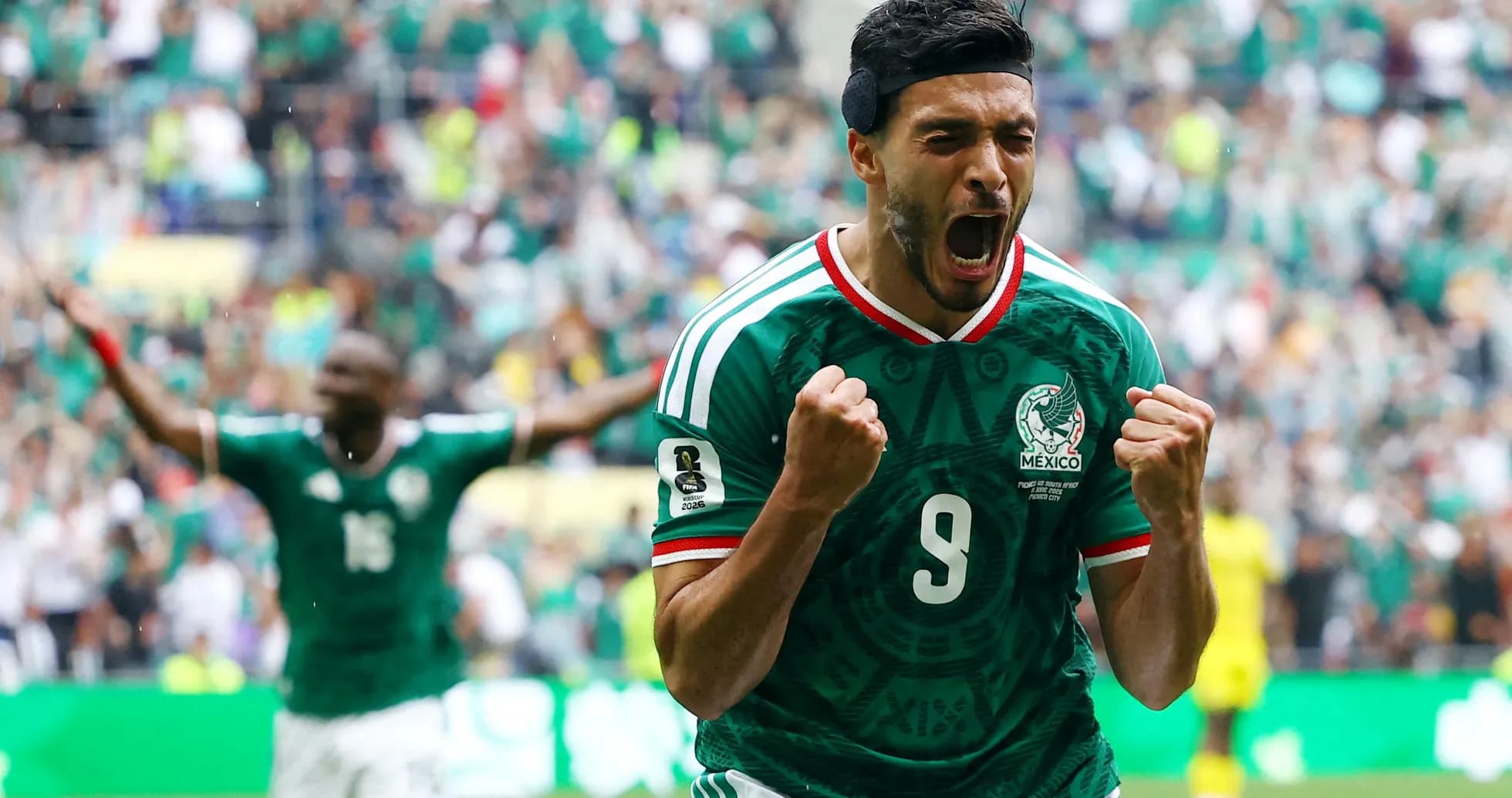
Mexico’s 2-0 win over South Africa at Estadio Azteca was a tactical demonstration of control and structure, built on a clear contrast of game plans: Mexico’s ball-dominant 4-1-4-1 against South Africa’s deep 5-3-2 that gradually collapsed under numerical and territorial pressure.
Javier Aguirre’s 4-1-4-1 was designed to monopolize possession and fix South Africa’s back five in their own third. Erik Lira operated as the single pivot, anchoring in front of the centre-backs and enabling both full-backs, Israel Reyes and Jesús Gallardo, to push high and wide. With 61% possession and 520 passes (467 accurate, 90%), Mexico circulated the ball with patience, using the midfield line of Roberto Alvarado, Brian Gutiérrez, Álvaro Fidalgo and Julián Quiñones to constantly occupy interior pockets between South Africa’s midfield and defence.
The first goal on 9 minutes encapsulated this structure. Mexico had already established a stable rest defence with Lira screening transitions and the centre-backs holding a high line. Lira’s assist to Quiñones came from that pivot zone: he received centrally, facing forward, with South Africa’s midfield three pinned by Mexico’s advanced interiors. Quiñones attacked the space between wing-back and outside centre-back, a recurring theme, and finished a “Normal Goal” once the passing lane was opened. The move was not a counter; it was the product of sustained positional play and a well-organised occupation of the half-spaces.
Defensively, Mexico’s pressing was measured rather than frantic. The 4-1-4-1 often morphed into a 4-1-4-1 mid-block, with Raúl Jiménez curving his runs to screen passes into Teboho Mokoena, while Gutiérrez and Fidalgo stepped onto South Africa’s other midfielders. South Africa were restricted to just 3 total shots (2 on goal), reflecting how rarely they could break the first Mexican line and connect through the thirds. When South Africa did find Lyle Foster or Iqraam Rayners, Mexico’s centre-backs, César Montes and Johan Vásquez, defended aggressively in front, trusting Lira’s cover.
Second Half
The second half was decisively shaped by discipline. Siphephelo Sithole’s red card for “Professional foul last man” on 49 minutes forced Hugo Broos’s 5-3-2 even deeper. Reduced to ten, South Africa had to compress their block around the box, ceding even more territory and allowing Mexico to increase their shot volume (16 total, 9 inside the box). The structural superiority Mexico already enjoyed now came with a permanent numerical advantage in midfield.
Aguirre’s in-game management was geared toward refreshing the pressing and maintaining technical superiority. On 66 minutes, Gilberto Mora (IN) came on for Álvaro Fidalgo (OUT), injecting fresh legs in the central lane, while Luis Chávez (IN) replaced Brian Gutiérrez (OUT), adding a left-footed distributor capable of switching play quickly against a tiring block. The impact was immediate: one minute later, at 67', Jiménez doubled the lead from a “Normal Goal” assisted by Alvarado. The pattern again emerged from Mexico’s width and patience—Alvarado, operating from the right half-space, exploited the stretched South African back line to slide a decisive pass into Jiménez, whose movement between centre-backs had been a constant problem.
From there, Mexico shifted into game-management mode without abandoning their structure. On 76 minutes, Armando González (IN) came on for Jiménez (OUT), and Edson Álvarez (IN) replaced Lira (OUT), slightly rebalancing the side toward greater defensive security in the pivot while keeping the front line active. Quiñones (OUT) later made way for Alexis Vega (IN) at 79', ensuring the wide threat remained, even as the tempo dropped.
South Africa’s substitutions were reactive and largely damage-limiting. At 56', Thalente Mbatha (IN) came on for Foster (OUT), suggesting a desire to stabilise midfield and protect the central corridor after going down to ten. On 61', Themba Zwane (IN) replaced Jayden Adams (OUT), offering more ball security and dribbling in transition. However, the red card to Sithole had already tilted the pitch. Later, on 77', Oswin Appollis (IN) for Aubrey Modiba (OUT) and Evidence Makgopa (IN) for Iqraam Rayners (OUT) were attempts to refresh the wide and forward lines, but by then South Africa were pinned too deep to consistently reach those players.
The late disciplinary collapse further undermined any chance of a comeback. After a VAR “Card upgrade” review at 82', Zwane was sent off at 84' for “Violent conduct”, leaving South Africa with nine players. Mexico also finished with ten after Montes received a red card at 90+2' for “Professional foul last man”, but the game state by then was fully under Mexican control, with South Africa unable to exploit the numerical adjustment.
In goal, Raúl Rangel (Mexico) had a relatively controlled evening, facing only 2 shots on goal and making 2 saves. His involvement was more about maintaining Mexico’s high line, offering a secure outlet for recycling possession, and helping his side hold a compact shape behind the advanced full-backs. At the other end, Ronwen Williams (South Africa) also recorded 2 saves, but he was under far more structural stress: Mexico’s 4 shots on goal and 9 efforts inside the box came on the back of relentless circulation and positional overloads, forcing him to constantly organise a back five that was being stretched horizontally and vertically.
Statistically, Mexico’s 1.41 xG aligns with a performance of territorial dominance and steady chance creation rather than a flurry of high-quality opportunities. South Africa’s 0.07 xG underlines how effectively Mexico’s rest defence and counter-press shut down transitions and prevented deep progressions. The passing figures reinforce the tactical story: Mexico’s 520 passes, 467 accurate (90%), reflect a controlled, possession-first approach, while South Africa’s 335 passes, 272 accurate (81%), show a side mostly confined to low-risk circulation in their own half.
In sum, this was a match where structure dictated outcome. Mexico’s 4-1-4-1, anchored by Lira and then Álvarez, systematically dismantled South Africa’s 5-3-2, and once the first red card arrived, the tactical imbalance became insurmountable.
Related News
Dean Huijsen Reflects on World Cup Snub After Spain’s 4-1 Win Over Croatia

Ivan Rakitic Reveals He Still Avoids Watching Croatia’s 2018 World Cup Final Loss to France
Francesco Totti Claims Italy's 2006 World Cup Win Owed to Him
Brazil's First Post-World Cup Friendly: What Should the Lineup Be?
Harry Kane Calls England’s World Cup Exit to Argentina His Deepest International Pain
Estevao Opens Up on World Cup Heartbreak and His Unexpected Return to Brazil Under Ancelotti