
Mexico Secures Statement Win Against South Africa in World Cup Opener
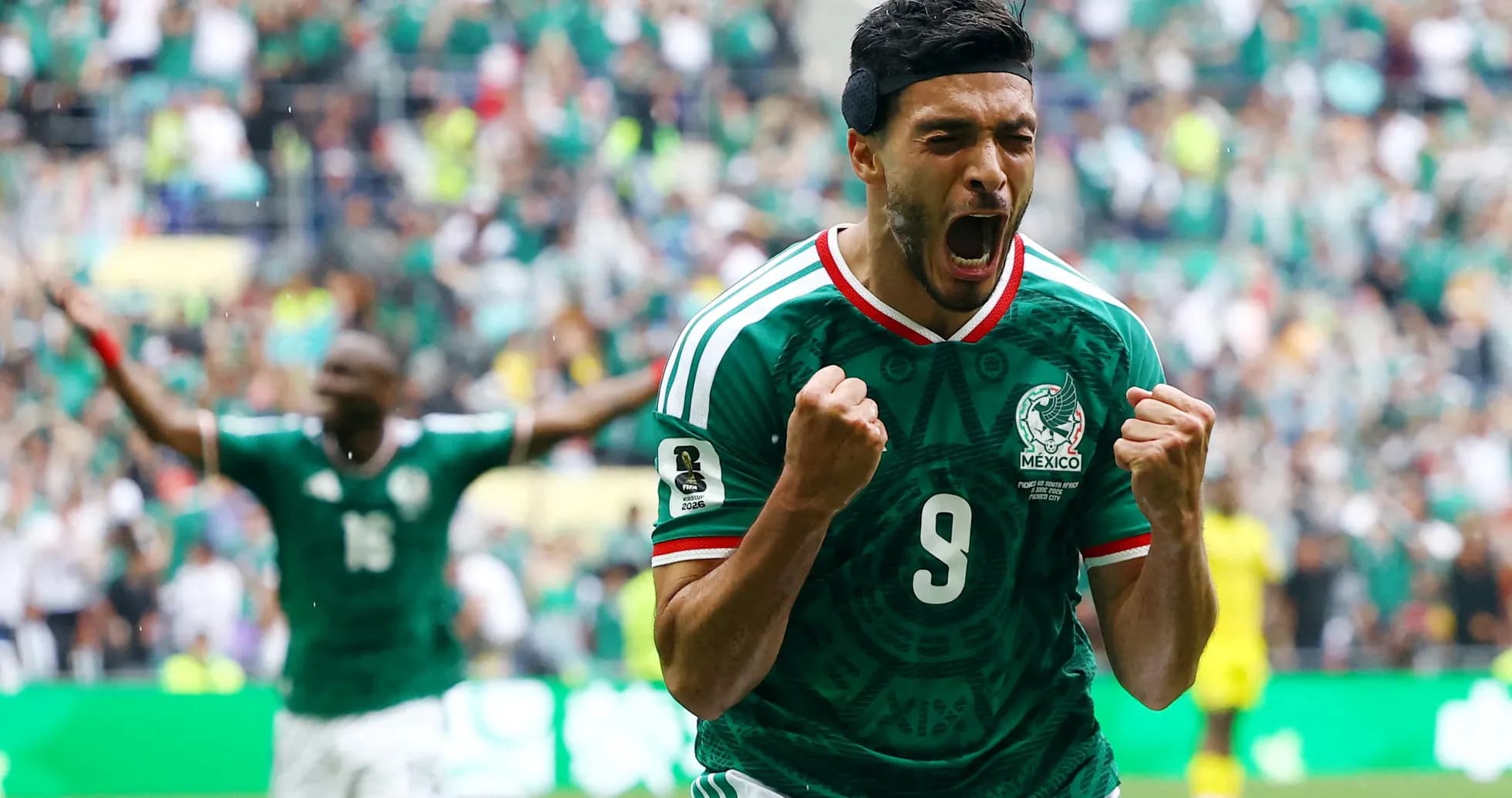
Under the lights of Estadio Azteca, Mexico opened their World Cup on home soil with the kind of controlled, emotionally charged performance that can define a campaign. In a Group Stage opener that felt bigger than “Matchday 1”, Javier Aguirre’s side beat South Africa 2-0, a result that immediately placed Mexico top of Group A with 3 points, a goal difference of 2 and, perhaps more importantly, a clear tactical identity.
I. The Big Picture – Structure, control, and a statement win
Following this result, Mexico’s numbers tell a simple story: one match played in total this campaign, one win, two goals for and none against. At home in this tournament they have played 1, won 1, scored 2.0 goals on average and conceded 0.0. It is a small sample, but the way they arrived at those figures felt anything but accidental.
Aguirre’s 4-1-4-1 was bold for a tournament opener. R. Rangel in goal sat behind a back four of I. Reyes, C. Montes, J. Vasquez and J. Gallardo. In front of them, É. Lira anchored as the single pivot, with a line of four creators and runners – R. Alvarado, B. Gutiérrez, A. Fidalgo and J. Quiñones – feeding lone striker R. Jiménez.
Opposite them, Hugo Broos set South Africa up in a 5-3-2 that signalled respect and caution. R. Williams was shielded by a back five of K. Mudau, N. Sibisi, I. Okon, M. Mbokazi and A. Modiba, with a midfield trio of T. Mokoena, Y. Sithole and J. Adams tasked with compressing central spaces. Up front, I. Rayners and L. Foster were meant to threaten in transition, but they rarely escaped the Mexican press.
By half-time Mexico led 1-0; by full-time 2-0 felt a fair reflection of their territorial dominance and superior structure.
II. Tactical Voids – Discipline, risk and the shadow of red
If there is a dark undertone to Mexico’s perfect start, it lies in discipline. Heading into this game, their season card profile already hinted at volatility: 100.00% of their yellow cards arriving between 16-30 minutes, and a red card recorded in the 91-105 window. South Africa’s pattern was even more alarming – yellow cards split 50.00% between 16-30 and 61-75, with red cards coming in the 46-60 and 76-90 ranges.
Those numbers materialised on the pitch. B. Gutiérrez, who otherwise offered 23 passes at 86% accuracy and three key passes, took a yellow that underlined the risk in Mexico’s aggressive counter-press. On the South African side, N. Sibisi and T. Mokoena both went into the book, while T. Zwane and S. Sithole – introduced to tilt the game – ended up as symbols of implosion, each receiving a straight red. South Africa finished not just beaten, but emotionally frayed.
There were no notable absentees listed for either side; this was close to full-strength against full-strength. That makes the disciplinary picture even more telling: both squads, as constructed, carry an edge that can tip either towards heroic intensity or self-destruction.
III. Key Matchups – Hunter vs Shield, and the battle for the engine room
The “Hunter vs Shield” duel was embodied by R. Jiménez against the South African back line. Jiménez’s total of 1 goal from 3 shots (2 on target), combined with 19 passes and 2 key passes, confirmed his role as more than just a finisher. He pinned centre-backs, dropped between lines and allowed J. Quiñones to attack the half-spaces. N. Sibisi, South Africa’s central reference at the back, completed 50 passes at 82% accuracy and made 1 interception, but he was constantly forced to retreat rather than step out, his yellow card a by-product of being half a step late to Mexico’s rotating front.
Behind Jiménez, J. Quiñones was the game’s chaos agent and its most polished technician. With 1 goal, 4 shots (2 on target), 33 passes at 84% and 6 dribbles attempted with 5 successful, he repeatedly shredded South Africa’s defensive block. His duel numbers – 10 contested, 7 won – show how often he received under pressure and still emerged with the ball. Every time South Africa’s wing-back on his side hesitated between tracking him inside or holding the line, Mexico found a seam.
On the other flank, R. Alvarado was the workhorse and metronome. Ninety minutes, 35 passes at 91%, 2 key passes, 2 successful dribbles from 2 attempts and 4 tackles in total: his two-way output explains why Mexico could commit numbers forward without being shredded in transition. He and J. Gallardo formed a left-sided chain that suffocated K. Mudau’s attempts to advance.
In the engine room, É. Lira quietly dictated the tempo. Across 76 minutes he completed 45 passes at 93% accuracy, added 1 key pass and the assist that put him on the assists leaderboard, and won all 4 of his duels in the top scorers dataset and 5 of 5 in the assists dataset. His ability to receive under pressure, turn and immediately connect to the advanced midfield four meant South Africa’s trio – Mokoena, Sithole, Adams – were constantly chasing shadows rather than setting traps.
South Africa’s response in the “Engine Room” was mixed. T. Mokoena’s 42 passes at 92% and 2 interceptions showed intelligence and positioning, but with Y. Sithole losing 7 of 8 duels despite blocking 2 shots and making 1 interception, the midfield lacked the bite to disrupt Mexico’s rhythm without fouling. As fatigue and frustration grew, that lack of control morphed into rash challenges and, eventually, red cards.
IV. Statistical Prognosis – Mexico’s platform, South Africa’s crossroads
Following this result, the standings snapshot is stark. Mexico sit 1st in Group A with 3 points, 2 goals scored and 0 conceded in total. South Africa are 4th, with 0 points, 0 goals scored and 2 conceded in total, their goal difference of -2 a mirror image of Mexico’s +2 (Mexico’s GF 2 minus GA 0; South Africa’s GF 0 minus GA 2).
Even without explicit xG data, the patterns are clear. Mexico’s 2.0 total goals per game at home in this tournament, combined with a clean sheet and a defensive line that allowed no goals against in total, suggest an underlying expected goals profile tilted heavily in their favour. The volume and quality of contributions from their attacking unit – Jiménez, Quiñones, Alvarado, plus creative surges from Fidalgo and Gutiérrez – point to a side that will regularly generate high-value chances.
Defensively, their structure around Lira, Montes and Vasquez, with full-backs stepping in and wingers tracking back, looks robust enough to keep their goals against average at 0.0 sustainable against most group opponents. The one caveat is discipline: with a history of late red cards in the competition data, the fine line between intensity and overreach must be managed.
For South Africa, the prognosis is more fragile. On their travels so far in this World Cup they have played 1, lost 1, scored 0.0 goals on average and conceded 2.0. The lack of total goals for, combined with a total failed-to-score count of 1 and no clean sheets, hints at a team whose xG for is modest while their xG against is rising under pressure. The back five can absorb phases of play, but without a reliable out-ball or a midfield that can hold under the press, the defensive block is asked to survive too many waves.
The disciplinary profile deepens the concern. Two red cards already in their total card data – one between 46-60 minutes, another between 76-90 – mean that in tight matches the probability of finishing with ten men is non-trivial. That undermines any tactical plan built on compactness and counter-attacks.
In narrative terms, Mexico leave this opener not just with points, but with a blueprint: a 4-1-4-1 that maximises Jiménez’s link play, Quiñones’ dynamism and Lira’s composure. South Africa, by contrast, depart Estadio Azteca at a crossroads. They must decide whether to double down on the 5-3-2 and trust it to stabilise, or to release more attacking talent like E. Makgopa and O. Appollis earlier, accepting the risk of open games.
What is beyond doubt is that this night in Mexico City felt like more than a routine group win. It looked and sounded like a host nation discovering that its squad has both the technical range and the tactical maturity to carry the weight of a World Cup on home ground.
Related News
Dean Huijsen Reflects on World Cup Snub After Spain’s 4-1 Win Over Croatia

Ivan Rakitic Reveals He Still Avoids Watching Croatia’s 2018 World Cup Final Loss to France
Francesco Totti Claims Italy's 2006 World Cup Win Owed to Him
Brazil's First Post-World Cup Friendly: What Should the Lineup Be?
Harry Kane Calls England’s World Cup Exit to Argentina His Deepest International Pain
Estevao Opens Up on World Cup Heartbreak and His Unexpected Return to Brazil Under Ancelotti