
Michael Olise: From Hayes Estate to World Cup Stardom
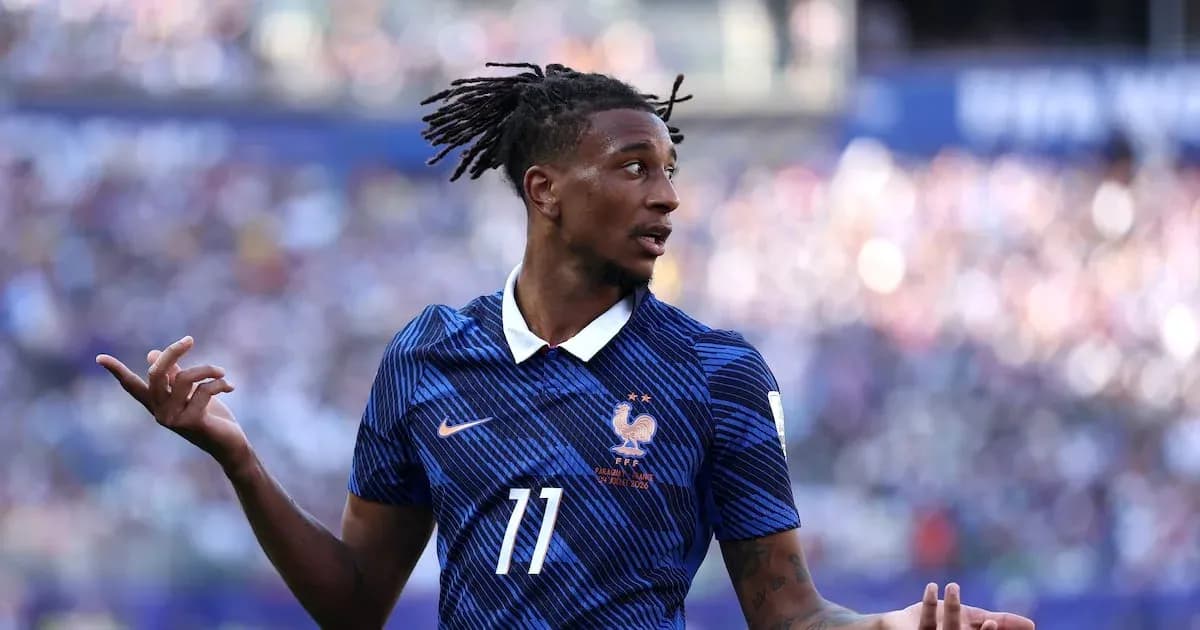
If Michael Olise lifts the World Cup, a thin strip of grass on a Hayes housing estate will belong to France as much as to England. It is his corner. A worn patch of parkland framed by west London semis, where a seven-year-old boy and his brother, Richard, chased a ball until the light went.
“Football in these conditions, it’s just freedom,” Olise told L’Équipe last month. “It’s not really learning in the strict sense. It was simply the pleasure of playing football. I just loved it.”
Those kickabouts are the roots of the game’s most elusive new star.
A childhood built on concrete and obsession
Sean Conlon remembers the scene vividly. One of Olise’s first coaches at Old Isleworthians, he would turn up at the family home and find the same picture every time.
“I would go over to his house and he would be practising outside with Richard,” Conlon recalls. “That little estate probably really aided him; there weren’t a lot of cars but it had a lot of concrete open space and then a small green. He’d just be practising out here all the time, obsessed with football.”
The setting was modest, the talent anything but. Conlon first saw him at six, playing for Hayes.
“What stood out was his physical movement,” he says. “He glides around the pitch: very graceful, perfect co-ordination, everything effortless. The way he moves today was how he moved when he was six. That’s something he’s been born with. People say he’s the best player England has ever developed.”
England developed him. England never picked him.
Rejected by giants, rescued by Reading
Chelsea spotted him early. Conlon had coached there and as soon as Olise turned nine, the club drew him into their academy. The talent held. Manchester City took him next, in the same year group as Cole Palmer and one behind Phil Foden.
Then, at 16, City let him go. Chelsea had already done the same.
The wonderkid of Hayes was suddenly just another released teenager, back with Conlon at his We Make Footballers academy and scrambling for a professional lifeline. That lifeline came from Reading, thanks to academy scout Brendan Flanagan and a recommendation from a contact who insisted they take a look.
“There was a lot of scepticism from various members of staff at Reading that he would be a bad egg,” Flanagan says. “[They said]: ‘He’s been released by Chelsea, by Man City. We shouldn’t be bringing him in. He’ll be a problem.’ I said: ‘Look, let’s just get the kid in and make our decision.’”
Conlon heard the same doubts.
“All the other scouts were: ‘He’s just come out of Manchester City, he’s just come out of Chelsea, why have they not kept him on?’” he says. “They were half and half. They could see him and say: ‘Why are we not taking this talent?’ But Reading were the ones that committed.”
The first impression at Reading was not of an attitude problem, but of a polite teenager trying to find the right bus.
Olise had to commute from London, with the club running a shuttle from the station to the training ground. “On his first day I got a call from him at the station and he was asking: ‘Where do I need to pick the bus up please?’” Flanagan says. “I directed him to the shuttle bus but everything was ‘please’ and ‘thank you’ and I thought to myself: ‘This ain’t a bad kid. He’s just a kid who’s a bit misunderstood, different.’
“And we never had a problem with him. He wasn’t ever a bad lad. He was always an intelligent, quiet lad who just expressed himself a bit differently. What wasn’t right for them [City and Chelsea] ... well, we’re just little old Reading. We can work with these kids.”
Reading did more than work with him. They handed him a platform.
The Sparta Prague moment
Olise flew through the age groups, into Reading’s under‑21s. It was there, against Sparta Prague in the European Under‑21 Cup, that Flanagan saw the penny drop for everyone else.
“We were playing Sparta Prague in the European Under-21 Cup,” Flanagan says. “I got there at half‑time. Michael was about 17 and on the bench. I sat in front of [the former Crystal Palace and West Ham player] Hayden Mullins, who used to work for us and who I got on well with.
“Michael came on with 17 minutes to go. Within five minutes Hayden leaned over to me and said: ‘Who the fuck is that?!’ I just started laughing. And Hayden said: ‘Come on then, tell me, where did you find this one?’ So I explained the story ...”
From there, everything accelerated. “He was absolutely unbelievable that day,” Flanagan says. “Hayden and I shook hands at the end and said: ‘This kid will play for the first team by the end of the season.’”
A few weeks later, José Gomes, then Reading’s manager, pulled Olise into first‑team training to make up the numbers. The impact was immediate. That Saturday he was on the bench. The debut followed soon after.
“The manager obviously saw him and thought: ‘This kid is unbelievable,’” Flanagan says.
The boy from the Hayes estate had survived rejection by two of England’s superclubs and broken into senior football via “little old Reading”. The next twist would be international.
Four countries, one choice
Olise’s story is not just about who developed him, but who claimed him.
He was born in England. He grew up in London. His football education came through English clubs and English coaches. His roots stretch further.
His mother, Mina, is French Algerian. His father, Vincent, is British Nigerian. “I actually come from four countries,” he told Bayern Munich’s website last season. “France, Algeria, Nigeria and Great Britain. I consider myself very lucky to possess these four parts, which all enrich me.
“I’ve developed attachments in all my countries. When I was growing up in London, we regularly visited Algeria, Nigeria and France. My dad always spoke English with me at home, my mum, French.”
England never called him as a teenager. Not once.
“We weren’t as attractive a club,” Flanagan says of Reading. “It’s slightly changed now, but back then, for England, generally, you had to come from Chelsea, Manchester City, Manchester United and Arsenal.”
France did call. They had been tipped off about his French connection and moved first, bringing him into their under‑18s. By the time England tried to intervene, it was too late.
“France reached out to us and we spoke to Michael,” Flanagan says. “They were the first one who selected him [for the under-18s] and, even though England came in for him for the under-20s, he was happy where he was.”
The decision looks seismic now. At this World Cup, the most creative player in the tournament was born in England, schooled in England, but dressed in blue. Olise has more assists than anyone else – five – and is being talked about as a Ballon d’Or contender.
Premier League academies have educated the world. The Football Association can only watch as one of the sharpest products of that system pulls strings for France.
A trajectory that refuses to level out
Flanagan is honest enough to admit he never saw this exact ceiling.
“Could I see he would reach the levels that he’s reached?” he says. “I don’t think anyone could. Some kids do look like they might be a Ballon d’Or contender at 16 and then kind of level out. But Michael was on a trajectory that went up and up and up, and he still hasn’t levelled off. He just seems to be getting better and better.
“He’s always had a picture in his head, saw things quicker than anyone else and had the ability to find a way to make the pass. But he’s just gone to another level.”
Conlon feels the same sense of disbelief, tinged with vindication.
“It’s crazy,” he says. “With the under-8s, we say to the kids: ‘One day you’re going to win the World Cup. One day you’re going to win the Champions League.’ This is why you have to have these standards. You preach it and now we’ve actually had someone go and do it.”
From a Hayes estate to the World Cup, the line now feels straight. It never was. It bent through rejection, doubt, long train journeys and a shuttle bus from Reading station.
England v France – and the view from Hayes
The success has created a peculiar tension for those who backed him when others walked away. If England and France collide in a World Cup final with Olise at the heart of it, loyalties will split.
“What to do?” is no longer a hypothetical question for his mentors; it is a genuine dilemma.
“I’m going to be sat on the fence,” Flanagan says. “I want Michael to do well, but I want England to win as well. So I probably won’t watch the game and stay out of the way.”
Somewhere in Hayes, on that strip of grass between the concrete, kids will still be playing, dreaming. If Olise does end up with the trophy in his hands, they will know exactly what that little estate can produce – and exactly which flag the next prodigy might choose to follow.
Related News

Anthony Joshua Names Murat Gassiev as Next Opponent if He Defeats Tyson Fury
UFC 332: Start Time and Fight Highlights for Natalia Silva vs. Wang Cong
Court McGee Opens Up About Choosing UFC 332 as His Final MMA Fight
WBC Orders Lightweight Title Unification: William Zepeda vs Jadier Herrera
BCCI Pension List: Monthly Payments to Retired Indian Cricketers in 2025

Why Fury vs Joshua Is Set for Cardiff, and Dua Lipa’s Unexpected Role