
New York RB II Edges Toronto II in MLS Next Pro Clash
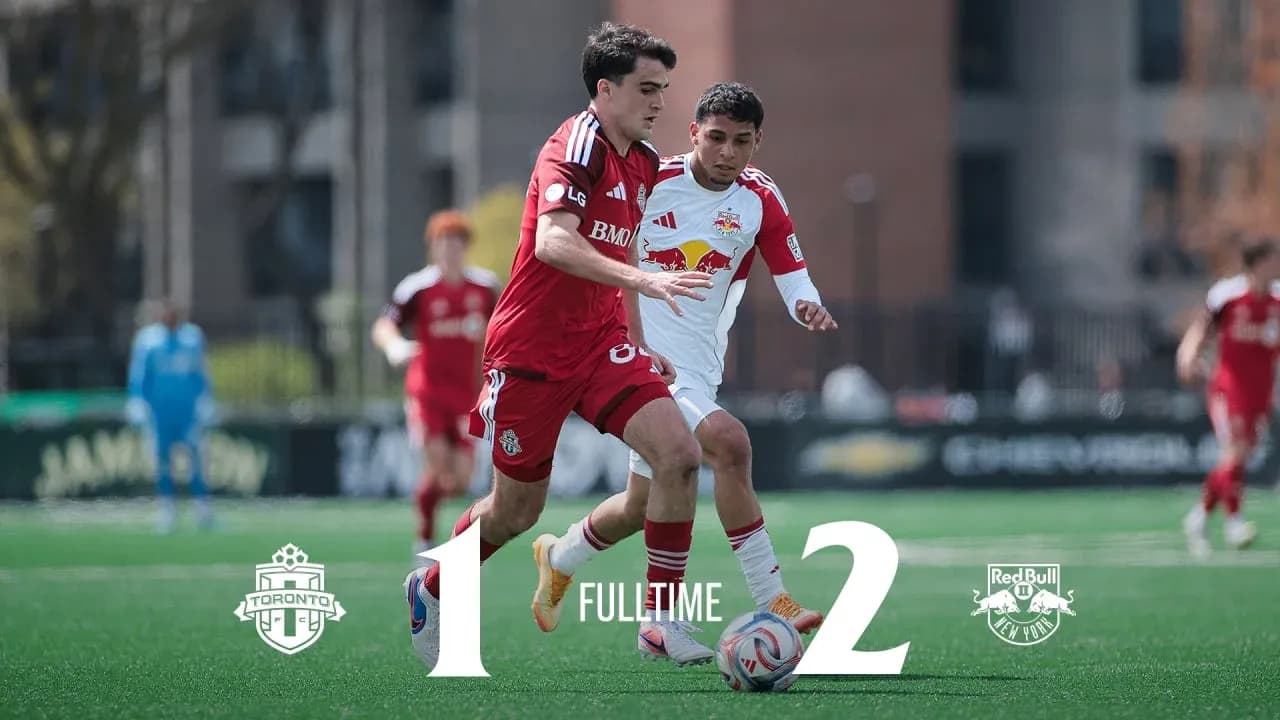
York Lions Stadium felt like a proving ground rather than a neutral backdrop as Toronto II and New York RB II walked out for this MLS Next Pro Group Stage clash. By the final whistle, the table-toppers from New York had edged a 2–1 away win, a result that neatly mirrored the broader seasonal narratives of both clubs.
Match Context
Heading into this game, the standings already drew a stark contrast. Toronto II sat 4th in the Northeast Division and 10th in the Eastern Conference with 11 points from 9 matches, their overall goal difference at -1 after scoring 14 and conceding 15. New York RB II arrived as the standard-setters: 1st in both the Northeast Division and Eastern Conference, on 23 points from 9 games, with a commanding overall goal difference of 13 built from 22 goals for and just 9 against.
Statistical Overview
The season’s statistical DNA set the tone. At home, Toronto II had been unpredictable but dangerous, with 7 goals scored and 7 conceded across 4 matches, an average of 1.8 goals both for and against. They were capable of chaos: their biggest home win was 2–1, their heaviest home defeat 3–4. New York RB II, on their travels, were more controlled and efficient. Away, they had 3 wins and 1 loss from 4, scoring 7 and conceding 4, averaging 1.8 goals for and 1.3 against. It was the classic clash of a volatile host against a ruthless visitor.
Team Lineups
Gianni Cimini’s Toronto II XI underlined that volatility. A. De Rosario led the line, supported by the likes of R. Campbell-Dennis, R. Fisher and J. Gilman, with L. Costabile and B. Boneau offering structural ballast. T. Fortier and S. Pinnock were tasked with knitting transitions, while A. Bossenberry and D. Dixon added directness and running. E. Khodri rounded out a youthful, energetic starting cast. The bench—Z. Nakhly, D. Barrow, J. Nugent, K. Kerr, E. Omoregbe, T. Blyth, S. Sappleton, L. Dawson and D. Eniang-Olatunji—promised attacking changes rather than conservative shut-down options.
New York RB II’s lineup carried the quiet authority of a league leader. T. Szewczyk, A. Modelo and J. Bazan formed part of a back line that has underpinned that excellent defensive record. A. Sanchez and J. Masanka Bungi added physical presence, while N. Worth and D. Cadigan hinted at the club’s trademark verticality. In advanced areas, A. Rojas, D. Gjengaar, M. Jimenez and D. Nelich gave the visitors multiple ways to threaten: between the lines, in behind, and from wide overloads. On the bench, C. Harper and Shunya Sakai—who features across the league’s top-scorer, top-assist and card charts—joined A. Causey, R. Mitchell, P. Sokoloff, S. Sakai, B. Rodriguez, S. Kone, C. Faello and B. Boulanger, a deep rotation befitting a side chasing promotion and play-off seeding.
Tactical Insights
Tactically, the voids were less about absences—no formal injury list was recorded—and more about structural weaknesses. Toronto II’s season-long numbers hinted at a defensive fragility that would again be exposed. Overall, they had conceded 17 goals in total this campaign, an average of 1.9 per match, and while they had managed 2 clean sheets, they had also failed to score in 3 games, all away. At home, they had yet to draw; every match was open-ended, decided by fine margins. Their yellow-card distribution revealed a tendency to get dragged into reactive defending late in halves: 30.77% of their bookings came between 31–45 minutes, with another 23.08% from 76–90 and 7.69% stretching into 91–105. This pattern suggested a young side that tires mentally as games approach half-time and full-time.
New York RB II’s disciplinary profile painted a different picture. Their aggression is concentrated in the closing stages: 40.00% of their yellow cards arrive between 76–90 minutes, with an additional 10.00% from 91–105. They also carry a flashpoint in the 61–75 window, where they have a 100.00% share of their red cards. This is a team that pushes the line late, pressing high and fouling tactically to protect leads or turn the screw. In a 2–1 away win, that late-game edge—both physical and psychological—likely played out in the duels around the final quarter-hour, where Toronto II’s composure historically dips.
Overall Assessment
The “Hunter vs Shield” dynamic leaned heavily New York’s way. On their travels, they averaged 1.8 goals for, while Toronto II at home were conceding 1.8. That symmetry was ominous for the hosts. In total this campaign, New York RB II’s attack has been one of the league’s sharpest, with 22 goals across 9 matches at an overall average of 2.4 per game. Their defense, conceding 11 overall at 1.2 per match, is compact without being passive. Toronto II, by contrast, scored 14 overall at 1.6 per match but leaked 17 at 1.9, often unable to control game states once the tempo rose.
In the “Engine Room”, Toronto II relied on the collective graft of Boneau, Fortier and Pinnock to handle New York’s surging midfielders and wide runners. Without a standout creator in the statistical record, their chance creation depended on quick combinations and the individual spark of De Rosario and Dixon. New York RB II, meanwhile, could rotate threats: Rojas between the lines, Gjengaar’s movement, Jimenez’s direct running, and the option of introducing someone like Shunya Sakai from the bench to add defensive stability or ball progression from deeper zones.
From a statistical prognosis, New York RB II’s superiority in Expected Goals terms would have been easy to anticipate even before a ball was kicked. A side averaging 2.4 goals overall, conceding only 1.2, and winning 7 of 9, arriving with five straight wins in their immediate form (“WWWWW”), is structurally built to generate more and better chances. Toronto II’s form line (“LLWWL” in the conference snapshot, “LLLWLWWLL” across the broader run) reflected streakiness rather than sustained control.
Following this result, the 2–1 scoreline felt less like an upset and more like a confirmation. Toronto II once again found a way to score at home, leaning into their attacking volatility, but once again could not keep the door shut against a top-tier offense. New York RB II, for their part, did exactly what their season profile promised: travel efficiently, create enough to win, and manage the dark arts of the game in the final 15 minutes, even at the cost of yellow cards, to see out another three-point performance.
Related News

MLS Winners and Losers: Cavan Sullivan’s USMNT Rise, St. Louis City SC’s Smart Moves, and Chicago Fire’s Hugo Cuypers Gap

MLS Winners and Losers: Portland Timbers' Historic Hat-Trick, Josh Sargent Shines, and Cavan Sullivan's Rising Star
Tacoma Defiance Injury List: Players Out and Return Dates vs Colorado Rapids II
Carolina Core injury list: Players out, potential return dates
Tacoma Defiance vs Colorado Rapids II Predicted Lineups and Team News
Orlando City II vs Huntsville City Predicted Lineups and Team News