
Real Madrid's Tactical Superiority Against Sevilla in 1-0 Victory
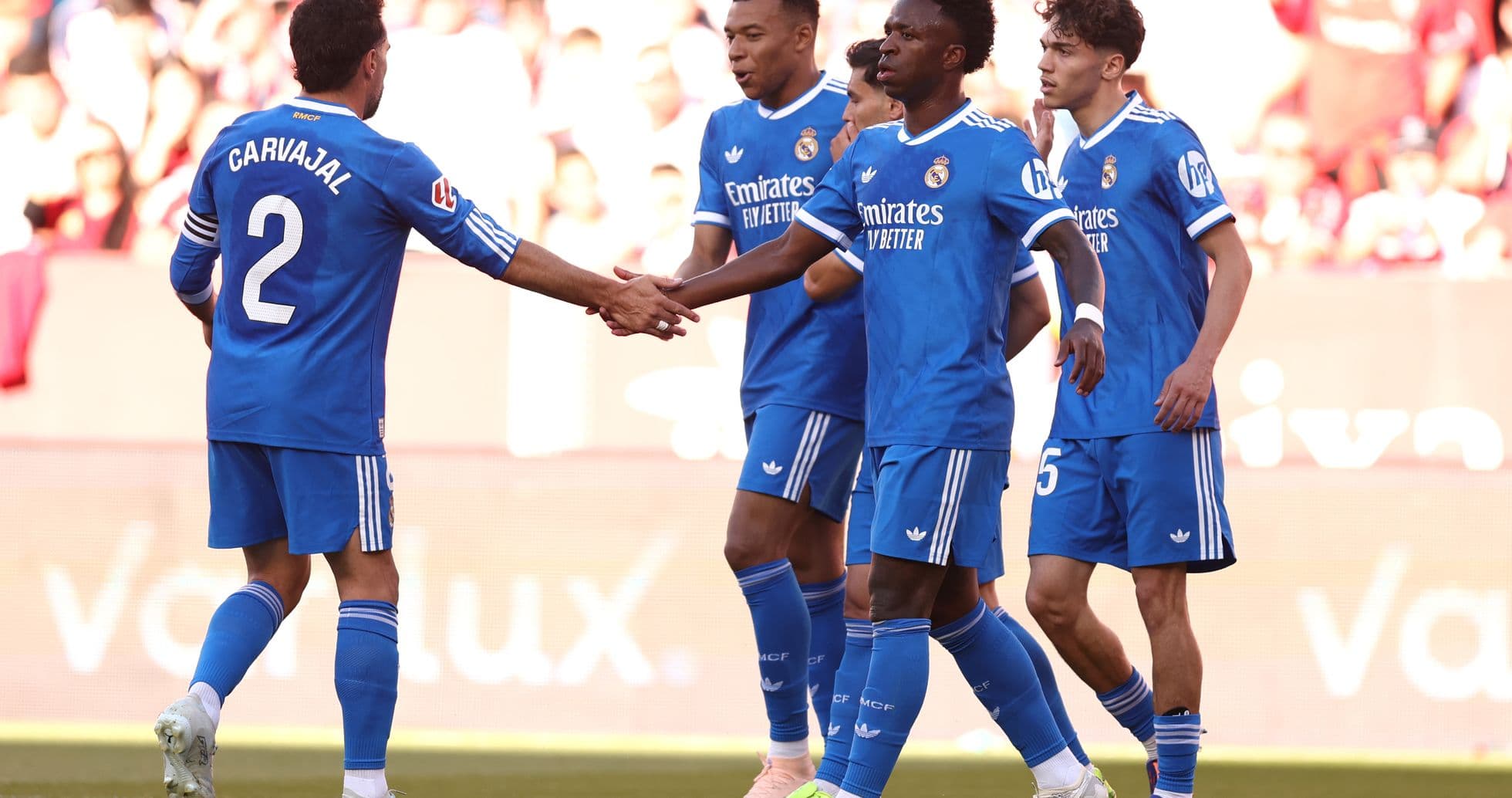
Sevilla’s 1-0 defeat to Real Madrid at Estadio Ramón Sánchez Pizjuán was defined by structural control from the visitors against a largely direct, high‑effort but imprecise home approach. In a match decided by Vinicius Junior’s 15th‑minute strike, Real Madrid’s 4-3-3 under Alvaro Arbeloa imposed territorial and possession superiority (59% to 41%), while Luis Garcia Plaza’s 4-4-2 for Sevilla generated volume of attempts (14 total shots to 12) but never the level of chance quality to overturn the early deficit, as reflected in the xG split of 0.73 versus 1.03.
Vinicius Junior’s goal came early and shaped everything. Operating from the left of the front three in Madrid’s 4-3-3, he exploited Sevilla’s aggressive but poorly staggered back line. With Sevilla defending in a flat 4-4-2, their first line of pressure from A. Adams and N. Maupay was easily bypassed by Madrid’s back four and A. Tchouameni dropping between the centre-backs. Once progression was established, Vinicius repeatedly found isolation against J. A. Carmona’s side and the right half-space around Castrin. The 15th‑minute breakthrough reflected that pattern: Madrid created a shooting lane inside the box, and Vinicius finished clinically for 0-1, the only goal of the match and the one that forced Sevilla to chase from an early stage.
Tactical Overview
From there, the tactical story became one of Madrid’s possession control versus Sevilla’s more vertical transitions. Real Madrid’s 528 total passes, with 463 accurate (88%), highlight how comfortably they circulated the ball through their midfield trio of T. Pitarch, Tchouameni and J. Bellingham. Tchouameni acted as the primary pivot, receiving from D. Carvajal and F. Garcia and switching play to stretch Sevilla’s wide midfielders R. Vargas and Oso. That circulation pinned Sevilla’s 4-4-2 into a deeper block, especially once Nemanja Gudelj collected a yellow card for an “Off the ball foul” on 48', which reduced his freedom to step out aggressively into Bellingham’s zone.
Sevilla, by contrast, leaned into a more direct, transitional style. Their 355 total passes with 285 accurate (80%) show a willingness to play forward quickly rather than sustain long phases. The 4-4-2 structure asked D. Sow and Gudelj to screen in front of the back four while Oso and Vargas tried to spring early runs to support Adams and Maupay. Sevilla actually out-shot Madrid on target, 6 to 1, but their xG of 0.73 underlines that these were mostly low‑probability efforts, often from wide or under pressure. Madrid’s back line, anchored by A. Rudiger and D. Huijsen, protected the central channel effectively, forcing Sevilla’s forwards to shoot from less threatening positions.
Substitutions
The substitutions from Luis Garcia Plaza were clearly aimed at injecting more dynamism and creativity into the final third. On 53', Alexis Sánchez (IN) came on for Neal Maupay (OUT), adding more mobility between the lines and a greater capacity to drop and combine. A minute later, on 54', C. Ejuke (IN) replaced R. Vargas (OUT), giving Sevilla a more one‑v‑one oriented threat on the flank, while L. Agoume (IN) came on for Nemanja Gudelj (OUT), freshening the double pivot and allowing Sevilla to press higher without risking a second card for Gudelj.
At 70', Juanlu Sánchez (IN) came on for J. A. Carmona (OUT), a move that sought both fresh legs at right-back and more overlapping thrust to pin Vinicius deeper. Finally, at 78', I. Romero (IN) replaced Oso (OUT), shifting Sevilla’s attacking profile towards more penalty-box presence and a more aggressive front line. These changes collectively tilted Sevilla further towards a 4-2-4 in possession phases, with full-backs G. Suazo and Juanlu Sánchez pushing high. The result was an increase in total shots and territorial pressure, but Madrid’s compact 4-5-1 defensive shape without the ball, with wide forwards tracking back, limited the quality of chances.
Madrid’s changes were more about game management than structural overhaul. On 70', Eduardo Camavinga (IN) came on for A. Tchouameni (OUT), maintaining the single-pivot structure but adding more ball-carrying to break Sevilla’s lines when pressed. Simultaneously, F. Mastantuono (IN) replaced T. Pitarch (OUT), offering fresh energy and pressing from the right interior role. At 77', T. Alexander-Arnold (IN) came on for Brahim Diaz (OUT), a move that shifted Madrid towards a more conservative, control-oriented right side, with Alexander-Arnold’s passing range helping Madrid escape pressure. G. Garcia (IN) then replaced Vinicius Junior (OUT) on 77', prioritising defensive work rate and box protection over transition threat. Finally, on 87', A. Leiva (IN) came on for Jude Bellingham (OUT), closing central spaces and helping Madrid see out the final minutes.
Discipline and Fouls
Discipline played its own tactical role, almost entirely on Sevilla’s side. They received four yellow cards, all in the second half, underlining how their chase for an equaliser edged into frustration and risk. The card sequence was:
- 48' Nemanja Gudelj (Sevilla) — Off the ball foul
- 80' Alexis Sánchez (Sevilla) — Argument
- 84' Juanlu Sánchez (Sevilla) — Foul
- 90+4' Lucien Agoumé (Sevilla) — Argument
Real Madrid, notably, finished without a single yellow card, reflecting both their control of tempo and their success in avoiding emergency defending. Sevilla’s 18 fouls to Madrid’s 12 mirror this imbalance; the home side increasingly resorted to breaking up Madrid’s counters and contesting decisions as the clock ran down.
Goalkeeping Performance
In goal, the numbers are revealing. Sevilla’s O. Vlachodimos made only 1 save, aligned with Madrid’s single shot on target; his goals prevented figure of 0.46 suggests he was beaten by a chance of reasonable quality but otherwise well-protected by his defence in terms of on‑target volume. At the other end, T. Courtois made 6 saves and also posted 0.46 goals prevented, underlining his importance in preserving the 0-1 lead, especially as Sevilla grew more direct and shot-happy late on. Madrid’s ability to restrict Sevilla to low‑xG attempts, combined with Courtois’ reliability, completed a performance in which structural control, early incision from Vinicius, and disciplined game management outweighed Sevilla’s volume of effort and late attacking reshuffle.
Related News
Barcelona Dominates Sevilla in Tactical Showdown
Atletico Madrid vs Real Madrid: A Tactical Derby Analysis
La Liga Officials Admit Refereeing Mistake in Madrid Derby Over Lee Kang-in's Tackle on Federico Valverde

Elche vs Real Madrid: A Clash of Opposites in La Liga
Atletico Madrid Dominates Osasuna 4-0 in La Liga Showdown

Barcelona's Dominance: 7-2 Triumph Over Racing Santander