
Rodri's Crucial Role in Manchester City's Transition
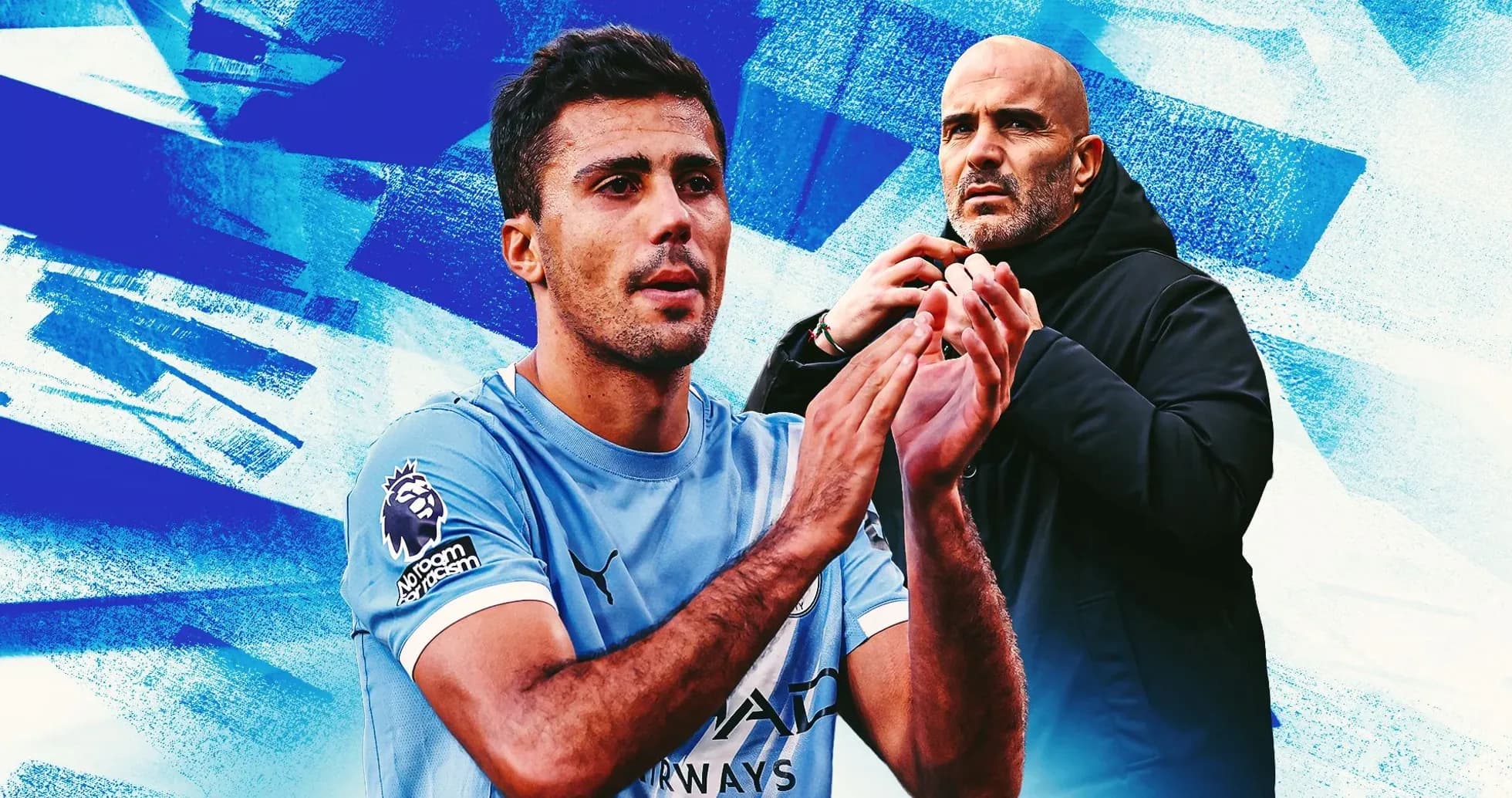
Rodri’s knee gave way before his era did.
The anterior cruciate ligament rupture in September 2024 ripped through more than cartilage. It broke Manchester City’s rhythm, stalled their dominance and left a Ballon d’Or winner watching from the sidelines just weeks before he was crowned in Paris. A few months earlier, he had been the metronome of a serial champion. Suddenly, he was a rehab case.
Before that injury, Rodri had missed only seven games for City. Seven. Across years of relentless football, he had been the constant. Once his knee went, so did City’s aura of inevitability in the league. The club will point to his sporadic absences, the cautious reintroductions, the recurring niggles as a central reason why the title has stayed out of their reach since the 2023-24 campaign.
Yet on the biggest stage this summer, the old Rodri reappeared.
The World Cup reminder
Pep Guardiola saw it coming long before anyone else. Back in October, with Rodri still fighting his way back, Guardiola said: “In the World Cup, he will be the best Rodri, and next season he will be the best Rodri.” It sounded optimistic. It turned out to be prophetic.
In North America, Rodri ran Spain’s World Cup from the base of midfield. He dictated the tempo for Luis de la Fuente’s side, took the ball under pressure, killed counterattacks before they started and broke up wave after wave of opposition moves. Spain lifted the trophy with him as their anchor and their organiser, the calm in the chaos.
For City, it was both reassuring and alarming. Reassuring because the player who had underpinned their greatest years is still very much at his peak. Alarming because it underlined just how irreplaceable he has become at the Etihad.
Rodri is 30 now. He has one year left on his contract. Guardiola’s era has ended. If he decides the time is right to return to Spain, City would lose more than a midfielder. They would lose the reference point of their entire structure.
Maresca’s problem, Madrid’s temptation
Enzo Maresca knows exactly what he has walked into. The new manager, a former City first-team coach and most recently in charge at Chelsea, understands why the speculation around Rodri refuses to die down. He just refuses to panic in public.
“First of all I have to say, that around big players there are always speculations so I am not worried about that,” he said in his first press conference back at the City Football Academy. “I think it is normal, also because they won the World Cup, because he is one of the best players.
“I think every manager wants to have Rodri because he is a top player. But now, surgery on Monday [on his back]. He needs a holiday, he needs to rest and recover and then he will be back with us.”
The words are calm. The reality is anything but.
Rodri is central to how City play and would be just as crucial to any Maresca blueprint. In a fluid system built on rotations and angles, he drifts between roles, drops into the back line, steps into midfield, launches attacks from deep and sets the press. He is also a World Cup-winning captain, one of the loudest and most respected voices in the dressing room.
Strip that out of a squad already losing leaders, and the scale of the rebuild becomes stark.
A thin midfield and failed auditions
Look beyond Rodri and the new £116 million signing Elliot Anderson, and Maresca’s midfield options start to look worryingly light for a club with City’s ambitions.
Nico Gonzalez, brought in during Rodri’s ACL layoff as a would-be like-for-like cover, has not convinced. He became one of the low points of City’s heavy January 2025 spending, drifting to the fringes and spending most of the second half of last season on the bench. His future is already being discussed in terms of a possible sale rather than a solution.
Tijjani Reijnders told a similar story. A £46m arrival from AC Milan, he burst out of the blocks early last season but faded badly. By the turn of the year he had slipped into a bit-part role, in and out of the side, struggling to impose himself week after week. City hope a full year in English football will harden him, but hope is not a plan when the cornerstone of your midfield might walk out.
Then there is the trio who appear to be heading for the exit. Mateo Kovacic, Rico Lewis and Kalvin Phillips have all reportedly been deemed surplus to requirements. Remove them and potentially Rodri from the equation, and City’s midfield suddenly looks like a construction site rather than a completed project.
Maresca will need reinforcements. He might also need a miracle.
Anderson, the heir apparent
Amid the uncertainty, Elliot Anderson senses an opening.
City did not spend £116m on a passenger. The 23-year-old arrives from Nottingham Forest with the profile of a modern No.6 and the numbers to back it up. Under Thomas Tuchel, he forced his way into England’s plans and quickly became one of the most complete midfielders in the Premier League.
Last season, no player in the division won possession more times than Anderson (306). No one won more duels either (297). He did all that while still topping Forest’s creativity charts, creating 54 chances, nine of them classed as big chances, even with Morgan Gibbs-White in the same side.
On the World Cup stage, he matched Rodri stride for stride in one key metric, finishing with the joint-most tackles in the tournament (18) alongside the Spaniard.
He can tackle, pass, press, build and break. He can do it all. If Rodri does decide to swap Manchester for Madrid, Anderson will be the obvious candidate to slide into that No.6 role and make it his own.
But even he might not be asked to do it alone.
Bouaddi and the next generation
City’s recruitment department has already looked ahead. Ayyoub Bouaddi, the teenage heartbeat of Morocco’s World Cup run, is on their list as a defensive midfield target. The original plan was simple: sign him from Lille, then send him straight back on loan to continue his development.
That plan may not survive a Rodri departure.
If the Spaniard pushes for a move this summer, City could accelerate Bouaddi’s arrival and keep him in-house, adding another young, aggressive ball-winner to Maresca’s options. It would not solve everything, but it would at least give the new manager another profile to work with at the base of his side.
The question is whether City really want to head into their first post-Guardiola season with their midfield in the hands of a newcomer, a 23-year-old signing and an 18-year-old prodigy.
Life after Pep
The backdrop to all of this is seismic change. Guardiola’s exit has left a void that cannot be filled, only managed. City are not just changing coach; they are stepping away from the architect of an era.
Key figures have already gone. Bernardo Silva, captain last season and the embodiment of Guardiola’s footballing ideals, has joined Real Madrid. John Stones, another serial winner and tactical chameleon, has moved to Inter. Two more leaders gone from a dressing room that once overflowed with experience and medals.
Add Guardiola’s emotional farewell and you have a club already dealing with more upheaval than at any point since Roberto Mancini arrived. The thought of Rodri walking out on top of that turns transition into risk.
The City hierarchy know the dangers. They watched Manchester United flounder in the years after Sir Alex Ferguson. They saw Arsenal struggle to define themselves after Arsene Wenger. They are determined not to repeat those mistakes, to avoid the churn and chaos that swallowed those giants.
Maresca’s mixed spell at Chelsea only sharpens the edge. He is highly regarded inside City, understands the structure and the people, but he is not a guaranteed success. Continuity around him will be crucial. Rodri is the biggest piece of that continuity puzzle.
Maresca’s calm in the storm
Publicly, Maresca leans on perspective and process.
“I want to say it is a privilege because the reason why the club decided to go for me, that is a privilege,” he said when asked about stepping into Guardiola’s shoes. “I have said many times, I consider Pep the best coach in the world in the last 20-25 years. It is a challenge.
“Also the history of the manager with many years in the same club, they struggle a bit. Sir Alex, Arsene. But it is also a challenge to do the right things.”
For Maresca, time and structure are his allies.
“I know the organisation quite well and the people inside the club from years ago. I just said before that when a club has three [sic] managers in almost 20 years, it shows how serious [they are]. The structure understands to give time for everything.
The organisation is the main thing. This club and organisation has had three [sic] managers in 17 years. That is not normal and has not happened often. I am confident that we can continue to do a great job and continue to do the job that has been done in the last 14, 15 years since Roberto Mancini was here.”
The words are measured, but the road ahead will not be smooth. City are entering a season of sharp edges and hard questions. They will do so under a new manager, with a new captain, a reshaped dressing room and a fanbase accustomed to perfection.
Whether they face that storm with Rodri still in sky blue, or watch him walk out as another symbol of a closing chapter, will define just how turbulent this new era becomes.
Related News
Carlos Alcaraz Calls for Change After Laver Cup Court Conditions
Alexander Zverev Secures Laver Cup Victory for Team Europe with Straight-Set Win Over Learner Tien
Novak Djokovic Shares Fitness Update Before China Open Return After US Open Upset
Shubman Gill's Captaincy Record Across All Formats: Tests, ODIs, T20Is, and IPL
Kuldeep Yadav Named Player of the Match Over Virat Kohli Despite Century in IND vs WI 1st ODI
India Advances to Asian Games 2026 Cricket Semi-Finals After Rain Washout Against Afghanistan