
Ronwen Williams Faces Online Abuse Amid World Cup Pressure
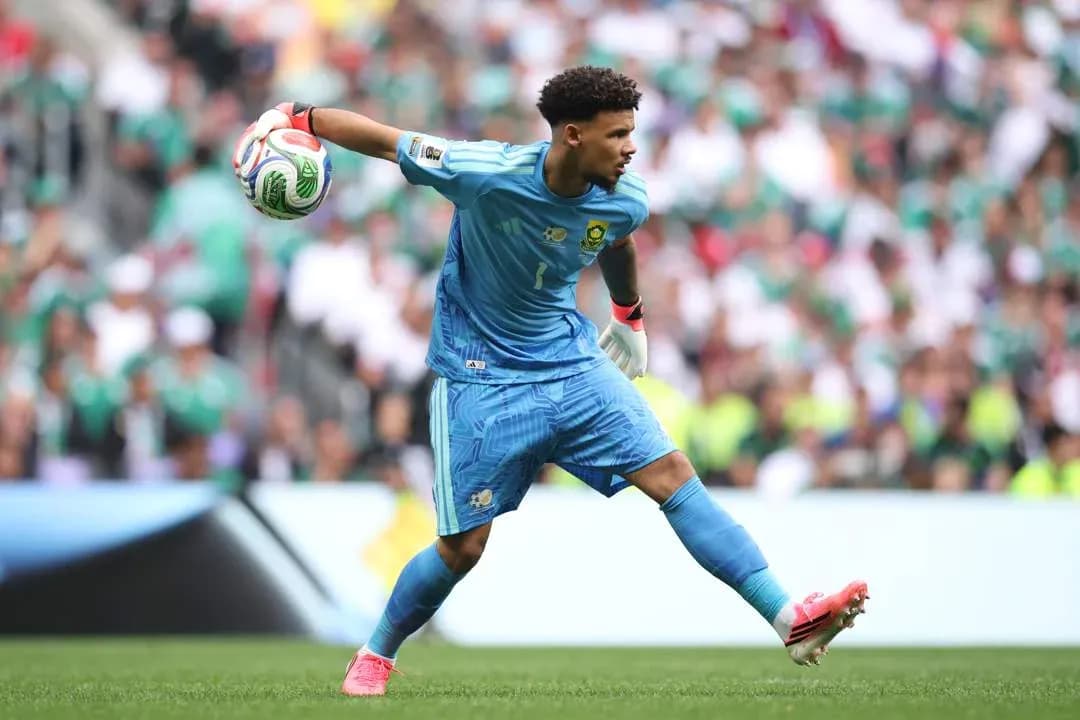
Ronwen Williams stands in the middle of a World Cup storm that has very little to do with football.
On the eve of Bafana Bafana’s crucial Group A clash with Czechia in Atlanta – and on the International Day for Countering Hate Speech, no less – the South African captain is preparing for a match that could define a generation, while fielding abuse from the very people he represents.
A World Cup dream poisoned
This World Cup was supposed to be the long-awaited return. The core of this Bafana squad grew up watching the class of 2010 on home soil, dreaming of their own shot on the global stage. That dream has curdled into something darker.
South Africa’s hardening anti-immigrant posture has bled straight into football. Bafana’s limp 2-0 defeat to Mexico at Azteca Stadium on 11 June lit the fuse. The politics back home poured petrol on it.
FIFA’s social media protection service has revealed that Bafana players are facing unprecedented levels of online abuse at this tournament. The volume of hate they have tracked at this World Cup has already surpassed the entire tally from Qatar 2022 – and we’re barely a week into the competition.
The numbers were laid out at the National Centre for Civil and Human Rights in Atlanta, just a few kilometres from Atlanta Stadium, where Bafana will try to drag their campaign back to life against Czechia.
The abuse is not just from angry South Africans disappointed with a slow start. It is coming from across the continent, from fans who see Bafana as an extension of a government stance they despise.
Politics at Bafana’s door
At the heart of the rage is March and March, a vigilante group that calls itself “a grassroots citizen movement addressing growing concerns about undocumented immigration in South Africa”.
Their rhetoric has grown louder. Loud enough to force President Cyril Ramaphosa to address the nation and announce measures to deal with the country’s porous borders. Loud enough to echo all the way to the United States, where Bafana are trying to focus on football.
March and March have set 30 June as a deadline for undocumented migrants to leave South Africa. They have not spelt out what happens after that, but the tone and scenes from their marches hint at potential violence.
Governments across Africa have responded by offering facilities for voluntary repatriation. At street level, some football supporters have taken a different route: “hate watching” Bafana, actively cheering against South Africa as a form of protest.
The backlash has spilled into disinformation. A fabricated quote attributed to Williams – suggesting he said the team was saddened that Africans supported Mexico over Bafana and that they “almost shed a tear” – was picked up by reputable publications before being debunked.
For Williams, that crossed a line.
“We know how difficult it is now on social media, where everyone is attacking you,” he said.
“Sometimes it’s (because of) false information. If you lose a game, and you don’t perform, you can take it as players. You can put your hand up. But when there’s false information that goes around, then it hurts.
“I have been a target over the last few days over things I didn’t say. I didn’t say anything about Africa, or people supporting Mexico. I have always said that as Africa, we are one. We support each other in good and bad moments.
“We’ve all got our own politics, our own problems and our own fights that we deal with back home. Every country has that. I don’t know where that stems from. It does hurt. I have been attacked... my country as well, for things that are going on back home.”
Old wounds, new tournament
This is not the first time Bafana have paid the price for South Africa’s domestic tensions.
In 2019, Madagascar and Zambia refused to honour international friendlies against Bafana because of xenophobic attacks in South Africa. That decision left then-new coach Molefi Ntseki starting the 2021 Africa Cup of Nations qualifying campaign without proper preparation.
The fallout was brutal. Bafana failed to qualify, finishing third in a group with Ghana, Sudan and São Tomé and Príncipe. Six years on, the political climate has once again seeped into the dressing room. Only this time, the stage is the World Cup.
“Players are human beings as well. We go through it. Sometimes it gets a lot,” Williams said.
“You want to focus on doing your job, which is being a footballer, but then you get involved in politics even though you don’t want to get into that space.”
The irony is stark. A team that should be a symbol of national pride has become a lightning rod for anger about borders and policy.
Football’s fragile sanctuary
And yet, inside the Bafana camp, there is a stubborn insistence on holding onto football’s better side.
“But the wonderful thing about sport is that it can unite, it can make or break you. It can bring people together,” Williams said.
“We are in Atlanta now, and I see so many Africans... so many South Africans and people from Mexico, in one room. That’s the beauty of sport. That’s the beauty of football.
“So, let’s just enjoy and have a wonderful time, and we leave politics to the politicians. Let us just play football, and enjoy ourselves.
“Criticise [us] for what happens on the field, but off the field things - we can’t deal with that, and it has nothing to do with us. As Africans, let’s unite and keep going because we are all in this together.”
The reality, though, is that there is no mute button for the noise. FIFA can track the abuse, condemn it, even shield some of it. The players still see enough to feel it.
Williams admits that, in a twisted way, they have come to accept it.
“As sad as this sounds, players have accepted it (the online abuse), that that’s how things are in the world now,” he said.
“We’ve had meetings to discuss this as players. But you have an experienced coach in coach Hugo (Broos), who says that the most important thing is to analyse the game.
“That is the most important thing, to block out the noise, focus on how we can do better, learn from our mistakes and just stick together as a team.
“If you are going to listen to a million people’s opinions, then you will lose your mind. So, at this moment, the most important comment and the person to listen to is our coach and technical team. He knows us, and we know him. He knows our strengths and weaknesses.
“We are there for one another. We came here together, and we will leave here together. So, let us stick together as a team and keep the focus.”
A defining night in Atlanta
The stakes on Thursday could hardly be clearer.
The top two teams in each group go straight into the last 32. Eight of the 12 third-placed sides will also squeeze through. Bafana’s route will be carved by what happens against Czechia and by how well they manage to keep the hatred at arm’s length.
Lose control of that, and the World Cup dream of a generation might disintegrate under a wave of vitriol that has nothing to do with tactics, shape or finishing.
Handle it, and this same group – scarred, angry, but united – could yet turn Atlanta into the place where the noise outside finally stopped dictating the story.
Related News
Anthony Joshua Names Murat Gassiev as Next Opponent if He Defeats Tyson Fury
UFC 332: Start Time and Fight Highlights for Natalia Silva vs. Wang Cong
Court McGee Opens Up About Choosing UFC 332 as His Final MMA Fight
WBC Orders Lightweight Title Unification: William Zepeda vs Jadier Herrera
BCCI Pension List: Monthly Payments to Retired Indian Cricketers in 2025
Why Fury vs Joshua Is Set for Cardiff, and Dua Lipa’s Unexpected Role