
South Africa's Women's Africa Cup of Nations Hopes Hang by a Thread
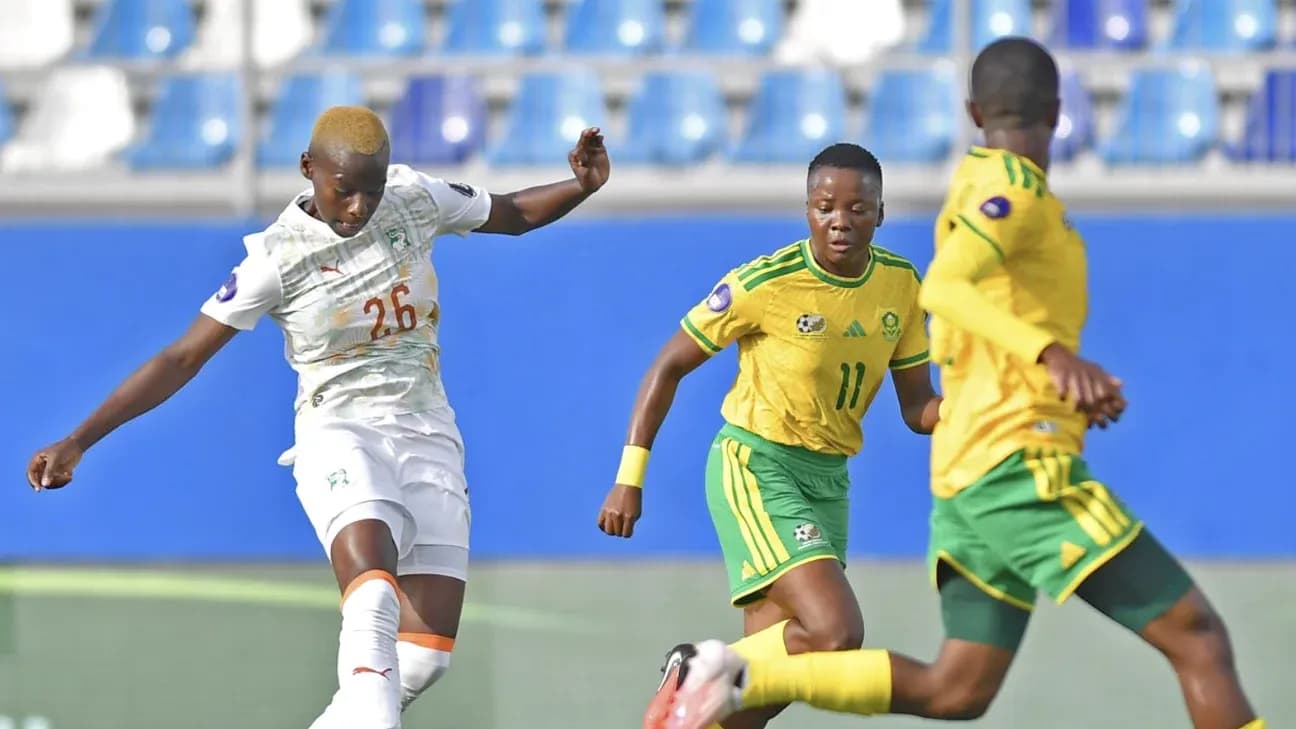
South Africa staggered away from Casablanca with their Women’s Africa Cup of Nations hopes still alive, but only just.
A 2-2 draw against Ivory Coast on Friday keeps Banyana Banyana in the hunt going into their final Group B game against Burkina Faso on August 4. It also laid bare every flaw, every crack, and every unanswered question around the defending African champions.
For 70 minutes, they were second best.
Torn open, twice
Ivory Coast did not need long to expose South Africa’s soft underbelly.
On 18 minutes, Banyana were ripped apart on the break, Grace Sery racing through to punish a disorganised defensive line. Eighteen minutes later, it was almost a carbon copy. Another counter, another gaping hole, the same ruthless finisher. Sery again. 2-0, and South Africa looked stunned.
The structure was loose, the transitions slow. Every turnover felt dangerous. Ivory Coast, already buoyed by a 4-1 win over Burkina Faso in their opener, played like a side that knew exactly where to strike.
South Africa, by contrast, barely laid a glove on them in that first half.
There was one flash of what they can be: Linda Motlhalo threading a superb pass to Thembi Kgatlana, forcing goalkeeper Aramatou Diakité to rush out and smother. Beyond that, nothing of note. Kgatlana drifted on the fringes, isolated and anonymous, starved of service and support.
For a player whose status in Banyana colours has long been unquestioned, the questions had grown louder in recent months. Were her best days for the national team behind her?
The second half delivered a sharp answer.
Kgatlana responds
Once South Africa finally started to knit passes together higher up the pitch, Kgatlana came alive.
She has always thrived with a proper link between midfield and attack. For years, Jermaine Seoposenwe was that conduit, dropping into pockets, bouncing passes, dragging defenders into places they did not want to go. Since Seoposenwe’s retirement last year, nobody has truly replaced that role.
On Friday, Ronnel Donnelly stepped into the spotlight.
The Mamelodi Sundowns striker has been a lightning rod for criticism, her limited club minutes used as a stick to beat both player and coach Desiree Ellis. Yet Ellis has kept the faith, insisting Donnelly offers things the numbers do not show.
In Casablanca, those qualities finally told.
Donnelly, only 22, is not Seoposenwe. She does not try to be. She offers something different: a physical presence, a willingness to contest every aerial ball, a knack for drawing centre-backs into duels they cannot ignore. She wins headers. She occupies space. She makes room for others.
Shortly after coming on, she carved out a shooting chance for herself, twisting into space in the box. The shot never came, but the move did not die. The ball was recycled to Kgatlana, who saw her moment.
She cut inside, opened up the angle and buried South Africa’s lifeline. Just under 20 minutes plus stoppage time remained. Suddenly, the game changed.
Ivory Coast, who had controlled so much of the contest, began to feel the weight of it. South Africa pushed higher, tackles bit harder, second balls started to fall in green and gold areas. The equaliser felt unlikely, but not impossible.
Donnelly’s moment, Magaia’s finish
Deep into stoppage time, the pressure finally broke.
A hopeful ball turned into a decisive one as Donnelly rose and flicked on a header. It was the kind of touch that rarely makes a highlight reel but changes a game. Hildah Magaia pounced, lashing home the equaliser with conviction.
From 2-0 down and heading out of the tournament in all but mathematics, Banyana had clawed back a point that keeps the door to the quarter-finals ajar.
Ivory Coast, with four points from two games and a +3 goal difference, remain in control of their own destiny. Tanzania, who beat South Africa 2-1 in their opener, have three points and a +1 goal difference ahead of their clash with Burkina Faso. South Africa sit on one point with a -1 goal difference. Burkina Faso, pointless, prop up the group.
The margins are thin. The equation for Banyana is not.
Win or go home
On August 4, South Africa must beat Burkina Faso. Nothing else will do.
Head-to-head records will decide between teams level on points, ahead of goal difference. That nuance shifts the emphasis slightly away from simply running up a scoreline, but Ellis knows her side may still need goals, and plenty of them, to feel safe.
The late surge against Ivory Coast offered a glimpse of what an aggressive front four could look like: Donnelly, Kgatlana, Lebohang Ramalepe pushing on from wide areas, and Magaia crashing in from advanced positions. For a team with their backs to the wall, that combination suddenly looks less like a gamble and more like a necessity.
Ellis now faces a clear choice. Stick with caution and risk drifting out with a whimper, or lean into the attacking verve that turned a looming defeat into a lifeline in Casablanca.
Whatever she decides, the expectation is simple. If Banyana Banyana are to leave this WAFCON early, they cannot do it quietly.
Related News
Carlos Alcaraz Calls for Change After Laver Cup Court Conditions
Alexander Zverev Secures Laver Cup Victory for Team Europe with Straight-Set Win Over Learner Tien
Novak Djokovic Shares Fitness Update Before China Open Return After US Open Upset

Shubman Gill's Captaincy Record Across All Formats: Tests, ODIs, T20Is, and IPL
Kuldeep Yadav Named Player of the Match Over Virat Kohli Despite Century in IND vs WI 1st ODI
India Advances to Asian Games 2026 Cricket Semi-Finals After Rain Washout Against Afghanistan