
Spain vs Austria: Round of 32 Tactical Preview
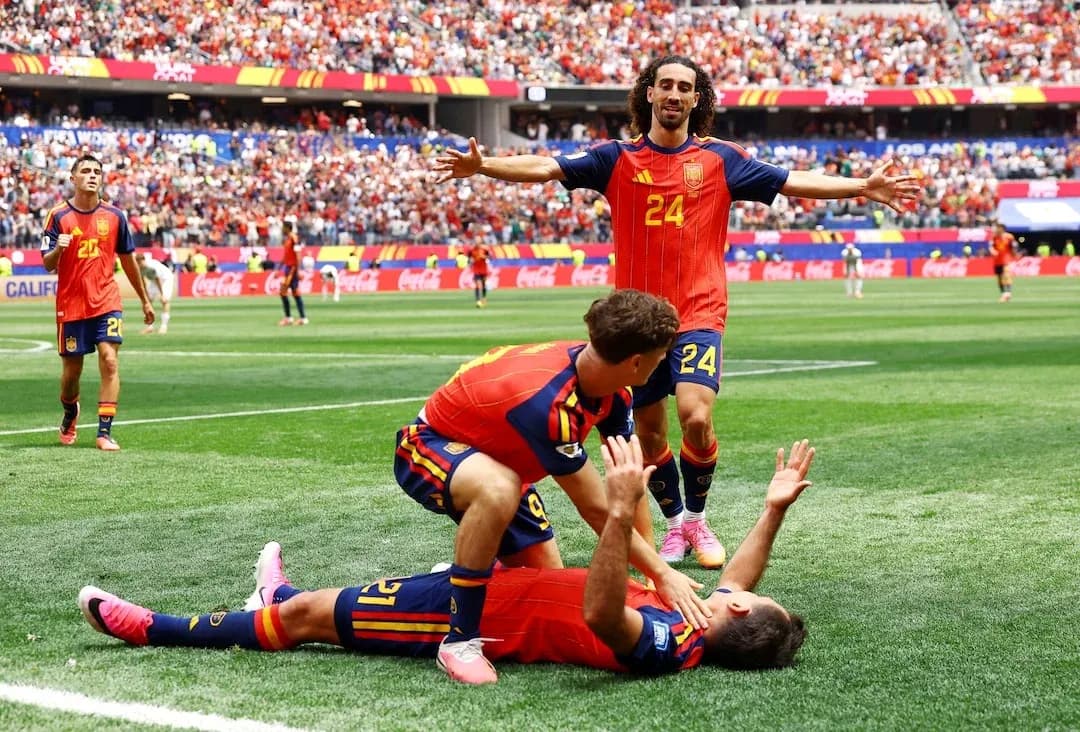
SoFi Stadium, vast and gleaming under California lights, hosted a Round of 32 tie that felt less like a knockout ambush and more like a logical extension of what these two sides had been building. Spain arrived as group winners from Group H, unbeaten and unbreached: in total this campaign they had played 4 matches, winning 3 and drawing 1, with 8 goals scored and none conceded. Austria, second in Group J, came in with a very different profile: in total 4 matches, only 1 win, 1 draw and 2 defeats, 6 goals scored but 9 conceded. One side was a machine of control; the other, a team living on the edge.
Both coaches doubled down on their core identity with matching 4-2-3-1 shapes. Luis de la Fuente’s Spain pushed their chess pieces high and wide: Unai Simón behind a back four of Pedro Porro, Pau Cubarsí, Aymeric Laporte and Marc Cucurella, Rodri and Pedri as the double pivot, and a fluid line of three in Lamine Yamal, Dani Olmo and Álex Baena supporting Mikel Oyarzabal as the nominal striker. Across from them, Ralf Rangnick’s Austria mirrored the structure but not the philosophy: Alexander Schlager in goal; a back line of Stefan Posch, Kevin Danso, David Alaba and Konrad Laimer; Nicolas Seiwald and Xaver Schlager screening; with Romano Schmid, Paul Wanner and Marcel Sabitzer supplying Michael Gregoritsch.
Statistical Contrast
Heading into this game, the numbers underlined the contrast. At home Spain had played 3 matches, winning 2 and drawing 1, scoring 7 and conceding 0, an average of 2.3 goals scored and 0.0 conceded per game. On their travels they had added 1 away win, with 1 goal scored and 0 conceded, for an overall average of 2.0 goals scored and 0.0 conceded in total. Their goal difference overall stood at +8 (8 for, 0 against). Austria’s journey had been shakier: at home they had played 1, winning it 3-1; away they had played 3, with no wins, 1 draw and 2 defeats, scoring 3 and conceding 8. That left them with an overall average of 1.5 goals scored and 2.3 conceded in total, and a goal difference overall of −3 (6 for, 9 against).
Tactical Analysis
Tactically, the absences list offered no extra drama; there were no confirmed missing or questionable players. The story was therefore about pure selection choices and how each coach chose to express his idea of control. De la Fuente leaned into technical dominance between the lines, trusting Rodri as the metronome and Pedri as the connector, with Yamal and Baena stretching and Olmo knitting. Rangnick, by contrast, needed his double pivot of Seiwald and Xaver Schlager to be both shield and springboard, compressing space against Spain’s No. 10s while offering quick outlets to Sabitzer and Wanner.
Discipline was always likely to shape the tempo. In total this campaign Spain’s yellow-card pattern had been remarkably restrained but oddly concentrated: just 2 yellows, both late — one between 46-60 minutes (50.00% of their yellows) and one in the 91-105 band (the other 50.00%). Austria’s profile was more volatile: in total their yellows were spread across the match but peaked late, with 20.00% between 0-15 minutes, another 20.00% between 31-45, and a heavy 60.00% between 76-90. Stefan Posch embodied that edge. In total he had committed 7 fouls and drawn 2 yellow cards, and also appeared among the red-card listings, a sign of how often he walks the disciplinary tightrope. His duel with Oyarzabal was always going to test his restraint.
Key Matchups
That “Hunter vs Shield” confrontation was perhaps the clearest narrative thread. Oyarzabal entered the Round of 32 as one of the World Cup’s sharpest weapons: in total 4 goals and 1 assist from 4 appearances, with 15 shots (8 on target) and a player rating of 7.7. Austria’s defensive record, especially away from home, was brittle: on their travels they conceded an average of 2.7 goals per game, with 8 conceded in 3 away fixtures. The numbers suggested that if Spain could isolate Oyarzabal on the blind side of Posch or Danso, Austria’s line would bend.
Behind that duel, the “Engine Room” battle promised a different kind of theatre. Rodri and Pedri against Seiwald and Xaver Schlager was less about spectacle and more about territorial rights. Spain’s overall clean-sheet record — 4 clean sheets in 4 matches, with 0.0 goals conceded per game both at home and away — depended heavily on Rodri’s ability to snuff out transitions before they became shots. Austria, who had failed to score in 2 away matches in total, needed Sabitzer and Schmid to break that screen with early runs and quick combinations, or else Gregoritsch would be starved.
Austria’s one technical comfort zone lay from the spot: in total they had won and converted 1 penalty, a 100.00% record with no misses. Spain, interestingly, had not yet taken a penalty in this tournament. But the broader statistical landscape still tilted heavily towards the favourites. Spain’s overall form line of DWWW, combined with an attack averaging 2.0 goals per match and a defence yet to concede, suggested a side operating in a rare equilibrium. Austria’s WLDL sequence, with no clean sheets in total and a tendency to collect 60.00% of their yellows in the final quarter-hour, pointed to fatigue and desperation as the minutes ticked away.
Conclusion
In a knockout framed by mirrored formations but divergent identities, the prognosis was clear. Spain’s structure, technical superiority and impeccable defensive record made them overwhelming favourites to control territory and chances. Austria’s best hope lay in chaos: disrupting Rodri’s rhythm, drawing Spain into that late-game yellow-card window, and trusting Sabitzer or Gregoritsch to exploit the one moment that statistics cannot predict. Yet on the balance of xG trends implied by 8 scored and 0 conceded for Spain against 6 scored and 9 conceded for Austria, and the defensive solidity of a side with 4 clean sheets from 4, the tactical preview always leaned towards the inevitable: Spain advancing, Austria chasing shadows in the Californian night.
Related News
Brazil's First Post-World Cup Friendly: What Should the Lineup Be?
Harry Kane Calls England’s World Cup Exit to Argentina His Deepest International Pain
Estevao Opens Up on World Cup Heartbreak and His Unexpected Return to Brazil Under Ancelotti
Thomas Tuchel Shares Unusual Regret After England's 10-Man World Cup Victory Over Mexico
South Korea Names Robert Moreno as Interim Coach After World Cup Exit

Jude Bellingham Returns to Form at Real Madrid Following World Cup Success