
Spain Dominates Austria 3-0 in World Cup Round of 32
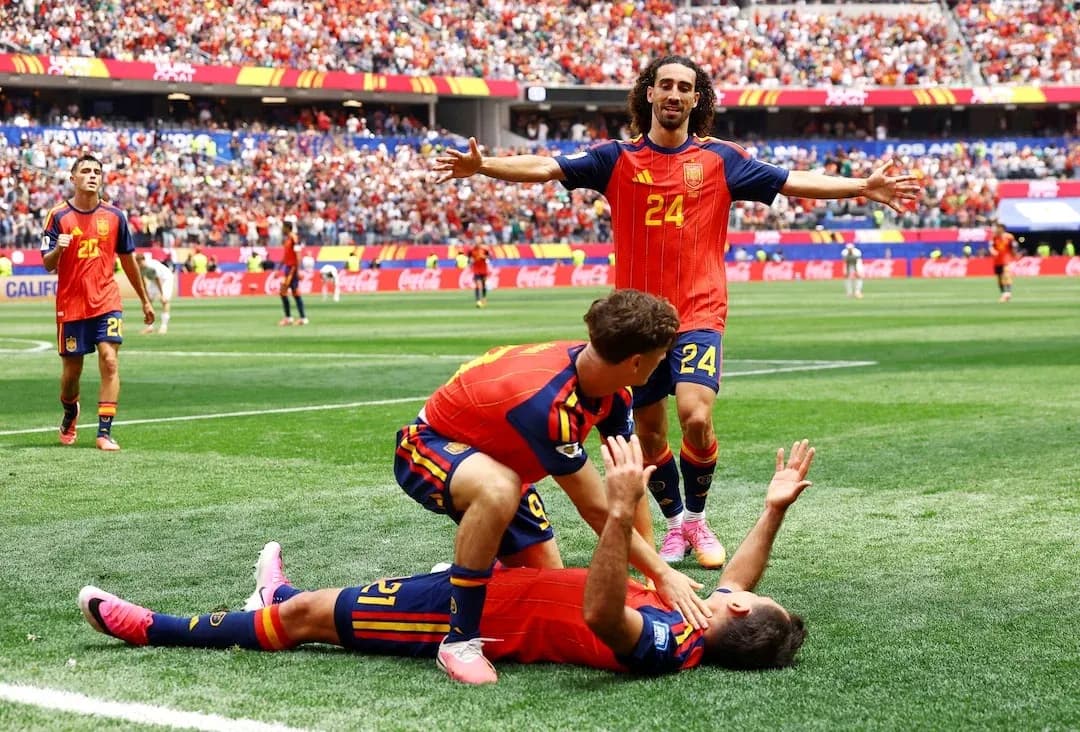
Spain’s 3-0 win over Austria at SoFi Stadium in this World Cup Round of 32 tie was a clinic in territorial control and structured dominance. The 65% possession, 23-5 shot count and 9-0 corner advantage capture the direction of travel, but the tactical story is how Spain methodically stretched and then dismantled Austria’s compact block, while denying them any shot on target across 90 minutes.
Spain set up with Unai Simón (Spain) behind a back four of Pedro Porro, Pau Cubarsí, Aymeric Laporte and Marc Cucurella, a line clearly tasked with aggressive positioning rather than deep protection. With Austria failing to register a single shot on goal, the defensive line spent most of the night camped near halfway, compressing the pitch and allowing Rodri to orchestrate from a high pivot. Rodri’s presence enabled both full-backs to step into midfield zones, turning Spain’s base shape into a fluid 2-3-5 in possession.
The first-half pattern was established quickly: Spain circulating with patience, using 629 passes (570 accurate, 91%) to probe side-to-side, then accelerating through Lamine Yamal and Dani Olmo between the lines. Austria’s initial 4-1-4-1/4-5-1 mid-block, with Michael Gregoritsch isolated up front and Marcel Sabitzer as the most advanced midfielder, tried to funnel play wide. But Spain’s positional discipline ensured that whenever Austria shifted across, the far-side full-back and interior midfielder were free to receive and switch the point of attack.
First Goal
The opening goal at 36 minutes, Mikel Oyarzabal finishing from a Marc Cucurella assist, was the logical outcome of that dynamic. It reflected Spain’s left-sided overload: Cucurella repeatedly received high and wide, supported by an inside midfielder and Oyarzabal’s diagonal movements from the front line. Austria’s back four were forced to defend the width of the box without much screening from the front, and once Spain broke the first line of pressure, they consistently found time to deliver or combine near the edge of the area.
At half-time, with Spain 1-0 up and Austria having managed only sporadic breaks and no corners, Ralf Rangnick reacted with a double change: Carney Chukwuemeka (IN) came on for Nicolas Seiwald (OUT) and Florian Grillitsch (IN) came on for Xaver Schlager (OUT), both at 46 minutes. The intent was to add ball-carrying and passing range to transition play, hoping to turn clearances into counters. However, Spain’s rest-defense structure—Rodri anchored centrally, with both centre-backs ready to step into midfield—meant Austria’s first pass after regains was almost always under pressure.
Austria’s later changes at 60 minutes, Marko Arnautović (IN) for Michael Gregoritsch (OUT) and Saša Kalajdžić (IN) for Romano Schmid (OUT), signalled a more direct approach with dual aerial threats. Yet with Austria finishing with just five shots (only one blocked and none on goal) and 0.32 xG, long balls and second-ball hunts rarely materialised into sustained attacks. Spain’s defensive line, especially Laporte and Cubarsí, won their duels early, and the compactness behind the ball limited any chance for Arnautović or Kalajdžić to receive in advantageous central pockets.
Second Goal
Spain’s second goal at 66 minutes, Pedro Porro scoring from an Alex Baena assist, underlined the impact of the full-backs in advanced positions. Porro repeatedly underlapped and overlapped on the right, taking advantage of Austria’s narrow midfield. With Spain circulating quickly and Austria’s block shuttling laterally, the right-back could appear in the half-space untracked, arriving onto cut-backs or switches. The 15 shots inside the box show how frequently Spain penetrated into prime finishing zones rather than settling for speculative efforts.
Luis de la Fuente’s in-game management at 71 minutes, with Mikel Merino (IN) for Dani Olmo (OUT) and Ferran Torres (IN) for Alex Baena (OUT), was less about changing the structure and more about maintaining intensity and pressing height. Fresh legs in the attacking and midfield lines ensured Spain could keep counter-pressing immediately after losses, preventing Austria from exploiting any late-game fatigue. The subsequent introduction of Pablo Gavi (IN) for Lamine Yamal (OUT) at 85 minutes, Marc Pubill (IN) for Aymeric Laporte (OUT) at 90, and Fabián Ruiz (IN) for Pedri (OUT) at 90 further reinforced control rather than inviting pressure.
Austria’s only yellow card, Stefan Posch booked for “Foul” at 83 minutes, encapsulated their defensive struggle: often late to duels after long periods without the ball. Moments later, Alexander Prass (IN) came on for Posch (OUT) at 85 minutes, a forced reshuffle that did little to change the game’s direction. Austria finished with 15 fouls to Spain’s 8, a reflection of chasing shadows rather than orchestrating pressure in defined zones.
Third Goal
Spain’s third goal at 89 minutes, again Oyarzabal from another Cucurella assist, was a near-copy of the first in structural terms: left-sided combinations, a full-back high and creative, and Oyarzabal timing his movement between centre-back and full-back. That repeat pattern is key tactically: Spain didn’t just dominate; they repeatedly accessed the same weaknesses in Austria’s shape, particularly the space behind the wide defenders once the midfield line was dragged inside.
Goalkeeper data adds an important nuance. Unai Simón (Spain) officially made 0 saves, which aligns with Austria’s 0 shots on goal and underlines how effectively Spain protected their penalty area. Alexander Schlager (Austria), by contrast, registered 6 saves despite Spain hitting 10 shots on target, implying several blocks or efforts off-frame in addition to those he stopped. Both keepers are credited with -0.57 goals prevented, suggesting that while Schlager faced higher volume, the chances Spain created were broadly in line with the three goals scored, and Austria never tested Simón with efforts of significant quality.
Statistically, Spain’s 2.84 xG against Austria’s 0.32 confirms the eye test: this was not a flattering scoreline but a fair reflection of chance quality and volume. Spain’s passing dominance (629 vs 346 total passes) and superior accuracy (91% vs 82%) underpinned their territorial control, while a 9-0 corner count shows how often they locked Austria into their own third. With only one yellow card shown all match—Stefan Posch’s at 83 minutes—the game remained tactically intense but largely controlled, devoid of chaotic phases that might have favoured the underdog. Spain advanced by imposing their positional play, squeezing the pitch without defensive risk, and repeatedly exploiting the same structural cracks in Austria’s defensive block.
Related News
Brazil's First Post-World Cup Friendly: What Should the Lineup Be?
Harry Kane Calls England’s World Cup Exit to Argentina His Deepest International Pain
Estevao Opens Up on World Cup Heartbreak and His Unexpected Return to Brazil Under Ancelotti

Thomas Tuchel Shares Unusual Regret After England's 10-Man World Cup Victory Over Mexico

South Korea Names Robert Moreno as Interim Coach After World Cup Exit

Jude Bellingham Returns to Form at Real Madrid Following World Cup Success