
Spain vs France Semi-Final Tactical Analysis
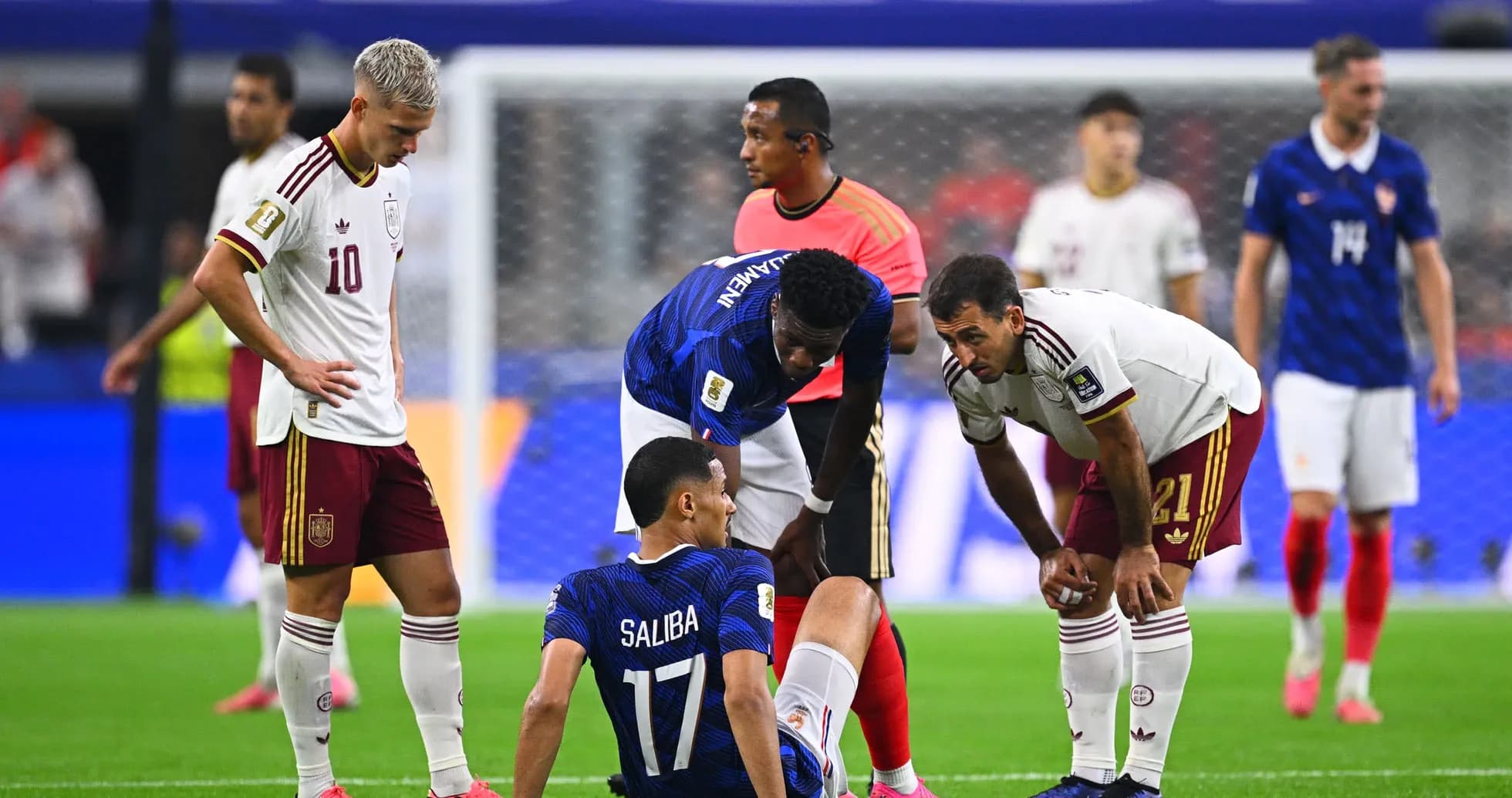
France and Spain mirrored each other structurally in a 4-2-3-1 at Dallas Stadium, but the semi-final was defined by how effectively Spain turned their framework into territorial control and penalty-box clarity. The 2-0 scoreline and the underlying metrics — Spain’s 1.63 xG against France’s 0.3 — underline a match where Luis de la Fuente’s side consistently forced the game into zones that suited their strengths, while Didier Deschamps’ France never truly solved Spain’s pressing traps or their own buildup issues.
France’s 4-2-3-1 was built on a back four of Jules Koundé, Dayot Upamecano, William Saliba and Lucas Digne in front of Mike Maignan, with Aurélien Tchouaméni and Adrien Rabiot as the double pivot. Ahead of them, Ousmane Dembélé and Bradley Barcola flanked Michael Olise as the nominal No. 10 behind Kylian Mbappé. On paper this offered width and individual dribbling threats, but in practice the structure struggled to progress cleanly through the thirds. France completed 473 passes with 396 accurate (84%), yet the low xG and just 4 shots inside the box show that most of this circulation was either in deeper zones or forced wide, with Spain comfortably protecting the central lane.
Spain’s own 4-2-3-1, with Rodri and Fabián Ruiz as the double pivot, Dani Olmo central behind Mikel Oyarzabal and Lamine Yamal plus Alex Baena between the lines, was far more cohesive. Their 500 total passes and 428 accurate (86%) were not just sterile possession; they used small overloads around Rodri to break France’s first line, then looked early for diagonal passes into Yamal and Baena. That structure pinned France’s full-backs and prevented them from stepping out aggressively, which in turn isolated Mbappé and limited his transition opportunities.
First Key Tactical Hinge
The first key tactical hinge came early with Adrien Rabiot’s yellow card for “Foul” at 9'. Already on a booking, Rabiot had to moderate his intensity in duels, reducing France’s capacity to disrupt Spain’s midfield rhythm. Spain’s penalty at 22', converted by Mikel Oyarzabal, crystallised that pattern: sustained pressure and occupation of the half-spaces forced France into reactive defending inside their own box. From that point, Spain could manage the tempo with a one-goal cushion and lean even more on their positional play.
Deschamps’ first adjustment was enforced on the defensive line rather than the midfield: at 30', Maxence Lacroix (IN) came on for William Saliba (OUT). The change did not alter the basic 4-2-3-1 shape but did subtly affect France’s rest-defense. Lacroix is more aggressive stepping into midfield, yet Spain’s structure — with Oyarzabal pinning the line and Olmo dropping — continued to find pockets between France’s centre-backs and pivots. France’s pressing remained disjointed: Mbappé often jumped alone, while the second line arrived a beat late, allowing Spain to escape via Rodri.
Second Half Adjustments
The second half opened with a clear French attempt to add dynamism in midfield: Manu Koné (IN) for Rabiot (OUT) at 46'. This was an acknowledgement that France needed more ball-carrying and verticality from deep. However, Spain’s compact 4-4-2 out of possession — Olmo stepping up alongside Oyarzabal — funneled France towards the flanks, where Dembélé and Barcola were doubled up by full-back and wide midfielder. France did increase their volume of attacks, but the quality remained low: 10 total shots, only 3 on target, and an xG of 0.3 highlight how rarely they broke Spain’s last line with clean, central entries.
The 57' substitution of Désiré Doué (IN) for Bradley Barcola (OUT) signalled a push for more direct 1v1 threat and interior dribbling. Yet within a minute, Spain struck the decisive tactical blow. At 58', Pedro Porro’s goal, assisted by Dani Olmo, came from precisely the type of wide-to-half-space mechanism Spain had been building all night. By then, France’s full-backs were caught between pressing high on Spain’s wide men and protecting the box. Spain exploited that indecision, with Porro advancing from right-back into a more advanced channel to finish and make it 2-0.
From there, Deschamps leaned fully into attacking changes. At 72', Theo Hernández (IN) replaced Lucas Digne (OUT), adding a more aggressive overlapping profile on the left, while Rayan Cherki (IN) for Michael Olise (OUT) aimed to inject creativity between the lines. The idea was clear: Theo to provide width and underlaps, Cherki to connect with Mbappé and Dembélé in tighter central pockets. France’s 7 corner kicks against Spain’s 1 show that this phase did at least pin Spain deeper and generate set-piece pressure. However, Spain’s box defense — anchored by Aymeric Laporte and Pau Cubarsí — dealt well with crosses, and France’s 2 blocked shots indicate that many attempts were smothered before truly troubling the goalkeeper.
On the other side, Luis de la Fuente’s substitutions were oriented around game-state management. At 74', Ferran Torres (IN) for Oyarzabal (OUT) refreshed the pressing from the front and offered a counter-attacking outlet. At 78', Pedri (IN) for Fabián Ruiz (OUT) and Mikel Merino (IN) for Dani Olmo (OUT) rebalanced the midfield with fresh legs and more defensive security, subtly shifting Spain towards a more conservative 4-3-3/4-5-1 without fully abandoning their passing identity. The double change at 84' — Marcos Llorente (IN) for Pedro Porro (OUT) and Nico Williams (IN) for Alex Baena (OUT) — completed the transition into a robust, transition-ready block: Llorente’s energy on the flank and Williams’ pace on the break allowed Spain to defend deeper while still threatening in behind.
Discipline and Goalkeeping
Discipline also shaped the closing stages. Marc Cucurella’s yellow card for “Foul” at 31' did not materially change Spain’s defensive approach; their structure protected him well, and France rarely isolated him in true 1v1 emergencies. By contrast, Kylian Mbappé’s late yellow for “Violent conduct” at 86' symbolised France’s growing frustration. Even as France pushed bodies forward, Spain’s compactness limited clear chances; Spain committed 12 fouls to France’s 11, but they were mostly tactical, breaking up play without losing structural integrity.
In goal, Mike Maignan (France) was statistically untested in terms of saves, registering 0 goalkeeper saves, which underlines how Spain’s chances were either finished clinically or did not require him to intervene. On the other side, Unai Simón (Spain) made 3 saves, matching France’s 3 shots on target, and his calm distribution was central to Spain’s ability to reset possession and relieve pressure late on. The goals prevented metric at 0.07 for each goalkeeper suggests neither was forced into extraordinary, high-difficulty interventions; the match was decided more by systemic superiority than individual heroics.
The statistical verdict reinforces the tactical story. Possession was almost even — 51% for Spain, 49% for France — but Spain turned their share into higher-quality opportunities: equal total shots (10-10) yet a clear edge in xG (1.63 to 0.3) and shots inside the box (5 to 4). France’s 4-2-3-1 never consistently connected its midfield to Mbappé in advantageous zones, and despite more corners and similar passing volume, their attacks were too predictable and peripherally focused. Spain, with a similar base shape, better spacing, and smarter in-game adjustments, controlled where the game was played and how dangerous each phase became, fully justifying their 2-0 progression from this Semi-finals clash.
Related News
Brazil's First Post-World Cup Friendly: What Should the Lineup Be?
Estevao Opens Up on World Cup Heartbreak and His Unexpected Return to Brazil Under Ancelotti
Thomas Tuchel Shares Unusual Regret After England's 10-Man World Cup Victory Over Mexico
South Korea Names Robert Moreno as Interim Coach After World Cup Exit
Jude Bellingham Returns to Form at Real Madrid Following World Cup Success

Chloe Kelly, Beth Mead and 13 Lionesses Target Big WSL Seasons Ahead of England's 2027 World Cup Campaign