
Sporting JAX and Brooklyn Share 2–2 Draw in USL Championship
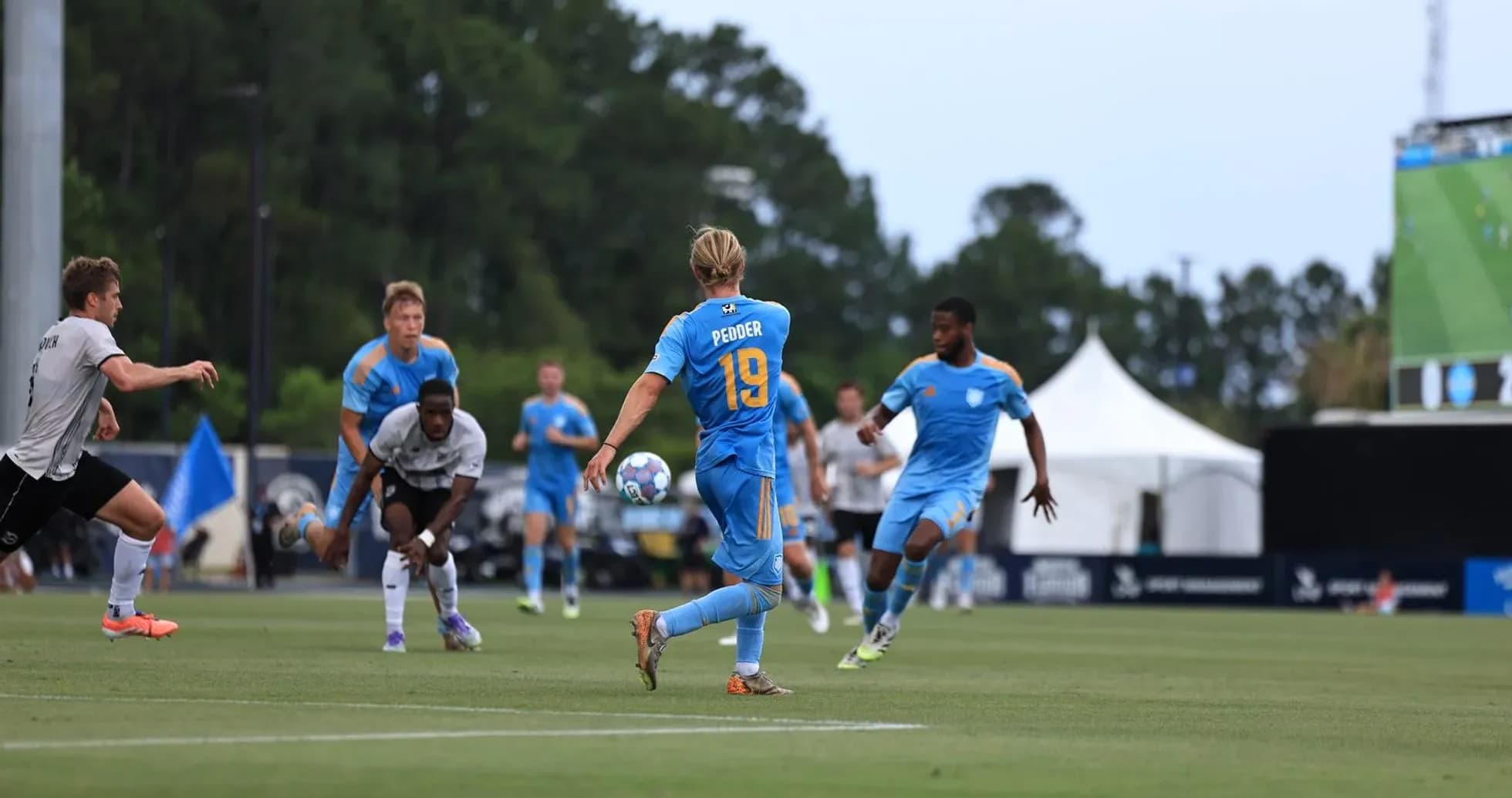
Under the lights at Hodges Stadium, Sporting JAX and Brooklyn shared a 2–2 draw that felt less like a deadlock and more like a tactical reset for two sides trying to redefine their season identities in the USL Championship. Match finished in regular time under referee B. Meyer, with Brooklyn’s 2–1 half‑time advantage eventually erased by a more assertive second‑half response from the hosts.
I. The Big Picture – Two Struggling Identities Collide
Following this result, the table still paints a stark picture. Sporting JAX sit 13th in USL 1 on 3 points, with a goal difference of -14, built from 12 goals scored and 26 conceded across 11 matches. Their seasonal DNA is clear: at home they are relatively more dangerous going forward but remain porous. At Hodges Stadium they have scored 8 goals in 5 matches, an average of 1.6 at home, but conceded 14, an average of 2.8 at home. On their travels they have added only 4 goals in 6, averaging 0.7 away, while allowing 12, an average of 2.0 away.
Baltimore, 12th with 8 points and a goal difference of -9 (11 for, 20 against), carry a different split personality. At home they are competitive and compact: 6 goals scored and 5 conceded in 6 matches, exactly 1.0 scored and 0.8 conceded on average at home. Away from home, though, they unravel defensively. On their travels they have scored 5 in 5 (1.0 away on average) but conceded 15, shipping an average of 3.0 away.
The 2–2 scoreline, with Sporting JAX coming from behind, fits the season-long patterns: the hosts can hurt teams at Hodges Stadium, but rarely control games; Brooklyn can strike, but cannot close the door away from home.
II. Tactical Voids – Discipline, Fatigue, and Invisible Absences
No explicit injury list is provided, so the tactical voids here are more structural than personnel-based. For Sporting JAX, the season-long form line of LDLLLLLLLDD and 0 wins in 11 fixtures tells of a side still searching for a stable spine. They have yet to keep a single clean sheet overall, at home or away, and have failed to score in 5 matches overall. The absence, then, is not a missing player but a missing reliable defensive framework.
Disciplinary trends underline this instability. Sporting JAX’s yellow cards cluster late: 27.59% of their bookings arrive between 76–90 minutes, with another 20.69% between 61–75 and 20.69% between 46–60. They also have a red‑card profile that spikes at high‑stress moments: 50.00% of their reds come between 16–30 minutes, and 50.00% between 76–90. This is a team that frays under pressure, especially as legs tire and game states become more chaotic.
Brooklyn’s card map is different but equally revealing. Their yellows peak in the 46–60 and 61–75 windows, each carrying 20.83% of their bookings, suggesting aggressive mid‑second‑half pressing or tactical fouling as they try to wrestle back control. Intriguingly, 25.00% of their yellow cards fall in the 91–105 range, and their only red card this season has also arrived in that 91–105 window, pointing to late‑game emotional spikes and risky challenges when protecting or chasing results.
In this fixture, those profiles translate into a late‑game tension zone: Sporting JAX’s tendency to pick up cards between 76–90 collides with Brooklyn’s history of disciplinary issues spilling into added time. Any future meeting between these sides will likely be decided not just by tactics, but by who keeps their nerve in the final quarter‑hour and beyond.
III. Key Matchups – Hunter vs Shield, Engine Room Battles
With no top‑scorer or assist tables available, the “Hunter vs Shield” narrative must be built from positional roles and structural needs rather than raw individual numbers. For Sporting JAX, the attacking burden naturally falls on the creative and forward‑facing cluster of K. Sadlier, E. Jaaskelainen, R. Pedder and T. Rose. Sadlier, wearing 10, is the likely reference point between lines, while Jaaskelainen and Pedder provide vertical running and penalty‑box presence.
Their collective task is to exploit Brooklyn’s glaring away weakness: 15 goals conceded on their travels at an average of 3.0 away. Brooklyn’s “shield” is the central defensive triangle of goalkeeper J. Lee and centre‑backs V. Latinovich and T. Vancaeyezeele, supported by full‑backs Gabriel Alves and R. McLaughlin. When this unit holds its line and keeps the ball in front of them, Brooklyn resemble their home‑form version: compact and difficult to break. When stretched, as the away numbers show, they concede heavily.
In midfield, the “Engine Room” battle is defined by contrasting profiles. Sporting JAX lean on W. Kuzain and J. Rossiter to connect back to front and protect a back line that has allowed 2.4 goals per match overall. Their job is twofold: to slow transitions against Brooklyn’s direct outlets like J. Obregon and C. Olney JR, and to release wide and advanced runners early enough to pin Brooklyn’s full‑backs deep.
Brooklyn’s response comes from the technical and tactical intelligence of T. McNamara and M. Pinto, supported by S. Stojanovic and P. Mangione between the lines. This group must manage tempo, especially after half‑time, where Brooklyn’s yellow‑card spikes suggest a tendency to get dragged into frantic exchanges. If McNamara and Pinto can keep the ball and dictate rhythm, they can expose Sporting JAX’s fragile defensive averages and force the hosts’ midfield two into deeper, reactive positions.
On the benches, Sporting JAX’s options such as J. Evans, A. Reid and W. Ackwei offer energy and fresh legs, critical for a side whose disciplinary and defensive issues intensify late. Brooklyn’s substitutes list — including S. Hundal, J. Servania and J. Klein — hints at additional pace and creativity, ideal for exploiting space as Sporting JAX chase games or tire.
IV. Statistical Prognosis – xG Shape and Defensive Solidity
Even without explicit xG values, the season data allows a clear expected‑goals shape. Heading into any future clash between these two, you would project Sporting JAX to generate chances roughly in line with their home average of 1.6 goals for, while conceding opportunities consistent with their 2.8 home goals‑against figure. Brooklyn, away, typically create enough for about 1.0 goal while allowing chances worth close to their 3.0 away goals‑against average.
Overlay those profiles and the statistical prognosis leans toward a chance‑rich, defensively open contest, with Brooklyn’s away fragility and Sporting JAX’s overall lack of clean sheets combining to produce a high‑variance match. Penalties are unlikely to be a bailout: both sides have been perfect from the spot so far, but Sporting JAX have taken 3 overall and Brooklyn only 1, and neither has yet missed, so any awarded penalty is more likely to confirm the underlying xG trend rather than transform it.
Following this 2–2 draw, the narrative shifts slightly. Sporting JAX have shown they can fight back at home and turn their attacking potential into goals. Brooklyn have once again demonstrated that they can score but cannot reliably protect leads away. Until one of these sides repairs its defensive structure — Sporting JAX at home, Brooklyn on their travels — future meetings are likely to be shaped less by control and more by momentum swings, late‑game discipline, and which engine room can keep its composure when the match stretches into chaos.
Related News
San Antonio's Tactical Edge Secures 2–1 Victory Over Colorado Springs

Charleston Battery Dominates Loudoun United 4–1 in Statement Win

Miami FC vs Orange County SC: USL Championship Clash Highlights
Colorado Springs vs San Antonio: USL Championship Group Stage Preview

Charleston Battery vs Loudoun United: Match Preview
Miami FC vs Orange County SC Match Preview