
Switzerland's Tactical Masterclass in 2-0 Victory Over Algeria
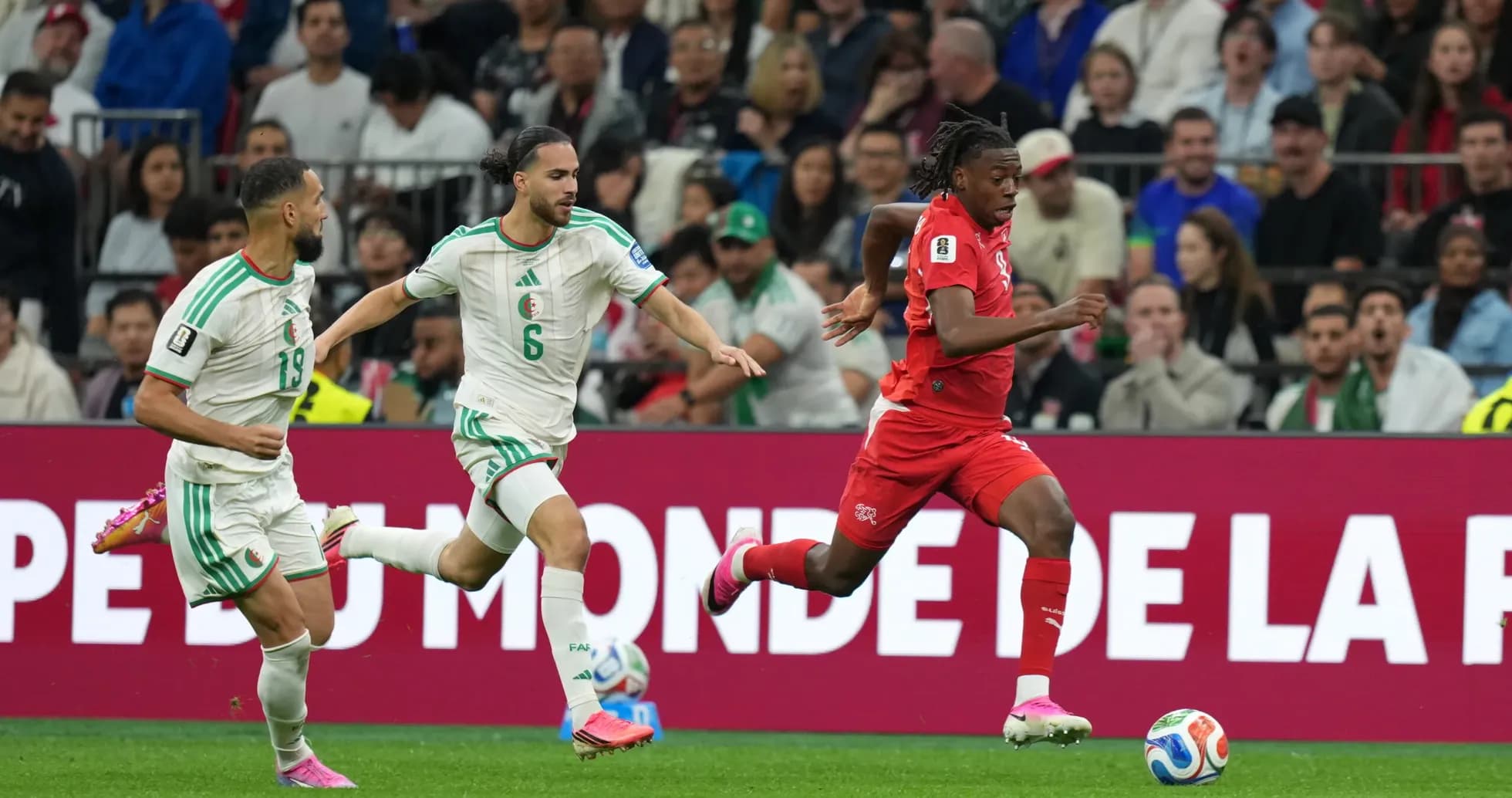
Switzerland’s 2-0 win over Algeria at BC Place in this World Cup Round of 32 tie was a controlled, structurally coherent performance built on a compact 4-2-3-1 and ruthless exploitation of key moments, rather than territorial dominance. Despite ceding 55% possession and facing a technically adept Algerian midfield, Murat Yakin’s side consistently manipulated the central zones and half-spaces to create higher-quality chances, reflected in a clear xG edge of 2.56 to 0.73.
Out of possession, Switzerland’s 4-2-3-1 was highly disciplined. Manuel Akanji and Nico Elvedi held a relatively high but narrow line, with Ricardo Rodríguez and Denis Zakaria tucking in to form a compact back four that invited Algeria toward the flanks. Granit Xhaka and Remo Freuler screened intelligently, staying close enough to deny Ramiz Zerrouki and Nabil Bentaleb clean progression lanes, but without overcommitting into pressing traps they could not win. This allowed Switzerland to keep Algeria’s 4-3-3 largely in front of them; Algeria managed eight total shots but only two on target, underlining how often they were forced into lower-quality efforts.
In possession, Switzerland’s structure tilted subtly. Rodríguez advanced more aggressively on the left, with Rubén Vargas moving inside to form an interior triangle with Xhaka and Johan Manzambi. On the right, Zakaria was more conservative, giving Dan Ndoye the license to attack one‑v‑one and underlap into the half-space. Breel Embolo acted as a hybrid target and channel runner, pinning Aïssa Mandi and Ramy Bensebaini while also drifting wide to create overloads.
Opening Goal
The opening goal on 10 minutes captured Switzerland’s attacking plan. A vertical progression through midfield found Manzambi between Algerian lines, and his assist to Embolo exploited the gap between Algeria’s centre-backs and full-backs. Embolo’s timing and body orientation were key: he received on the move, attacked the space behind the line, and finished clinically. It was a textbook use of the 4-2-3-1’s central overload to isolate a forward in a high-value zone; Switzerland would end with nine of their 11 shots coming from inside the box.
Algeria’s 4-3-3, under Vladimir Petkovic, sought to dominate the ball and use the technical qualities of Farès Chaïbi, Riyad Mahrez and Houssem Aouar between the lines. Their 561 total passes at 85% accuracy, versus Switzerland’s 436 at 81%, show that they succeeded in establishing possession platforms. However, the circulation was too often in front of Switzerland’s block. When they did try to accelerate, Swiss counterpressing around Xhaka and Freuler forced rushed decisions, contributing to only five shots inside the box and a modest 0.73 xG.
Second Goal
The second Swiss goal, immediately after half-time at 46 minutes, was tactically decisive. Ndoye’s strike came at the perfect psychological moment, just as Algeria would have been adjusting any interval tweaks. It underlined Switzerland’s ability to attack quickly after regains and restarts, catching Algeria before their 4-3-3 defensive structure could reset. At 2-0, Switzerland could lean even more into their controlled mid-block, prioritising compactness over pressing high.
Both coaches turned to the bench to shift dynamics. Algeria’s double change on 58 minutes — Amine Gouiri (IN) came on for Ramiz Zerrouki (OUT) and Jaouen Hadjam (IN) came on for Houssem Aouar (OUT) — signalled a move toward greater attacking risk, reducing midfield ballast to add forward threat and extra width. Later, at 71 minutes, Anis Hadj Moussa (IN) came on for Riyad Mahrez (OUT) and Hicham Boudaoui (IN) came on for Nabil Bentaleb (OUT), further refreshing the front line and midfield energy. Structurally, this pushed Algeria toward a more aggressive, almost 4-2-4‑like posture in possession, with full-backs higher and more players committed ahead of the ball.
Yakin’s response was measured. At 71 minutes, Fabian Rieder (IN) came on for Rubén Vargas (OUT), adding fresh legs and defensive work rate in the advanced midfield band, while Noah Okafor (IN) came on for Johan Manzambi (OUT), providing a direct outlet on the break. Later, Zeki Amdouni (IN) came on for Breel Embolo (OUT) at 83 minutes to maintain pressing from the front, and Silvan Widmer (IN) came on for Denis Zakaria (OUT) plus Michel Aebischer (IN) for Dan Ndoye (OUT) at 87 minutes, shoring up the right flank and ensuring defensive stability in the closing phase. These changes preserved the 4-2-3-1’s integrity while keeping intensity high in the wide channels where Algeria were trying to force late entries.
Defensive Performance
Defensively, Switzerland were helped by strong goalkeeping fundamentals from Gregor Kobel (Switzerland). He made 2 saves, but more importantly, his positioning and command of the box reduced the need for desperate interventions, aligning with Algeria’s low xG. At the other end, Luca Zidane (Algeria) also made 2 saves, yet Switzerland’s 2.56 xG shows that the Algerian defensive structure allowed too many high-quality looks; both keepers’ goals prevented figure of -0.29 underlines that neither outperformed the underlying shot quality.
Statistically, the match tells a clear tactical story. Algeria’s 55% possession and higher passing volume did not translate into penetration, constrained by Switzerland’s compact 4-2-3-1 and well-drilled double pivot. Switzerland, with 11 total shots (five on goal, nine inside the box) and four corners, consistently reached better zones and created more dangerous situations. Algeria’s eight shots, only two on target and three blocked, reflect their struggle to turn territory into real jeopardy.
Discipline also played a subtle role. Algeria collected two yellow cards — Farès Chaïbi for “Tripping” at 36 minutes and Hicham Boudaoui for “Roughing” at 72 minutes — often as a by-product of being late into duels once Switzerland had played through the first line of pressure. Switzerland, by contrast, avoided bookings entirely, mirroring their controlled, low-risk defensive approach.
Overall, Switzerland’s victory was less about volume and more about clarity: a clear defensive structure, efficient use of central overloads, and well-timed substitutions that protected their advantage while still offering a counter-attacking threat. Algeria’s possession-based 4-3-3 lacked vertical incision and, against a compact and disciplined opponent, never found a consistent route to destabilise the Swiss block.
Related News
Brazil's First Post-World Cup Friendly: What Should the Lineup Be?
Harry Kane Calls England’s World Cup Exit to Argentina His Deepest International Pain
Estevao Opens Up on World Cup Heartbreak and His Unexpected Return to Brazil Under Ancelotti
Thomas Tuchel Shares Unusual Regret After England's 10-Man World Cup Victory Over Mexico
South Korea Names Robert Moreno as Interim Coach After World Cup Exit

Jude Bellingham Returns to Form at Real Madrid Following World Cup Success