
Tuchel's Blunt Critique of England's Left Flank
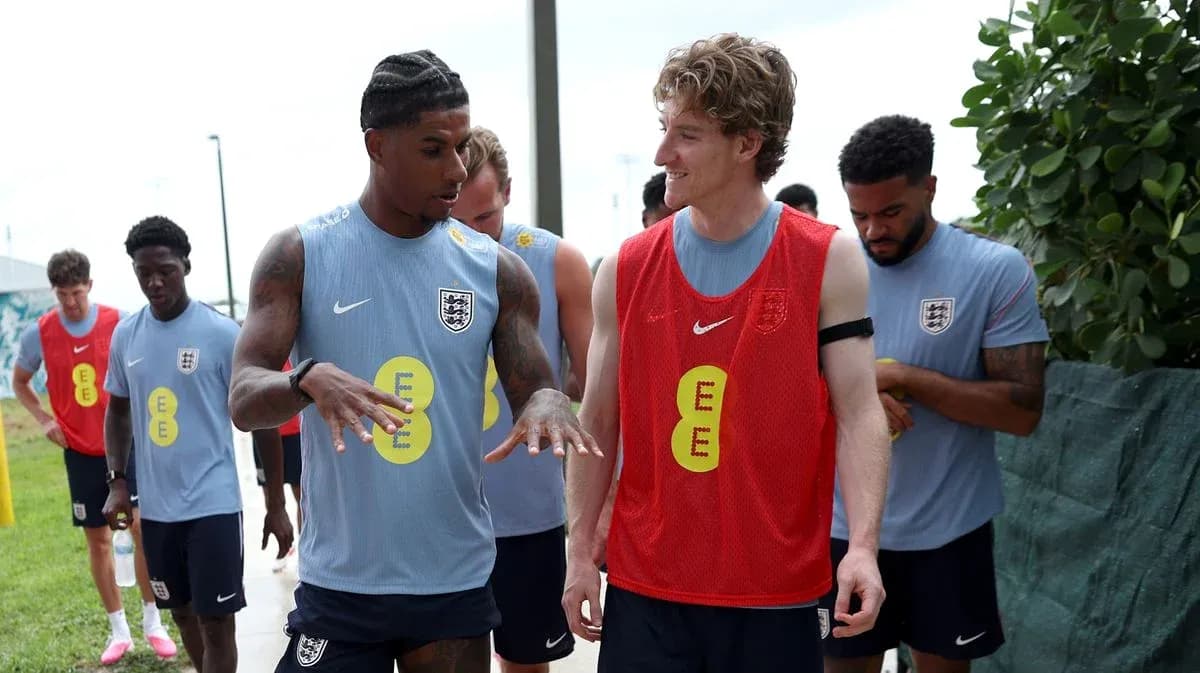
Thomas Tuchel did not bother with diplomacy. Not with a World Cup group on the line and one flank of his England side misfiring.
The Three Lions manager delivered a blunt assessment of his entire left side, taking aim at Anthony Gordon, Marcus Rashford and the full-backs Nico O’Reilly and Djed Spence after a laboured start to the tournament.
Left flank under fire
Tuchel thought the problem had been cracked. Gordon dazzled in the final warm-up against Costa Rica, the combinations on that side looked slick, and the manager walked away believing he had found his solution.
“I saw the game against Costa Rica and thought: ‘OK, left side is solved, this unit, they find their link,’” he said.
That conviction has quickly evaporated.
Across England’s first two group matches, Tuchel has seen little of the “connection and penetration” he demands down that flank. The numbers are not the issue; the chemistry is. The understanding that looked so natural in a friendly has vanished under tournament pressure.
“The unit on the left side hasn't provided the same quality as they did against Costa Rica,” Tuchel admitted. “It was not the same amount of connection, not the same amount of penetration, not the same amount of verticality.”
He did not spare the full-backs either. O’Reilly paid the price as Spence came in at left-back against Ghana, but the manager’s criticism clearly extends beyond one selection. The entire channel, from back to front, stands accused of under-delivering.
Rashford the impact man, not the starter
Rashford sits at the heart of this debate. The question was simple: will he start against Panama? The answer turned into a wider indictment of England’s left side.
“Marcus is in a good place, but when he started he was not as decisive as Anthony, that's just it,” Tuchel said.
The manager praised Rashford’s influence off the bench. He has repeatedly turned games as a substitute, stretching tired defences and injecting urgency. Tuchel even admitted that holding him back can be useful.
“He struggled to have the same influence for us from the start, and yet from the bench he was always pushing,” Tuchel said. “Marcus is just also very good from the bench, and it's sometimes nice to hold someone back.”
The conundrum is clear. With Gordon, Rashford, Eberechi Eze and Spence, Tuchel thought he had two functioning “units” on the left. In the Costa Rica friendly, both combinations clicked. In the World Cup group stage, neither has.
“It turns out we played the first match and they're not clicking, I’m not even sure why,” he admitted.
Tuchel insists his trust has not wavered. Rashford, he says, “is a candidate to start,” but the message could not be clearer: “the left side in general, no matter who plays, needs to click a bit more and provide a bit more threat.”
Wrestling with the low block
England’s problems are not confined to one flank. The goalless draw with Ghana has left Tuchel’s side under pressure to beat Panama at the MetLife Stadium to secure top spot in the group, and it has sharpened the focus on how this team copes against deep, disciplined defences.
“It is difficult to accelerate the match against these low blocks,” Tuchel said. He pointed to similar struggles in the Champions League and Premier League, where even elite sides can spend 90 minutes probing without reward.
For Tuchel, the margins are tiny: “It needs this one moment of quality and a bit more precision with the crossing. A bit more timing with the crosses, maybe a bit more awareness with the crosses.”
Who attacks the ball? Who gambles on the second phase? Who shoots from distance to force a deflection or a scramble? These are the questions he wants his players answering in real time.
“I haven’t found the recipe where ‘they do this, then we do this - and then we are fine,’” he admitted. “Maybe I am proven wrong but I don’t think anyone likes to play against Ghana.”
Ghana’s celebrations told their own story. “Once Ghana came over the halfway line they celebrated like it was a goal,” Tuchel said. At full-time, they greeted the 0-0 like a famous win. England trudged off frustrated. The contrast underlined the reality of the contest.
Tuchel, though, refused to label it a disaster. “The highs should not get too high. The lows should not get too low. I don’t think it was a low,” he argued, pointing out that his team still had to contain dangerous counter-attacks and “did enough to win the Ghana game.”
Panama next, and no room for naivety
Now comes Panama, ranked 42nd in the world, 23 places above Ghana. On paper, that ranking should sharpen England’s focus. On the pitch, Tuchel expects something very familiar: another deep defensive block, another long night of patience and precision.
“We will try to find a very active and aggressive approach now against Panama but we cannot just be stupid and naive,” he said.
Tuchel is preparing for a shifting defensive wall: “We will face another deep block in another kind of formation. We now see a back five. For many moments in the match we see a back six, we see a back seven.”
The challenge is as much mental as tactical. Break the line once and the game opens up. Fail, and the noise grows louder.
The Palmer, Foden and Alexander-Arnold debate
That noise is already here. The draw with Ghana triggered an inevitable debate about who Tuchel did not bring to this World Cup: Cole Palmer, Trent Alexander-Arnold, Phil Foden. The kind of players many believe could unlock a packed defence with one pass or one moment of invention.
Tuchel has heard it all before.
“I cannot engage this after a draw,” he said, noting that Spain, Brazil and Portugal have all dropped points in their groups. For him, the story is not about the absentees but about the reality of the opponent.
He revealed a telling message from a “very famous” and “very well respected” coaching colleague after Carlos Queiroz took over Ghana.
“He texted us: ‘Your most difficult game is now the second game, I tell you that.’”
Tuchel’s respect for Queiroz’s organisation and Ghana’s discipline runs deep. “They made life very difficult for us,” he said. That, in his view, is where the analysis should start, not with fantasy squads or hindsight.
“It’s a reflex, things don’t go well and then the guys on the bench are suddenly the winners or the guys at home are the winners. That’s not it,” he said. “The game needs to be played how it’s played. It played out to be difficult.”
Tuchel stands by his selection. “We selected a group from the evidence that we had. It cannot be that you’re not selected as a player and suddenly you will be. This is not how it works.”
The England manager knows the scrutiny will only intensify if his side stumble again. He also knows there is only one way to quieten it.
“We want to step up in the next game,” he said.
On the left flank, in front of goal, and in the group table, England have nowhere else to go.
Related News

Anthony Joshua Names Murat Gassiev as Next Opponent if He Defeats Tyson Fury

UFC 332: Start Time and Fight Highlights for Natalia Silva vs. Wang Cong
Court McGee Opens Up About Choosing UFC 332 as His Final MMA Fight
WBC Orders Lightweight Title Unification: William Zepeda vs Jadier Herrera
BCCI Pension List: Monthly Payments to Retired Indian Cricketers in 2025

Why Fury vs Joshua Is Set for Cardiff, and Dua Lipa’s Unexpected Role