
United States Triumphs Over Australia in World Cup Showdown
Soccer won. That much felt inevitable on a mild, bright Friday in the Pacific north-west, where two nations that actually agree on the word “soccer” met with something bigger than three points at stake.
What nobody could script was how hard the United States would have to work to make a 2-0 look routine.
In front of 66,925 fans in a heaving, partisan Seattle Stadium, the hosts punched their ticket to the knockout round and put one hand on top spot in Group D, their position to be confirmed once Turkey and Paraguay finish their business later in the day. It was loud, tense, and at times raw. It was also a reminder that for the US and Australia, every World Cup still feels like a referendum on the sport’s future back home.
A stage dressed for a statement
The occasion never needed selling. Two sides fresh off impressive opening wins. A group with no soft touches. One of American soccer’s heartlands turned into a wall of red, white and blue, pierced by three defiant pockets of yellow.
Australia’s fans, massed around the south end, never stopped. They sang, they whistled, they roared their Socceroos on. They were outnumbered, not outvoiced. Yet this was unmistakably a US house. Every US touch in midfield drew a growl of approval, every Australian foray a nervous intake of breath.
Then came the flyover: four military helicopters sweeping over the stadium, timed to the final notes of the national anthem. It added steel to an already charged atmosphere. Patriotic spectacle before the football could speak for itself.
No Pulisic, no problem?
All week, the story had been Christian Pulisic’s calf. The star forward had limped out of the opener at half-time, then trained apart from his teammates. Every training clip, every still photograph, was dissected. Was he limping? Was he sprinting? Was he hiding something?
Mauricio Pochettino ended the guessing game shortly before kick-off. Pulisic was out, not available for selection. For a US side still learning to live with expectation, it posed a blunt question: could they break down a disciplined Australian backline without their main man?
Australia, for their part, arrived with a different kind of motivation. In the build-up, a few US pundits had dismissed them as a “layup,” a warm-up act for bigger challenges to come. The Socceroos noticed. Tony Popovic didn’t need to pin those words on the dressing-room wall; his players had already done it in their heads.
The US camp took a different line. Player after player, Pochettino included, spoke about Australia’s quality, about their physicality and structure, about how hard this would be. It sounded almost rehearsed, like a mantra. On the evidence of the opening minute, they were right to be wary.
Early scare, early break
Barely 60 seconds in, Alex Freeman’s loose pass invited trouble. Mohamed Touré pounced, driving toward goal. Chris Richards held his ground, forced him wide, and Touré’s low effort from a tight angle thudded harmlessly into Matt Freese’s arms. A warning, nothing more. But it snapped the US into focus.
From there, the hosts settled. They moved the ball with patience, working both flanks, trying to pull apart Australia’s compact lines. It was methodical, not spectacular. Then, suddenly, it was 1-0.
Antonee Robinson stepped up and slid a pass into Folarin Balogun, stationed wide left in the space Pulisic might usually occupy. Balogun simply burned past Jacob Italiano and drove a vicious low ball into the six-yard box. Defender Burgess, scrambling to adjust, could only stab it into his own net.
For the second straight match, the US had an early lead via an opponent’s misfortune. Paraguay had crumbled when it happened to them. Australia did not.
Within two minutes, they tried to hit back. Touré, wrestling with a tight US backline, laid the ball off for Mathew Leckie at the top of the box. Leckie went for the spectacular, an outside-of-the-boot curler around Richards. It flew high and wide, but it was a reminder: this would not be a procession.
The physical edge that both camps had predicted began to surface. Nishan Velupillay thundered into Tyler Adams right in front of the US bench, drawing howls from the crowd. Jordan Bos collected the first yellow for a hand to Weston McKennie’s face. Later, Alessandro Circati joined him in the book for clipping Malik Tillman as the US midfielder surged toward the box. The free-kick that followed was bravely headed clear.
Freeman’s redemption, and a crucial second
The half threatened to drift into a tactical arm-wrestle until the 39th minute brought a jolt. Freeman and Paul Okon-Engstler clashed heads going for a ball, both players crumpling to the turf and requiring treatment. It looked nasty. It also looked like the kind of moment that can change a game’s temperature.
Both men stayed on. Freeman did more than that. Moments later, he doubled the US lead.
The move started with Tillman, refusing to give in near the byline on Australia’s left. He fought Velupillay, shielded the ball, and eventually drew a foul in a dangerous area. Robinson rolled the free-kick back to the top of the box, where Sergiño Dest wound up and let fly. Harry Souttar launched himself into the shot, deflecting it, but only into chaos.
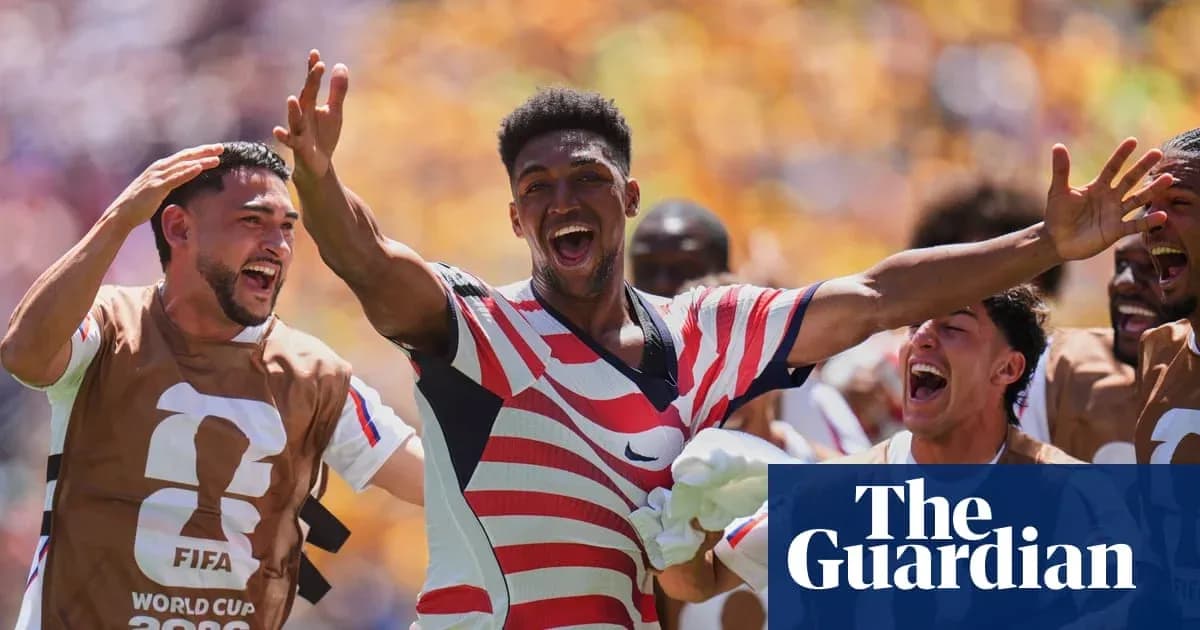
Freeman reacted first. He bundled the rebound over the line, a scruffy, vital goal that went to a VAR check for offside before being allowed to stand. By then, the defender had already sprinted the length of the pitch, celebrating near the opposite end, swallowed up by teammates pouring from the bench. From early error to cathartic goal, his night had spun on its axis.
At 2-0, with the crowd in full voice, the US had exactly what they wanted: a cushion, a platform, and the chance to manage the game.
Popovic rolls the dice
Popovic had seen enough of the first-half pattern. When the teams re-emerged, Australia were almost unrecognizable in shape and personnel.
Jason Geria replaced Burgess. Nestory Irankunda and Connor Metcalfe, the two scorers from the Socceroos’ opener, came on for Touré and Velupillay. On paper, it was a switch to a more aggressive 4-3-3 in possession, though without the ball they still dropped into a five-man backline.
The message was clear: Australia were coming.
Seven minutes into the half, they almost paid for that ambition. McKennie seized on a loose ball and slid Balogun through the middle, with only Souttar chasing. Balogun drove at goal, but the towering centre-back did just enough, and the shot was blocked. A let-off. A warning that the US could still slice through on the counter.
Australia kept pushing. Robinson picked up the US’s first yellow card in the 56th minute, forced to drag back a developing move down his flank. The pressure was building, slowly, stubbornly.
Just after the hour, Popovic made another attacking tweak, sending on Cristian Volpato for Leckie. The Sassuolo midfielder almost made an instant impact. Irankunda, electric down the right, tore into space and squared. Volpato arrived in the box but blazed over the bar. Minutes later, Metcalfe forced Freese into a routine smother. Half-chances, but enough to keep US nerves humming.
Hanging on, standing firm
The pattern of the final half-hour was clear: Australia throwing bodies forward, the US shuffling pieces to protect what they had.
Popovic pushed again, introducing Jackson Irvine for Okon-Engstler to add more drive from midfield. Pochettino answered by tightening the screws. Robinson, Dest, and Ricardo Pepi made way for Sebastian Berhalter, Auston Trusty, and Joe Scally, each move a small step toward a more defensive posture.
The changes tilted the field. Australia grew into the game, pinning the US back for long stretches. Circati flashed a desperate effort wide. Crosses flashed through the box, just beyond a stretching boot or a late run. Near-misses piled up, but the scoreboard refused to budge.
The temperature rose with the stakes. Crunching tackles drew furious reactions. The crowd roared “USA” in rhythmic waves, trying to drag the team over the line. Late yellow cards for Souttar, Balogun and Italiano — some for fouls, some for off-the-ball flashpoints — told their own story about the game’s frayed edges.
Even the referee didn’t escape unscathed. Felix Zwayer suffered an odd injury that briefly halted play before he resumed, limping through the final minutes.
When the whistle finally came, the release was instant. Balogun, sensing the moment, turned to the stands, arms windmilling, inviting a celebration worthy of a city that had just watched its national team impose itself on a dangerous opponent.
Soccer, on this day, belonged to the United States. The question now is whether this blend of resilience, depth and big-stage composure can carry them from “host nation under pressure” to something far more serious in the weeks ahead.
Related News
Anthony Joshua Names Murat Gassiev as Next Opponent if He Defeats Tyson Fury
UFC 332: Start Time and Fight Highlights for Natalia Silva vs. Wang Cong
Court McGee Opens Up About Choosing UFC 332 as His Final MMA Fight
WBC Orders Lightweight Title Unification: William Zepeda vs Jadier Herrera
BCCI Pension List: Monthly Payments to Retired Indian Cricketers in 2025
Why Fury vs Joshua Is Set for Cardiff, and Dua Lipa’s Unexpected Role