
World Cup Last 16: England Faces Mexico in High-Stakes Match
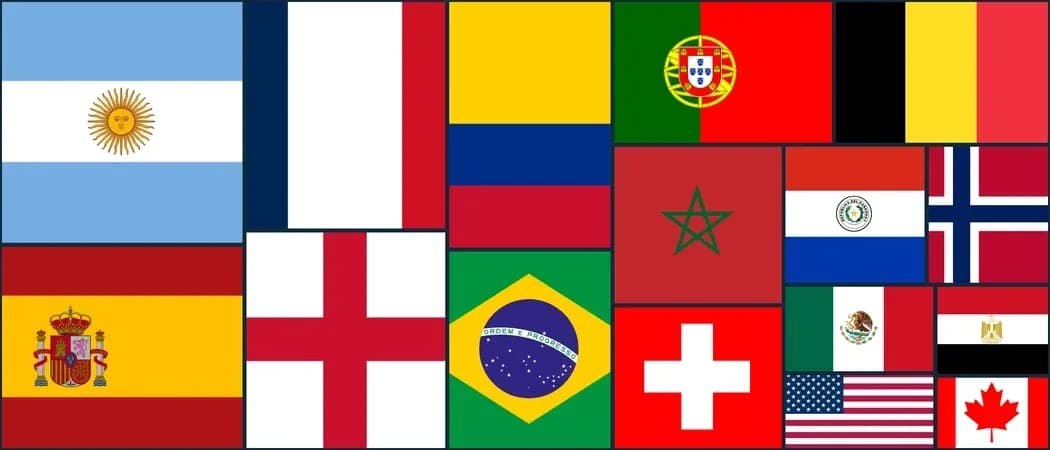
Six days, 16 matches, and half the field is gone. The World Cup has shed its excess and arrived at the last 16 with a familiar look: Europe and South America in command, a handful of outsiders clinging to the dream, and one seismic shock already reshaping the tournament.
Germany are out. Not in a late collapse in normal time, not to another heavyweight, but on penalties to Paraguay – a result that ripped up the bracket and the numbers. The Germans came into that tie with roughly a 63% chance of progressing, the model’s clear favourite. The shoot-out swung the axe instead, and with it shifted the balance of power at the top of the market.
Senegal nearly delivered a second thunderclap of similar scale. Had they held on against Belgium, the upset would have rivalled Paraguay’s ambush. They didn’t, but the warning shot was clear: the underdogs are not just making up the numbers.
Morocco’s win over the Netherlands looked like another shock on paper, though the data tells a subtler story. Elo ratings had the Dutch at only about 55% – a marginal edge rather than heavyweight dominance. This was always one of the round’s most even contests, and it played out like it.
Some of the supposedly straightforward ties were anything but. Cape Verde, given just a 10% chance of knocking out holders Argentina, dragged them all the way to extra time. Congo, rated at 17% to progress, led England with 15 minutes to go. The favourites survived, but not without a scare and not without consequence for their title chances.
Old powers, new pretenders
The last 16 has a familiar feel. All Asian sides have gone. Africa is down to just two representatives. The bracket is once again dominated by Europe and South America.
On the outside looking in are Canada, Egypt, Mexico, Morocco and the United States – five nations carrying the hopes of the non-traditional powers. Between them, their combined chance of lifting the trophy is only about 3.5%. They are long shots, not fairy tales in waiting, at least according to the numbers.
At the other end of the spectrum, the usual suspects. Argentina are still the team to beat, but not quite with the aura they carried into the knockouts. Surviving Cape Verde in extra time has trimmed their overall probability of winning the World Cup to 28%. The drop is not just about their own laboured performance; it also reflects the fact that France have quietly cashed in on Germany’s exit.
France now sit at around a 14% chance of lifting the trophy, Spain at 16%. Both cruised through their first knockout tests – Spain brushing aside Austria, France doing the same to Sweden – and every step forward in a tournament like this magnifies probability as much as perception.
England, meanwhile, edge up to 12%. That rise says as much about the shrinking field as it does about Gareth Southgate’s side. Brazil and Argentina still loom in their path, assuming England first handle a far more immediate and awkward assignment: Mexico, in Mexico City.
England, Mexico and the myth of the mountain
Altitude has become the talking point. England at the Estadio Azteca, the hosts at over 2,000 metres, the thin air, the heavy legs, the old stories of teams wilting on the slopes of Latin America.
Strip away the mythology and the data offers a cooler view.
Even after accounting for home advantage, the underlying numbers rate England as the stronger side. On expected goals, Mexico sit at 0.6, England at 1.6 – a full goal’s worth of edge. Turn that into probabilities and you get England at 62% to win outright, Mexico at 13%, and a 25% chance of a draw that would drag the tie to penalties.
So what does altitude really do?
Across thousands of international matches played at different heights, the pattern is not what the folklore suggests. Around a third of all games have been staged within 250 metres of sea level, where home teams win about 55% of the time. Between 250 and 750 metres, in a sample of close to 4,000 matches, the picture barely shifts. Even in the narrow band between 2,000 and 2,250 metres – where Mexico City sits, with just 265 games historically – home teams have won 52% of the time. That is actually a slightly lower home advantage than at sea level.
The raw numbers, though, don’t tell the whole story. Team strength matters. That is where the Economic Observatory’s Elo ratings come in – a system that tracks results and performance and correlates closely with FIFA’s own rankings. These ratings can be interpreted as the expected probability of a home win: 1 if the home team is virtually certain to win, 0 if the away side should dominate.
By coding a home win as 1 and everything else as 0, then subtracting the Elo prediction and averaging the difference, you can see where home teams outperform or underperform expectations. Below 1,750 metres, the pattern is broadly as expected: home teams win roughly as often as their ratings suggest.
Above that line, something changes. High-altitude nations – Bolivia above 3,000 metres, and Ecuador, Ethiopia and Mexico above 2,000 – start to punch slightly above their Elo weight. The over-performance at the highest levels of altitude reaches around 20 percentage points, though that sits within the margin of error. It hints at an edge, not an overwhelming one.
Translate that into England’s meeting with Mexico and you get a more nuanced picture. If you assume altitude shaves 0.25 expected goals off England and hands the same boost to Mexico, England’s win probability falls to about 48%. Mexico’s rises to 24%. The remaining chunk is the draw and the lottery of penalties.
Altitude, then, is a leveller. It nudges a clear favourite back towards the pack. It does not, on the evidence, turn a superior side into a coin toss.
England still arrive as the better team by past results, by Elo, and by market-based measures such as Transfermarkt valuations. They carry the weight of expectation; Mexico carry the air – and perhaps just enough of it – to make this more than a routine assignment.
The rest of the bracket
Beyond Mexico City, the numbers sketch out a last 16 that tilts heavily towards the established powers.
Simulations based on team strength point to Argentina advancing against Egypt with a 77% likelihood. England, even with the altitude caveat, are rated at 74% to progress past Mexico. Morocco, fresh from toppling the Netherlands, are 70% favourites to beat Canada.
Spain are given a 72% chance of knocking out Portugal in a tie loaded with history and tactical intrigue. Colombia are 70% likely to overcome Switzerland. Brazil, always lurking near the top of any World Cup model, are at 69% to get past Norway. Belgium, who survived Senegal’s scare, are 64% favourites against the United States.
And then there is France versus Paraguay.
On paper, it looks like one of the more lopsided fixtures. In reality, the model sees it as France’s sternest examination yet. Their chance of progression stands at just 62%, the lowest among the major favourites in this round.
The reason lies in Paraguay’s defensive steel. As flagged before the tournament in Group D analysis, this is a side built on resilience. Aside from their more open opener against the United States, they have stuck to that identity and been rewarded for it.
The expected goals tell the story: France at 1.1, Paraguay at 0.6. For a free-scoring French attack, that is a noticeable drop. Space will be tight, chances fewer, frustration almost guaranteed if an early breakthrough does not come.
Germany’s fall has blown the top of the bracket wide open. France and Spain have stepped into the gap. Argentina are still out in front, but no longer cruising. England face the climb, literally and figuratively. Mexico have the altitude, the crowd and a sliver of statistical wind at their backs.
Now comes the question that will define this World Cup: do the numbers keep holding, or is there another Paraguay waiting in the shadows of the last 16?
Related News

Anthony Joshua Names Murat Gassiev as Next Opponent if He Defeats Tyson Fury

UFC 332: Start Time and Fight Highlights for Natalia Silva vs. Wang Cong

Court McGee Opens Up About Choosing UFC 332 as His Final MMA Fight

WBC Orders Lightweight Title Unification: William Zepeda vs Jadier Herrera

BCCI Pension List: Monthly Payments to Retired Indian Cricketers in 2025

Why Fury vs Joshua Is Set for Cardiff, and Dua Lipa’s Unexpected Role