
Andoni Iraola's Tactical Challenges at Liverpool
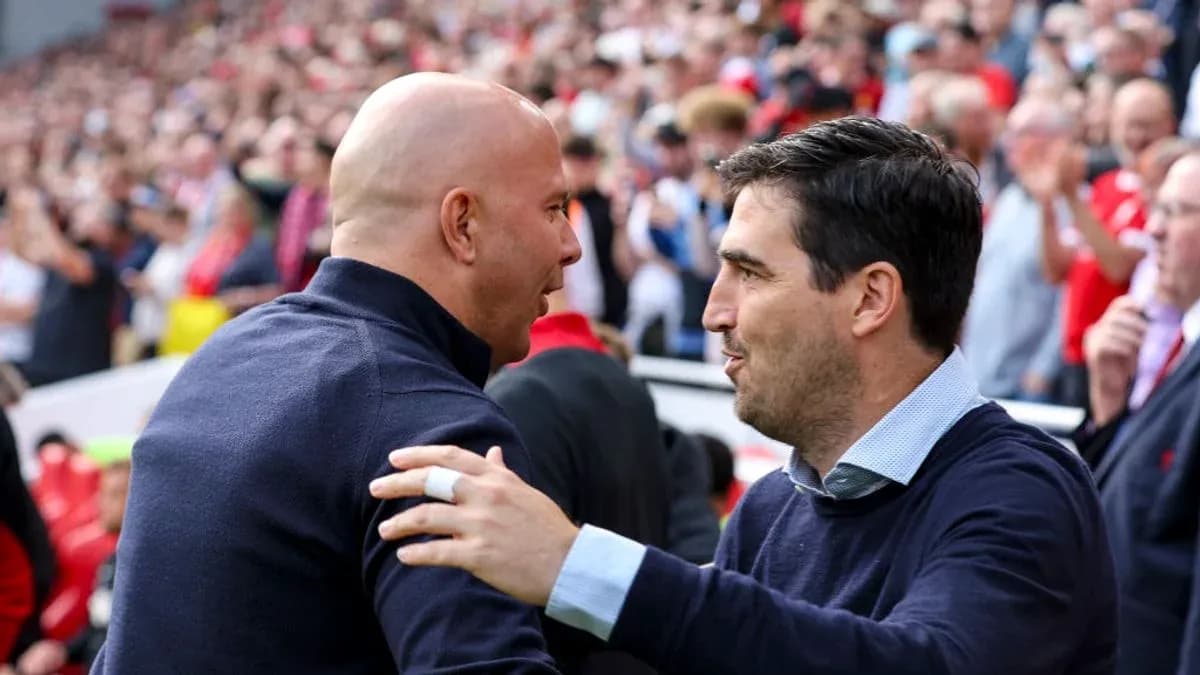
Andoni Iraola has never been afraid of a slow start. At Bournemouth, it took him 10 Premier League games to taste victory. At Liverpool, he will have to wait at least one more week.
A 2-2 draw with Newcastle on opening day was not a disaster. But it was revealing.
Liverpool were outrun, repeatedly exposed in transition and at times looked like a team still trying to remember which era they play in. That confusion sat at the heart of Iraola’s conversation with Steven Gerrard on TNT Sports – and it’s where the real story of this new Liverpool begins.
Caught Between Klopp and Slot
Asked bluntly by Gerrard whether he feels closer in style to Jurgen Klopp or Arne Slot, Iraola didn’t hesitate.
“Probably closer to Jurgen, probably, I would say. But I loved a lot of the things that the team had with Arne also,” he replied.
That “probably” carried weight. Klopp’s football – quick, vertical, transitional – is much closer to Iraola’s natural instinct. Slot’s Liverpool, by contrast, were built to dominate the ball, probe patiently and live high up the pitch. Iraola is now trying to weld those two ideas together in real time, in front of a fanbase that expects a title push, not a tactical experiment.
“There has to be a balance,” he said, reflecting on the Newcastle game. “Things are going to evolve differently because the first game we had 60, 61 percent of possession straight away.”
Then came the line that should make Liverpool supporters sit up.
“Naturally, because the natural tendency of the players is towards that side, and I need to adapt also towards that side. ... But we also need to keep being vertical, keep attacking, keep taking sometimes some risks.”
The natural tendency. That’s the crux.
Slot Habits, Iraola Demands
Under Slot, Liverpool were drilled to suffocate teams with the ball, especially against low blocks. Patience was a feature, not a flaw. The structure encouraged players to stay high, recycle possession and wait for gaps to open.
Against Newcastle, you could still see that imprint. Dominik Szoboszlai, Ryan Gravenberch, Jeremie Frimpong and Milos Kerkez often held advanced positions, happy to operate in and around the attacking third while Liverpool had the ball.
That’s exactly what Slot wanted. It’s not exactly what Iraola wants.
He wants speed. He wants directness. He wants waves of pressure and runners arriving from deeper zones, not a static line of attackers waiting in front of a set defence. When too many players stay high and wide without the ball being shifted quickly enough, Liverpool become stretched. And when they lose it, the punishment is brutal.
A 35-year-old Virgil van Dijk and a raw Jeremy Jacquet were repeatedly asked to defend large spaces on the break against Newcastle. Both goals Liverpool conceded came from situations where the structure around them had collapsed, leaving them exposed in exactly the zones Iraola’s system is supposed to protect with intensity and organisation.
The issue is not just tactical. It’s behavioural. Players have spent months, in some cases more than a year, leaning into a possession-first identity. They now have a coach asking them to sprint, break lines and embrace chaos again, without abandoning the technical control they’ve just learned to value.
That’s not a tweak. It’s a rewiring.
Energy Short, Demands High
This isn’t the first time Iraola has publicly flagged the gap between his demands and his squad’s current state.
After a preseason match against Leeds in early August, he laid out the problem with the same blunt honesty.
"I think we played really good [in the] first half, especially the first 30 minutes, but right now probably we don't have much more in terms of the level required to play like this," he said. "Then they were much better in the second half.
"The problem is right now probably they don't have the energy for 90 minutes and they start to get tired. It will take time with them, we need more training with them."
Those words now read like a warning. His game model asks for relentless running, repeated sprints, aggressive pressing and constant attacking intent. At the moment, Liverpool can deliver that for spells. Not yet for full games. Not yet with full clarity.
So Iraola walks a tightrope. He has to push them towards a more vertical, Klopp-like tempo while respecting the reality that many of his key players still gravitate to Slot’s possession rhythms. He has to adapt to their “natural tendency” without losing his own identity.
Two problems loom over everything: the leftover structural habits of the Slot era, and the physical demands of Iraola’s style. Both need fixing if Liverpool are to look like his team rather than a hybrid of three managers.
The draw with Newcastle showed how far there is to go. The question now is not whether Iraola can improve Liverpool. It’s how long this recalibration takes in a league that rarely offers patience.
Related News
Tottenham Hotspur v Newcastle United: De Zerbi's Call for Reaction
Liverpool vs Nottingham Forest: Iraola Seeks First Win at Anfield
Everton vs Bournemouth: A Clash of Styles in Premier League Showdown
Chadi Riad Ruled Out for Season After ACL Tear
Cork City Moves Closer to Premier Division as Teenager Shines
Matvey Safonov Collapses During PSG Warm-Up Before Lille Clash