
Arjen Robben: From ‘Man of Glass’ to Champions League Legend
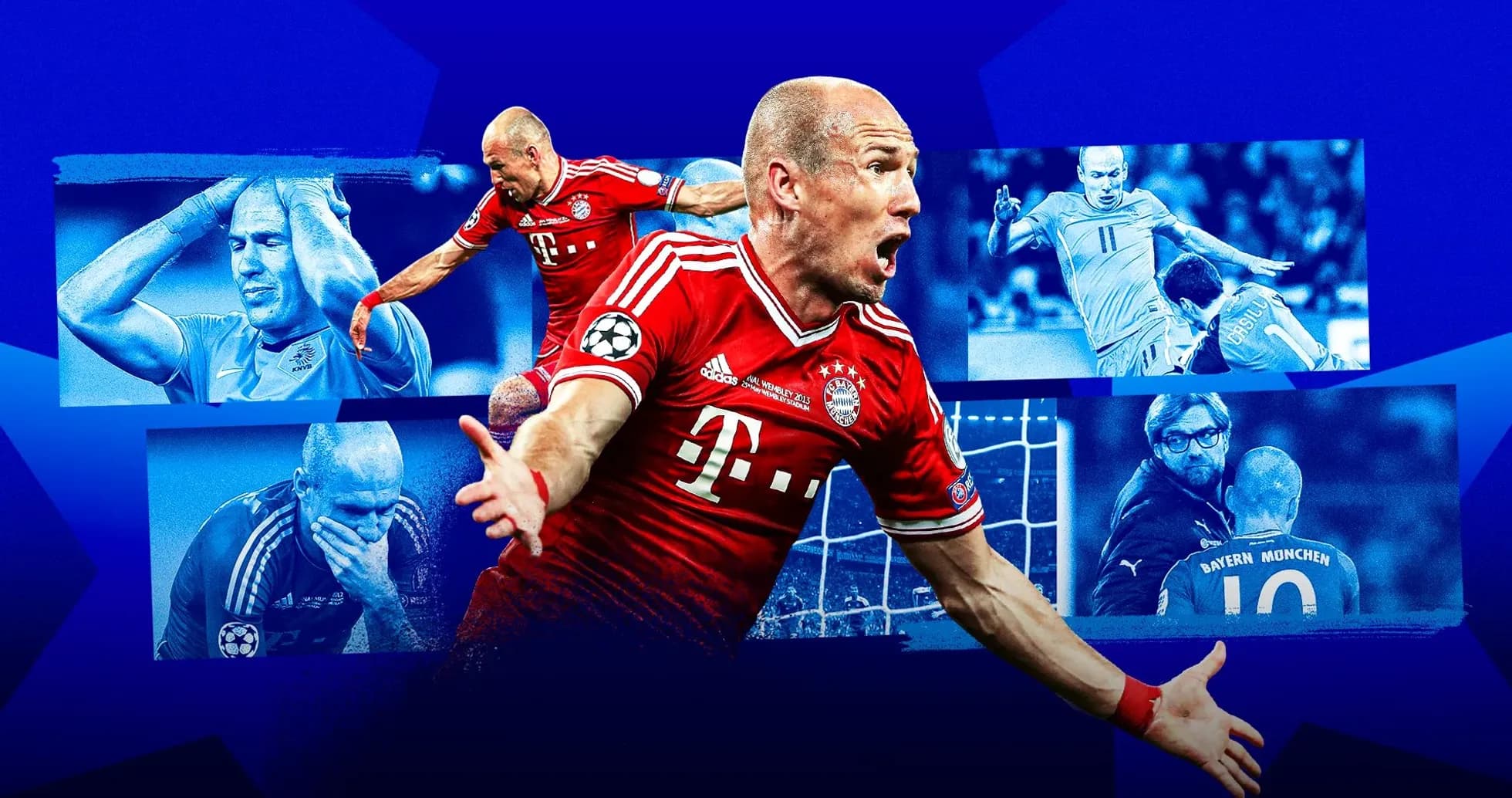
Before the labels and the memes, before “bottler” became a lazy punchline, Arjen Robben was something far simpler and far more frightening: inevitable.
Everyone knew what was coming. Full-backs knew he would drive down the right, feint, cut inside onto that left foot and go for the far corner. They knew – and they still couldn’t live with him. Manchester United, Barcelona, Borussia Dortmund: all were carved open on Champions League nights by the same move, the same ruthless execution.
He collected league titles as if they were routine – PSV, Chelsea, Real Madrid, Bayern Munich – and by 2010, it felt like the stage was set for him to rule Europe with Bayern. Louis van Gaal had them humming. Mario Gomez, Thomas Müller, Franck Ribéry, Bastian Schweinsteiger – a team built to dominate, guided by a coach who believed in them and a winger who could decide ties on his own.
The one-man rescue act
Bayern’s Champions League campaign that season did not begin like that of a future finalist. It stuttered. It needed rescuing. Robben obliged.
Against Fiorentina in the last 16, he had already scored in a 2-1 first-leg win. In Florence, Bayern fell 3-1 behind. The tie was slipping away. Then, in the 65th minute, Robben took the ball in the middle of Fiorentina’s half and unleashed one of the purest strikes of his career, a curling, vicious effort that dragged Bayern level on aggregate. At 4-4, the away goals rule saved them. The Dutchman had dragged them through.
The script barely changed in the quarter-final. Manchester United escaped him in the first leg through injury, yet still lost 2-1 in Munich. At Old Trafford, Bayern again went 3-1 down. Again, Robben stepped in. Meeting a corner from Ribéry on the edge of the box, he guided a left-footed volley into the far corner with such precision that even he seemed stunned as he wheeled away. Bayern advanced on away goals.
In the semi-final against Lyon, he struck from distance once more, an impulsive drive that left Hugo Lloris motionless in a 1-0 win. Bayern were in the final, carried by a winger who was winning ties almost by himself.
Then came Inter at the Santiago Bernabéu. José Mourinho’s team suffocated Bayern. Ivica Olić and Thomas Müller started up front, Ribéry was suspended, and the Germans never found a rhythm. Robben, star of the run, was reduced to flickers in a 2-0 defeat.
The biggest stage had swallowed him. It would not be the last time.
Johannesburg: the toe that changed everything
That summer, he walked into another storm. Robben arrived at the 2010 World Cup late, his introduction delayed by the familiar enemy: muscle injuries. The nickname had already stuck – the ‘Man of Glass’. When he did finally step onto the pitch, the Netherlands changed gear.
He scored the opener in a tight win over Slovakia in the last 16. Against Brazil in the quarter-final, he set up a crucial goal in a 2-1 comeback. In the semi-final versus Uruguay, he headed in what proved to be the winner. Oranje were in the final, and Robben was central to everything.
The final itself, against Spain in Johannesburg, has become infamous. Bert van Marwijk’s Netherlands hacked and harried, with nine Dutch players booked across 120 bad-tempered minutes. Nigel de Jong’s chest-high kick on Xabi Alonso is the enduring image of that night for many. Yet the true turning point came just after the hour, when Robben broke free.
Wesley Sneijder slid a pass straight through the heart of Spain’s defence. Robben surged clear, the entire World Cup narrowing into one duel: Robben versus Iker Casillas. He waited, measured, maybe overthought it. As he tried to guide the ball to his left, Casillas flung out a leg and diverted it wide with the faintest of touches.
Dutch media would call it “The toe of Casillas.” That toe ended Oranje’s dream and planted the seed of a reputation that would haunt Robben for years.
Casillas later admitted what was going through his mind: stay on your feet, stay big, wait. When he finally dived, he did so expecting Robben to go past him. “Of all the options he had,” the goalkeeper reflected, “Robben chose exactly the wrong one.” He even suggested that if Robben had scored, the final “would probably have ended very differently.”
Spain survived. Andrés Iniesta decided the game in extra-time. The Netherlands never truly recovered from that miss.
“It hurts to miss such a chance,” Robben said four years later. “It’s part of sport, just a moment, a snapshot. But it will be part of me and part of my career for all of my life.”
There were more snapshots to come.
Penalties, pressure and the stamp of a loser
Injuries again limited Robben in 2010-11, yet his numbers remained outrageous: 12 goals and eight assists in just 14 Bundesliga matches. When he stayed fit the following season, he was electric, propelling Bayern back to another Champions League final.
The route there ran straight through his past. In the semi-final second leg at the Bernabéu, against his former club Real Madrid, Bayern fell 2-0 behind within 14 minutes and trailed 3-2 on aggregate. The stadium roared for a rout. Bayern needed a lifeline. In the 27th minute, they got it: a penalty.
Robben walked up with all of Munich’s hopes on his shoulders, staring down Casillas again, two years on from Johannesburg. This time, the goalkeeper’s fingertip could not save Spain or Madrid. Robben’s penalty levelled the tie on aggregate and Bayern would go on to win the shootout. A demon, briefly, was pushed back.
But the real test waited at home.
The 2012 Champions League final at the Allianz Arena, against Chelsea, felt like destiny. Bayern, in their own stadium, in control of the ball and the night. They led 1-0 in extra-time when Didier Drogba bundled Franck Ribéry over in the box. Another penalty. Another chance for Robben to rewrite everything.
He went low and into the corner. Petr Čech guessed right and smothered it. The noise in the Allianz died in an instant. Bayern eventually lost on penalties.
It came just weeks after Robben had missed a title-deciding penalty against Borussia Dortmund in the Bundesliga. The narrative hardened. The missed one-on-one in the World Cup final, the lost Champions League final with Bayern in 2010, the squandered spot-kicks in 2012 – the “big-game bottler” tag began to cling.
“I can't describe how I feel with words, but it's been a terrible night,” he admitted. “Two or three times, you feel you have the cup in your hands but at the end you stand with nothing.
“It wasn't a good penalty. I wanted to shoot the ball hard and high in the goal, but the ball didn't go high enough. It was a terrible penalty kick. After that, I still played well but you have to change your mindset at that point.”
Changing that mindset would define the rest of his career.
The year everything turned
By 2012-13, the concern was simple and brutal: would Robben even be fit enough to matter? Injuries again chewed through his season. He played only 16 Bundesliga games, often left out for long stretches as Bayern rampaged through the league without him.
They did not, however, win Europe without him. They needed him there.
In the Champions League semi-final against Barcelona, Robben was not just fit. He was devastating. Over two legs, Bayern humiliated Barça 7-0 on aggregate, and the Dutchman sat at the heart of the destruction.
In Munich, he tortured Jordi Alba, stretching the defence until it tore. He scored Bayern’s third in a 4-0 first-leg win, cutting inside and curling home in the way everyone expected and nobody could stop.
At Camp Nou, he produced the purest version of himself. Early in the second half, he took a long pass on the right touchline, killed it with one touch, then sliced inside Adriano with that familiar, razor-sharp movement. One step, a sliver of space, and he whipped a glorious shot into the top corner.
“That 4-0 was my best game at the Allianz Arena,” he later told Sport Bild. “Against such a great team. With an uncharacteristic Robben goal. I broke through on the right wing with a stepover and had time to curl the ball into the far corner from a tight angle.”
He was saving his most important twist for Wembley.
Wembley: the goal that rewrote a career
The 2013 Champions League final against Borussia Dortmund was a clash of styles and states of mind. Jürgen Klopp’s side flew at Bayern in the first half, a blur of yellow shirts, pressing and pace. Bayern bent but did not break.
After the interval, Robben stepped into the spotlight. He burst into the box and squared for Mario Mandžukić to tap in the opener. Eight minutes later, Dortmund equalised from the penalty spot. The tension tightened. When Neven Subotić somehow hooked the ball off the line to deny Robben what looked like a simple finish, old fears resurfaced. Was this another final that would slip through his fingers?
Then came the 89th minute.
A long pass dropped toward the edge of the Dortmund box. Ribéry fought for it, back to goal, and with a flick of his heel nudged the ball into space, away from the swarm of yellow. Robben was already moving.
Ahead of him: Roman Weidenfeller. To his sides: Mats Hummels and Subotić. Behind him: a decade of near-misses, a World Cup final, two lost Champions League finals, missed penalties, whistles from his own fans.
He glided between the defenders, nudged the ball past Weidenfeller and, with a touch that seemed almost too gentle for the occasion, rolled it across the turf. Time slowed. The ball crept over the line and kissed the net.
“When I got the ball, I was free,” Robben said afterwards. “I anticipated Franck’s movement. The only thought was: ‘I hope he puts the ball there’ because I saw the space. I took it well. My first choice was actually to go past [Weidenfeller] on the left side but then he made a move and I could put it to the other side. He was on the wrong leg.”
Bayern were European champions again. Robben, at last, was the man who had won the final, not lost it.
“To finally win this Champions League, that's a dream come true,” he said. “You can't describe it – so many emotions go through your head, especially because you know what it is like to lose. I think you can enjoy it even more when you win the title.
“After the disappointment of last year, and to a [lesser extent] 2010, and the World Cup for me – that's three finals and you don't want the stamp of a loser. At last we did it today, and we can forget about the other things a bit. It was a sense of ‘finally’.”
In 2025, Bayern fans voted that goal the greatest in the club’s 125-year history. Second place? Another Robben strike, that volley against Manchester United.
The stamp had been ripped off.
Brazil and the freedom of a man unburdened
Freed from the weight of those failures, Robben entered the 2014 World Cup in Brazil like a man reborn. At 30, he looked faster, sharper, more fearless than ever.
The Netherlands opened against Spain, a rematch of Johannesburg. This time there was no toe of Casillas, no agonising miss. There was only carnage.
Oranje destroyed the reigning world champions 5-1. Robben was unplayable. For his first goal, he plucked a long pass out of the sky, toyed with Sergio Ramos and finished with clinical calm. His second was something else entirely.
He sprinted onto another long ball, leaving Ramos trailing, dragging Casillas to the turf with a feint before hammering the ball into the net while the goalkeeper flailed on his knees. It was the visual opposite of 2010: Robben in total control, Casillas helpless.
Under Van Gaal, a Netherlands side that many expected to struggle went all the way to the third-place play-off. Robben was their spearhead, their constant threat, their star.
The story around him had changed. No longer the fragile winger who disappeared in finals, he was now the man who had survived them, who had come back for more and finally imposed his will.
The legacy in red and white
The honours list in Munich is staggering. Across a decade at Bayern, Robben helped deliver eight Bundesliga titles and five DFB-Pokals. He finished with 144 goals and 101 assists in 307 appearances – numbers that barely capture his influence on the biggest nights.
After the 2013 triumph, Bayern reached four more Champions League semi-finals. Even as Pep Guardiola’s team fell short of reclaiming the European crown, Robben remained the sharpest weapon in their arsenal whenever the stakes rose.
When he finally left Bayern in 2019, tears in his eyes and another league trophy in his hands, the same supporters who had once whistled him off the pitch stood to serenade him. They did not see the man who had missed in Johannesburg or the forward whose penalty had been saved by Čech. They saw a legend.
The tragic figure was gone. In his place stood a ferocious winger who had felt the crushing weight of failure on the grandest stages and refused to let it define him.
Easy to predict, impossible to stop – and, in the end, impossible to forget.
Related News
Arsenal Faces Injury Setback as Christos Tzolis Exits Early for Greece Despite Refusing Substitution
PSG's Senny Mayulu Injured During France U21 Match
Giacomo Raspadori Withdraws from Italy's Nations League Squad Ahead of France Clash
Andoni Iraola Should Take a Risk on Forgotten Liverpool Talent
Holger Rune’s First ATP Tour Match Since Achilles Injury Set at Japan Open
Liverpool Faces New Injury Setback as Cody Gakpo Exits Early for Netherlands