
Arsenal's Dominant Start to the Season: A 3-0 Victory
The Premier League is back, and Arsenal have slipped into the new season like they’ve been here all summer, engine idling, waiting for the curtain to lift.
Against Coventry, this was less an opening-night scrap and more a controlled demonstration. A 3-0 win, barely a bead of sweat, the kind of performance title holders dream of on day one but rarely deliver. No chaos, no late flurries, no drama. Just a champion side running through its patterns and discovering that, yes, the machinery still hums.
Arsenal’s new problem: win it again, but easier
Retaining a title usually comes wrapped in clichés about hunger and edge, the old Roy Keane doctrine of suffering your way to serial success. Arsenal’s challenge feels different. The grind of last season left its mark. Winning hurt. Doing it again will require something more nuanced than just snarling a bit louder.
This looked like the answer: turn the dial down on jeopardy, up on control. Make the routine games genuinely routine.
From the first whistle, Coventry were caught in a storm they couldn’t quite see but could definitely feel. The ball moved too quickly, the angles shifted too sharply, and Arsenal’s press squeezed the air out of the visitors’ lungs. This was a champion side in “demo mode”, as if testing out new software on familiar hardware.
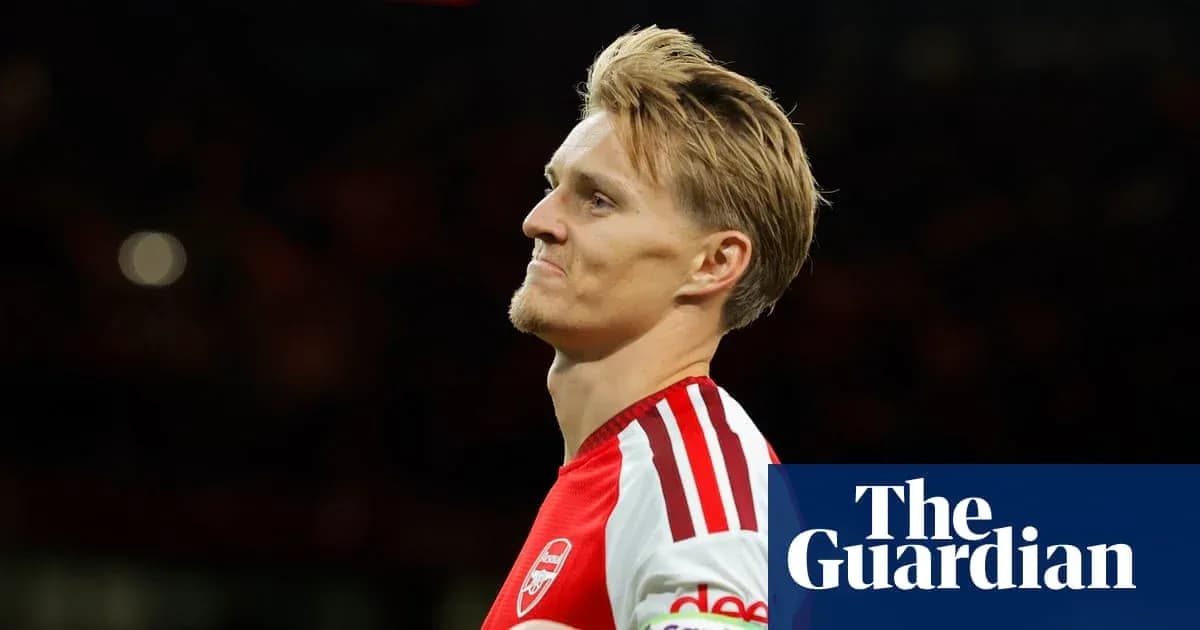
At the heart of it, back where he belongs, was Martin Ødegaard.
Ødegaard, rebooted
No marquee forward arrived in the summer. No blockbuster attacking signing to change the picture. That has thrown the spotlight squarely on Ødegaard and the question that has hovered over him for months: could he rediscover the version of himself that briefly lit up the league before injury turned him into a ghost of that player?
On this evidence, the answer is starting to look like a yes.
He lasted 75 minutes, touched the ball 72 times, and stitched together 55 short, precise passes that knitted Arsenal’s attacks into something coherent and relentless. This wasn’t the spectacular Ødegaard of highlight reels; it was the relentless one, the “constant ferret” in midfield, harrying, nudging, always available, always turning the dial a notch higher.
His goal, Arsenal’s third on 48 minutes, will lead the clips. It probably shouldn’t. The finish itself was almost slapstick. Ødegaard has an odd technique when he shoots, approaching the ball slightly side-on, hitting through it at a strange angle. Here, from close range, he seemed to miskick, yet somehow the ball floated away from Carl Rushworth and drifted into the corner. The Coventry goalkeeper clawed at it like a cat pawing at a shadow. No chance.
Ødegaard laughed as he spun away, the look of a man who knew he’d got away with one. The significance, though, was no joke. This was his first goal at the Emirates since December. For a player who lives on rhythm and feel, that matters.
More important still was what happened around that moment. The old current with Bukayo Saka crackled back into life. Just before half-time, the pair started bouncing passes off each other on the right, six or seven quick exchanges, a private game within the game that ended with Declan Rice bending a shot just wide. It felt familiar. It felt like the Arsenal that surged to the title, not the version that limped through patches of last season.
There is something rare at the top level in the way Ødegaard and Saka interact: not just understanding, but joy. A sense of play in a sport increasingly stripped of it.
Classic Barclays energy, clinical Arsenal edge
North London offered up a crisp, almost autumnal chill at kick-off, the kind of air that used to frame those old Arsenal-Coventry clashes with their grainy “Classic Barclays” feel. You could almost picture Darren Huckerby tearing into the channels and hear the TV graphics swooshing across the screen.
On the touchline, Frank Lampard and Mikel Arteta cut near-identical figures: black slacks, black mock-turtlenecks, black trainers with white soles. Two hyper-modern managers dressed like they were heading to a stealth corporate away day.
Their teams, though, were on very different planes.
The opener on 15 minutes was pure, clean, high-end football. Christos Tzolis started it with a sharp block-tackle on Milan van Ewijk by the right touchline, refusing to let the ball drift out and instead snapping it back into Arsenal’s control. He shifted it to Riccardo Calafiori, who stepped in and zipped a pass across the front of the Coventry box, low and fast, threading the needle into Kai Havertz.
Havertz finished with the kind of casual authority that makes you double-take. First time, left foot, guided rather than thumped, like a man slotting a ball around the garden rather than opening his league account. You half-expected him to be wearing slippers.
Coventry never really recovered. The speed of Arsenal’s rotations, the angles of their runs, the weight of their passing – it was all a level above what many of these players will ever have faced. The second goal arrived with an air of inevitability rather than surprise.
Rice provided the surge, powering forward to tilt the pitch. Ødegaard supplied the detail. A small, perfectly weighted nudge opened the lane, allowing the ball to be shifted wide and the cross to be delivered with venom. This is Ødegaard’s genius in its purest form: not always the assist, but the pass before the pass, the invisible hinge on which the move swings. Footballing WD-40.
By the time his looping mis-hit made it 3-0, the contest was over. Coventry were chasing shadows. Arsenal were already managing minutes, not the scoreboard.
Stage one: completed with a shrug
Across 90 minutes, Arsenal looked like a side not just intent on defending their crown, but on changing how that defence feels. Less chaos, more control. Less living on the edge, more playing within themselves and still being too good.
It was only one game, against a team they were expected to beat. But the signs were hard to ignore: Ødegaard sharper, Saka smiling, Rice striding, the whole structure purring without strain.
Win the league, then win it better. On this evidence, that ambition doesn’t sound outlandish. It sounds like a plan.
Related News

Hull City vs Manchester United: High Stakes and Injury Woes

Jaissle and Iraola Clash at St James’ Park: A New Era Begins
Celtic's Defensive Plans Impacted by Alistair Johnston Injury

Borussia Dortmund's Supercup Challenge Against Bayern Munich
Mourinho’s Return to Madrid Under Injury Crisis

Mourinho’s Return to Real Madrid: Squad Challenges Ahead