
Artificial Intelligence Transforming Football Decisions
Artificial intelligence has crept into football’s back rooms in all sorts of ways, from transfer scouting to youth development to injury rehab. The pitch is still the same size, the ball still rolls the same way, but the people making the decisions are staring at very different screens.
From Arsenal blog to global data department
For Doron Bracha, it started in a bedroom, not a boardroom.
A devoted Arsenal fan, he built a following by blogging obsessively about the Gunners, mixing his own “eye test” with whatever data he could scrape together. He highlighted players he thought big clubs were missing. The posts landed. Scouts started to notice.
When his day job in tech became too demanding, Bracha built an AI model to spit out the skeleton of those blog posts. He would then layer his own analysis on top. That blend – human judgment, machine structure – began to surface players few people were talking about.
Soon, his inbox filled with messages from professional scouts and club staff asking how he knew so much about certain players. Bracha’s answer was disarmingly simple: often, it was just ChatGPT helping him organize and explore ideas.
That raised a sharper question in his mind: if this was impressing the professionals, what exactly were they using?
What he found was not a lack of data, but chaos. Wyscout had helped drag the game into the numbers age in the early 2010s, but rival providers quickly flooded the market. Clubs were drowning in spreadsheets, dashboards and conflicting metrics.
“In the past 10 years, this industry has moved from complete scarcity to data overload,” Bracha said. “There are so many different data providers.”
His company, Marquee, exists to clean that mess up. It plugs into clubs’ existing systems, automates the “glorified spreadsheet” work and pulls everything into one place. For some clients, Marquee effectively becomes an outsourced analytics department.
This is not Football Manager dressed up as consultancy. At a price, Marquee builds highly specific player profiles and recruitment shortlists, tuned to a club’s style, system and needs. The human staff can ignore the recommendations if they wish, but enough clubs see value in them that Marquee now counts several Premier League sides among its users, with Barcelona and Chicago Fire publicly backing the platform.
Whether it has already helped unearth the next superstar is an open question. What’s clear is that tools like this are no longer on the fringes. They’re in the room when decisions are made.
When the machine knows your defender is in trouble
Data’s influence isn’t limited to transfers.
In an MLS match between FC Cincinnati and Nashville SC last year, the club’s technology flagged something unusual in Matt Miazga’s movement. Five minutes later, the defender asked to come off.
The system wasn’t feeding real-time alerts to the bench and it didn’t “save” him from injury. But it did identify an irregular pattern that suggested fatigue or a problem before Miazga himself called it.
That kind of clue feeds directly into a more complex question: when can a player safely return?
For Springbok Analytics, that puzzle usually starts with the same request to clubs: send us your most complicated injury. Almost every time, the answer is the hamstring.
The numbers are brutal. A 2020 NIH study found hamstrings account for 12 percent of all professional soccer injuries, with re-injury rates anywhere between four and 68 percent. Clubs have thrown GPS, force plates and endless testing at the issue. The injuries keep rising.
“We’ve got all the new technology that exists every which way,” said Matt Brown, Springbok’s Analytics Director. “Hamstring injuries have not gone down. They've gone up.”
Brown believes the game has misjudged the data problem. The injury itself is obvious. Understanding how the muscle is responding to rehab – strength, balance, atrophy – is painstaking.
His ideal scenario is simple: scan a player at the moment of injury, then again at two months, then six months, tracking changes in the muscle and whether the rehab work is actually doing what it’s supposed to.
Springbok’s technology was born far from the training ground. At the University of Virginia, scientists developed hyper-specific MRI analysis to help children with cerebral palsy, building 3D graphics so surgeons could calculate tendon lengthening with precision. When it worked, the team moved into sport. The NBA signed up in 2023. MLS brought Springbok into its Innovation Lab this year.
Traditional MRIs give doctors thousands of 2D grey slices to interpret. Clinicians stack them mentally to form a 3D picture, a laborious process. Springbok uses AI to pre-process the images, detect muscle boundaries and build what Brown calls a “beautiful 3D digital twin” of the player’s musculature.
Springbok doesn’t treat injuries and doesn’t claim to prevent them. It accelerates the journey from raw scan to actionable information, cutting a week of analysis down to hours.
“We are the support system,” Brown said. “We make imaging from an MRI way more impactful and actionable. We are providing you the measurements.”
The rest is up to the medical staff, the ones who have “done 10 years of this” and already have their own philosophies.
A phone, four photos and a youth player’s future
At the other end of the pathway, academy directors wrestle with a different kind of uncertainty.
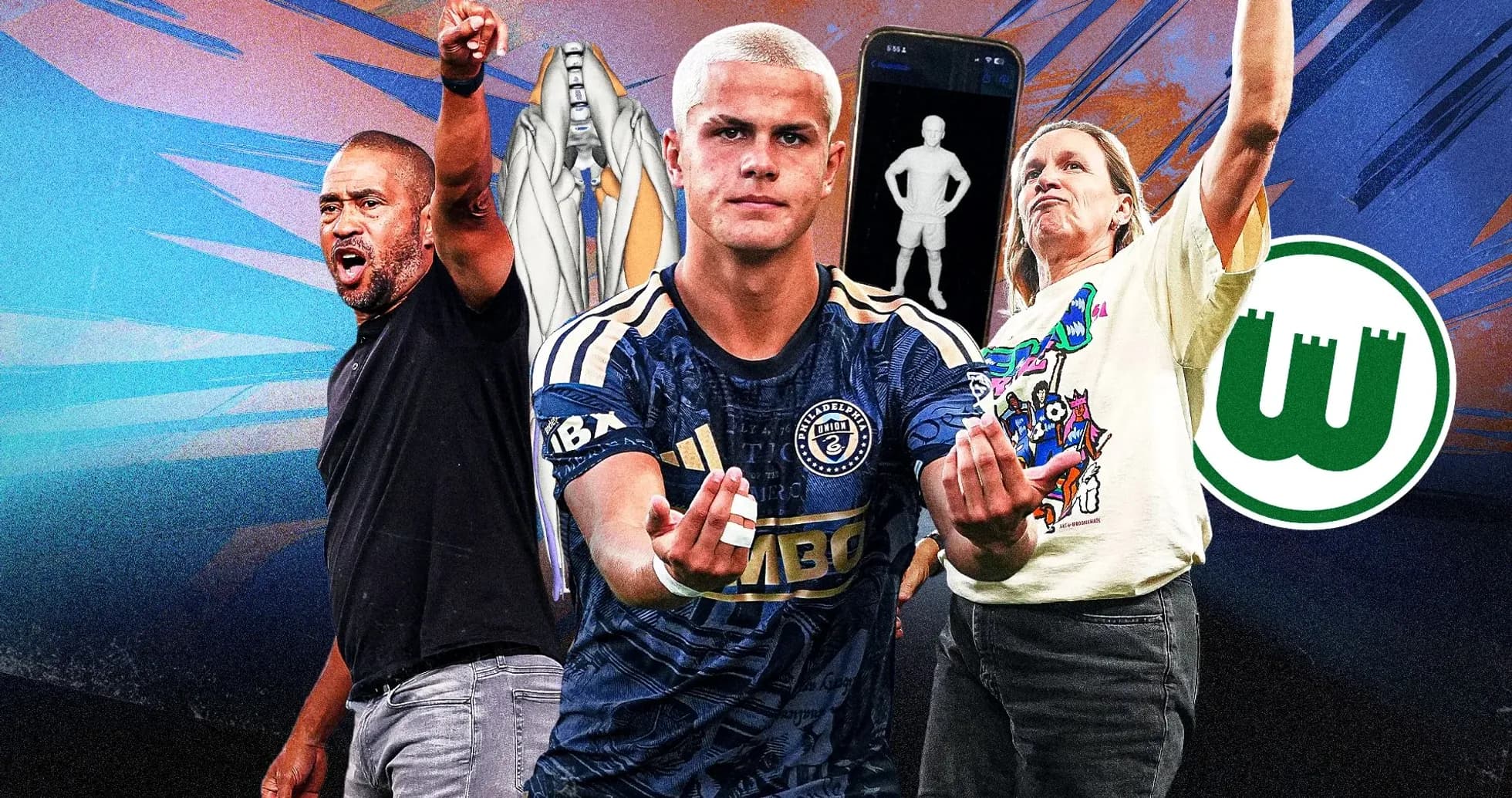
Every day at the Philadelphia Union, staff ask the same questions. What level can this kid handle? How much first-team football can a teenager like Cavan Sullivan absorb? Will his body hold up?
Clubs run battery after battery of tests: strength, size, projected height, peak performance windows. It’s slow and often inconsistent.
Fit:Match wants to compress that into a 10-second process on a smartphone.
The method is starkly simple. A coach or parent takes four photos of a player from different angles. The phone calculates height, body mass, wingspan and a long list of other measurements. On top of that, the system estimates likely adult height, growth stage and a basic picture of what full physical maturity might look like.
Founder Haniff Brown half-jokes that it’s “ChatGPT for soccer.” A process that normally chews up staff time across an academy is boiled down to a half-minute wait for a digital profile.
Brown didn’t come from football. He started in fashion, using instant body scans to help shoppers avoid buying four shirts just to return three. The same technology quickly drew interest from hospitals and healthcare providers.
Then came a call from a European club in 2024, asking Fit:Match to scan their academy players. Brown saw a bigger opportunity – but he also knew his audience.
He set one hard rule: the process could not take more than 15 seconds. Coaches, he knew, hate long assessments. They want kids back in drills. The longer and more complex the test, the less likely it is to be used.
That speed sold the first club. Others followed. A fresh problem emerged: human inconsistency. Two coaches could measure the same player and produce two different sets of numbers.
Fit:Match removed that subjectivity. Four photos, 30 seconds, one standardized profile.
Parents can now upload images when registering their children for academies. The system generates a digital twin, and on the back end, MLS receives a detailed physical dataset on that player. Clubs can then make more informed calls on which age group or environment suits them.
The stakes are high. Youth football still leans heavily on size. A 14-year-old who matures early can dominate and get fast-tracked; a late developer the same age can be overlooked and drift away.
“A player who is a 14-year-old but an early developer is far different from a player who's 14 and a late developer,” Brown said. MLS can now “scientifically” distinguish between the two and design better pathways so late bloomers don’t disappear.
All of this sounds revolutionary. It also opens up a thicket of ethical questions.
Ethics, jobs and the “build or buy” dilemma
Predicting a teenager’s physical trajectory with machine tools touches on sensitive ground. So does outsourcing recruitment thinking to algorithms.
Brown’s first battle was not technical. It was psychological. He had to convince coaches and parents to trust a process that strips out the tape measure and introduces an app.
Bracha ran into something similar on the recruitment side. Marquee learned quickly it couldn’t simply drop a model into a club and dictate decisions. It had to collaborate, build trust, and only then talk publicly about successes.
Lurking behind all this is a more uncomfortable question: whose job does this replace?
Bracha doesn’t sugarcoat the financial logic for clubs. Salaries are among their biggest expenses. Building an in-house analytics and AI infrastructure is costly and slow. Buying a ready-made platform is faster, cheaper and, in his view, more accurate.
From a return-on-investment standpoint, he argues, the choice is obvious: “build or buy?” In this case, he says, “buy.”
That doesn’t guarantee anything. Wolfsburg were one of Europe’s early AI evangelists, trumpeting savings of €1 million a year on admin and injury prevention. On the pitch, they struggled, and the PR push around AI jarred badly with poor results.
They have not backed away. If anything, they’ve doubled down. Sevilla now use IBM WatsonX to manage their data environment. The tech arms race continues.
When ChatGPT helps pick a back five
Some coaches dip a toe in. Others lean hard.
Fraser – one of the many coaches experimenting quietly – has admitted he played around with ChatGPT, asking the model to explore potential matchup edges and formations. He’s far from alone.
Seattle Reign head coach Laura Harvey went further, and she said so publicly. Speaking on the Soccerish podcast in October 2025 with Lori Lindsey and Christina Unkel, Harvey explained how she asked ChatGPT a blunt question: “What formation should you play to beat NWSL teams?”
For two of the league’s then-14 sides, the answer came back: play a back five.
Harvey didn’t just accept it. She took the idea to her staff, mulled it over and eventually rolled out a five-defender system. The Reign finished fifth, eight places higher than the previous season.
Did ChatGPT transform Seattle on its own? Of course not. But it nudged a coach toward a tactical tweak that stuck. For those arguing AI can add value without replacing human judgment, that’s a powerful example.
There are plenty of dead ends too – models ignored, recommendations shelved, experiments quietly abandoned. That may be the real point. AI is becoming another tool on the belt: sometimes sharp, sometimes blunt, rarely decisive on its own.
In a sport decided by inches and milliseconds, that’s enough to keep people coming back.
“We’re all looking for any advantage we can get,” Fraser said.
Football’s oldest truth now has a new, digital edge.
Related News
Jamal Musiala's Health Update: Managing Neurological Episodes

Lionel Messi Scores Meaningful Goal Amid Grief

Tottenham's New Era Under Roberto De Zerbi Begins Against Brentford
Serge Gnabry Reclaims Place in Bayern's Lineup

Lionel Messi Scores Emotional Goal Amid Personal Loss

Martin O'Neill's Remarkable Return to Celtic