
Aston Villa's Tactical Triumph Over Manchester City
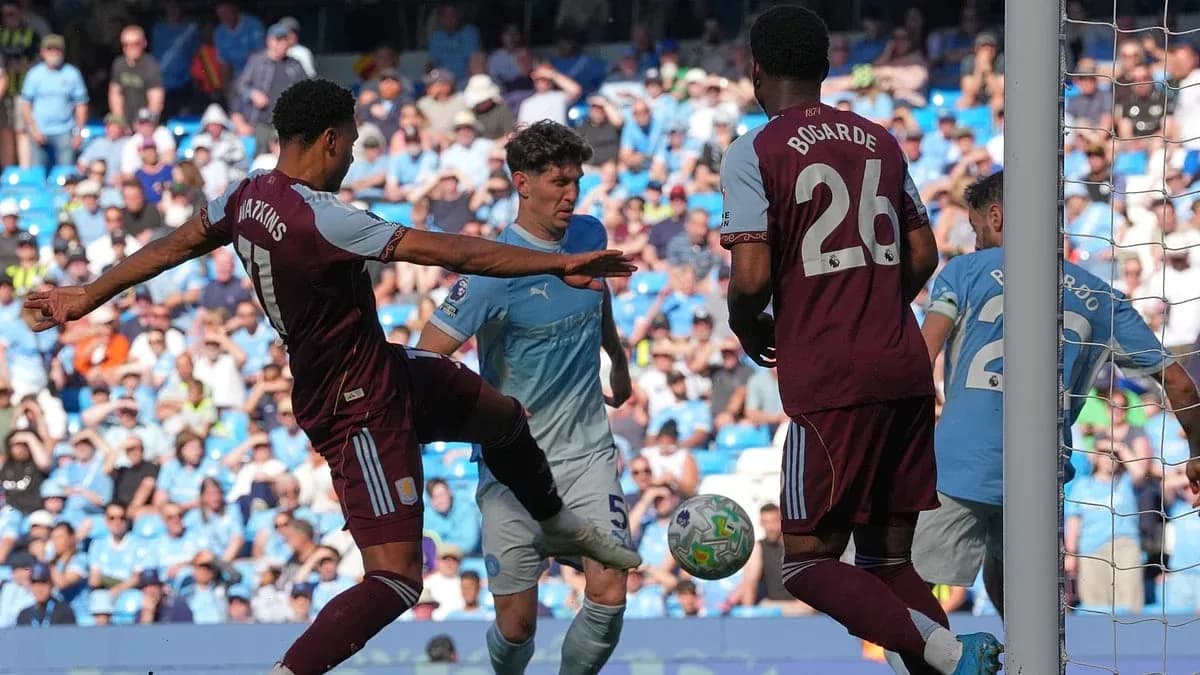
Manchester City’s 1-2 home defeat to Aston Villa at Etihad Stadium unfolded as a classic control-versus-punch contest. Pep Guardiola’s side, in a 4-2-2-2, dominated phases of possession and territory, but Unai Emery’s compact 4-2-3-1 was built to spring forward through transitions and direct runs from the front line. The numbers frame the story clearly: City edged the ball 52% to 48%, generated more total shots (16 to 12) and more blocked efforts (6 to 2), yet Villa produced the sharper cutting edge with higher xG (1.58 to City’s 1.25) and more shots on goal (5 to 3). Villa’s structure, plus efficient execution around the box, overturned a 1-0 deficit into a decisive 2-1 away win on the final day.
Tactical Setup
City’s tactical plan hinged on a back four of R. Lewis, J. Stones, R. Dias and N. Ake behind a double pivot of Nico and B. Silva, with A. Semenyo and Savinho as advanced midfielders and P. Foden plus T. Reijnders nominally up front. In practice, this morphed into the familiar Guardiola positional game: full-backs, particularly Lewis, stepping into midfield, Silva and Nico orchestrating circulation, and Foden drifting between the lines to overload Villa’s double pivot of L. Bogarde and Douglas Luiz. The reward came on 23 minutes when A. Semenyo found space to score the opener, capitalising on City’s ability to pin Villa deep and attack the inside channels.
However, the shot profile hints at a recurring issue. City managed 10 attempts from inside the box but only 3 on target, with 6 blocked. Villa’s central block of V. Lindelof and T. Mings, screened by Bogarde and Douglas Luiz, held a narrow shape that invited wide possession but aggressively stepped out to smother shooting lanes once City approached the “red zone.” Those 6 blocks are a tactical success marker for Villa’s low-to-mid block: they allowed City to progress but not to finish cleanly.
Pressing and Counterplay
Out of possession, City’s 4-2-2-2 press aimed to trap Villa’s build-up on one side, with Semenyo and Savinho jumping to Villa’s full-backs A. Garcia and I. Maatsen, while Foden and Reijnders tried to screen passes into O. Watkins. Early on, this limited Villa to 3 shots in the first half and helped City maintain a 1-0 half-time lead. Yet the pressing structure carried risk: when the first line was broken, space appeared behind the advanced eights and beside the centre-backs.
Emery’s 4-2-3-1 exploited exactly that after the break. With L. Bailey and E. Buendia attacking the half-spaces and R. Barkley operating as a high “10”, Villa looked to release Watkins quickly into channels. The equaliser at 47 minutes, scored by O. Watkins, reflected this more vertical intent: Villa transitioned faster through the centre, and City’s rest defence—Dias and Stones with full-backs high—was exposed. The second Watkins goal on 61 minutes, assisted by R. Barkley, underlined the pattern: Barkley finding pockets between City’s lines, then feeding Watkins into space. The VAR check at 63 minutes, which confirmed the goal, shows how fine the margins were in those transition moments but also how consistently Villa were able to access those zones.
Goalkeeping Performance
In goal, J. Trafford (Manchester City) made 3 saves, while M. Bizot (Aston Villa) registered 2. Those raw numbers understate their tactical roles. Trafford’s 3 saves, combined with Villa’s 5 shots on goal, indicate that when City’s press was broken, Villa generated high-quality looks rather than speculative efforts. Conversely, Bizot’s 2 saves from City’s 3 shots on target, combined with 0.28 goals prevented for each goalkeeper, suggest that Villa’s keeper was largely protected by the compact block in front of him, forcing City into blocked or off-target shots rather than repeated one-on-ones.
In-Game Adjustments
Guardiola’s in-game adjustments tried to restore penetration. On 58 minutes, R. Cherki (IN) came on for A. Semenyo (OUT), adding more dribbling and creative threat between the lines. A minute later, M. Kovacic (IN) replaced B. Silva (OUT), shifting the profile of the double pivot towards more vertical carries and late box arrivals. Later, J. Doku (IN) came on for T. Reijnders (OUT) at 77 minutes to increase direct wing threat, while R. Ait-Nouri (IN) for N. Ake (OUT) and J. Gvardiol (IN) for J. Stones (OUT) reconfigured the back line for more aggressive wide progression. These moves collectively pushed City into a more asymmetrical, attack-heavy shape, with Doku and Savinho stretching Villa’s full-backs and Cherki and Foden trying to combine centrally.
Yet Villa’s substitutions were equally, if not more, strategic. At half-time, M. Cash (IN) came on for A. Garcia (OUT), adding defensive solidity and transition running on the right. On 73 minutes, Y. Tielemans (IN) replaced Douglas Luiz (OUT), P. Torres (IN) came on for V. Lindelof (OUT), and A. Onana (IN) replaced L. Bogarde (OUT), effectively refreshing the spine: new legs at centre-back and in both pivot roles to withstand City’s late pressure. Finally, J. McGinn (IN) for R. Barkley (OUT) at 86 minutes added defensive work rate and ball retention to see out the lead. These changes preserved Villa’s compactness while maintaining enough technical quality to relieve pressure with short passing.
Discipline and Statistics
Discipline also shaped the closing stages. The only card of the match came on 82 minutes: Rico Lewis (Manchester City) — Foul. That booking encapsulated City’s increasing desperation to stop transitions as they pushed numbers forward. It also signalled how clean Villa’s defensive work was: 4 fouls to City’s 8, and no cards, despite long spells without the ball.
Statistically, the verdict is that Villa’s game plan outperformed City’s structure in the zones that matter most. City’s 458 passes to Villa’s 436, with 405 accurate (88%) against Villa’s 394 accurate (90%), show two technically secure sides. But Villa’s slightly better pass accuracy, combined with a higher xG (1.58 vs 1.25) from fewer total shots, underlines their superior shot selection and transition efficiency. City’s 9 corners to Villa’s 4 reflect territorial dominance, yet Villa’s defensive index—low foul count, zero cards, and only 3 shots on target conceded—speaks to a well-drilled block that absorbed pressure without losing structure.
The late VAR intervention at 90+2 minutes, when a potential goal by Phil Foden was disallowed, was the final tactical hinge: City’s positional play eventually broke Villa’s line, but the margins of offside and timing denied them. Across 90 minutes, the match became a study in how a compact, transition-focused 4-2-3-1 can overturn a possession-heavy 4-2-2-2 when the pressing structure is punctured and the front line—here, O. Watkins supported by Barkley, Bailey and Buendia—executes ruthlessly.
Related News

Premier League Managers Facing Potential Sackings During International Break

Arsenal's Myles Lewis-Skelly Names Unexpected Tottenham Rival as Toughest Premier League Opponent

Three Premier League Players Shining Early This Season

Premier League Early Season Reactions: Man City’s Strength, Arsenal’s Flaws, United’s Struggles

Premier League Returns October 10 After Extended September-October International Break

Fulham and Manchester United Share Points in 1-1 Draw