
Brighton vs Manchester United: A Lesson in Efficiency
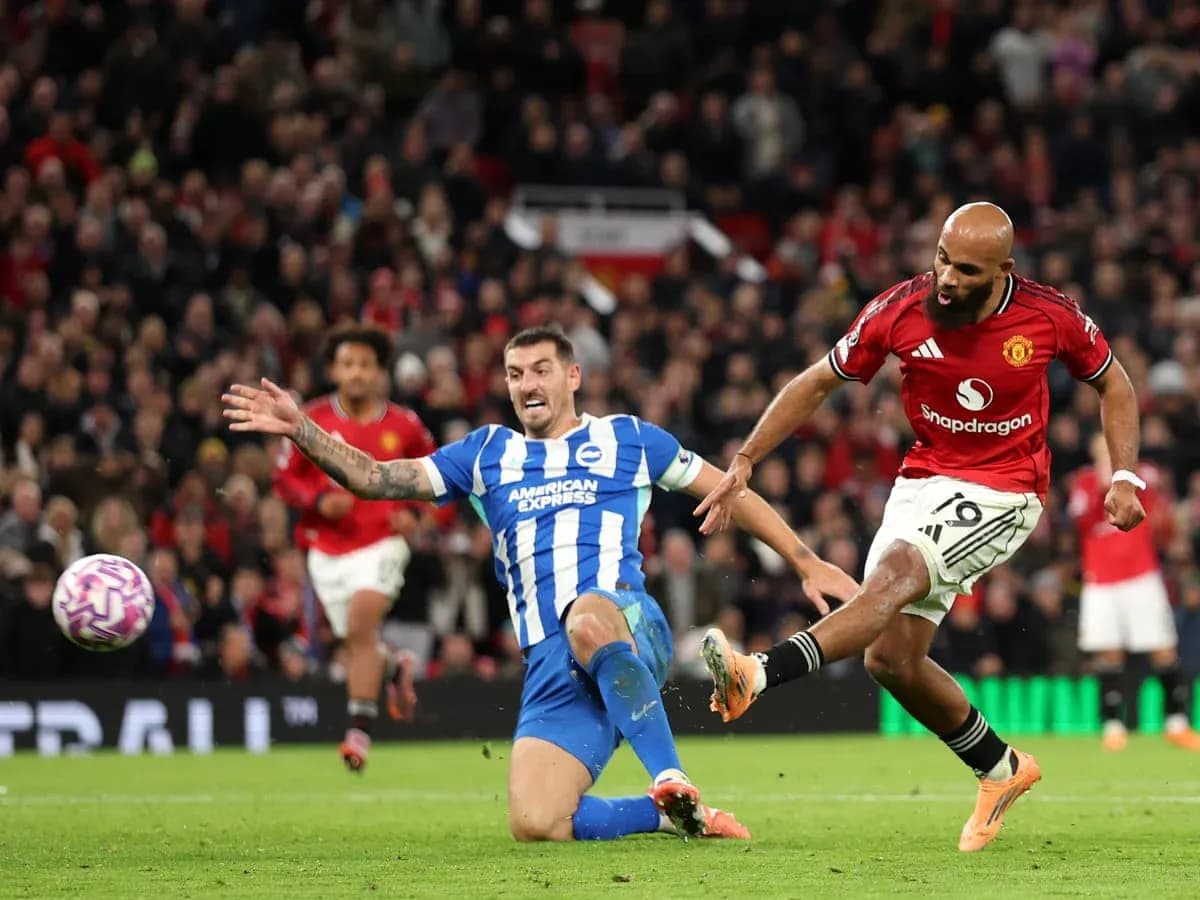
The season closed on the south coast with a hard lesson in efficiency. At the Amex Stadium, under the watch of Samuel Barrott, Brighton’s expansive 4-2-3-1 was dismantled 3-0 by a ruthless Manchester United side running the same shape but with sharper edges and a clearer cutting plan. Following this result, the table tells its own story: Brighton finish 8th on 53 points with a goal difference of +6 (52 scored, 46 conceded overall), while United lock in 3rd with 71 points and a goal difference of +19 (69 for, 50 against overall). One side is on the cusp of European adventure; the other is reminded what the next step up really looks like.
I. The Big Picture – Structures and Season DNA
Both coaches leaned into their seasonal identities. Brighton, under Fabian Hurzeler, stayed loyal to the 4-2-3-1 that has underpinned 33 of their 38 league matches. At home this season they have been enterprising and relatively secure: 9 wins, 6 draws, 4 defeats, scoring 30 and conceding 20 at the Amex. An average of 1.6 goals for and 1.1 against at home speaks to a side that usually finds a way to create while maintaining a decent defensive platform.
Manchester United, under Michael Carrick, mirrored the shape but not the risk profile. Their 4-2-3-1 has been used in 20 league games, balanced with 18 outings in a 3-4-2-1. Heading into this game they were already a high-output side: overall they averaged 1.8 goals scored and 1.3 conceded per match, with 1.6 goals scored on their travels and 1.4 conceded away. Seven away wins, eight draws, and only four defeats show a team that can manage hostile environments and control game states.
On the day, the shared formation masked very different intentions. Brighton’s back four of M. Wieffer, J. P. van Hecke, L. Dunk and F. Kadioglu stepped high, trying to compress space and feed a technically secure double pivot of P. Gross and J. Milner. Ahead of them, D. Gomez, J. Hinshelwood and M. De Cuyper were tasked with rotating around D. Welbeck, offering third-man runs and overloads in the half-spaces.
United’s back line of N. Mazraoui, H. Maguire, L. Martinez and L. Shaw played a more measured game, dropping off to tempt Brighton forward and then springing transitions through K. Mainoo and M. Mount. Higher up, A. Diallo and P. Dorgu flanked B. Fernandes, with B. Mbeumo leading the line. This was a front four built for verticality and quick punishment of turnovers.
II. Tactical Voids – Absences and Discipline
The absentees framed the contest before a ball was kicked. Brighton were without K. Mitoma, S. Tzimas and A. Webster, all listed as Missing Fixture. The loss of Mitoma stripped Hurzeler of a direct, one‑v‑one outlet on the flank, forcing him to lean more on combination play through central zones. Webster’s absence removed a ball‑playing centre‑back option, leaving Dunk and van Hecke to handle both build-up and United’s front-line pressure.
United, for their part, travelled without Casemiro, B. Sesko and M. de Ligt. Casemiro’s omission was particularly significant: his season profile – 90 tackles, 27 successful blocks and 31 interceptions – usually anchors United’s rest defence. In his place, Mainoo and Mount had to share both progression and protection. De Ligt’s absence pushed Maguire and Martinez together as the main pairing, a duo reliant more on positioning and aerial dominance than outright pace.
From a disciplinary perspective, both clubs carried warning signs into the fixture. Brighton’s yellow card distribution this season shows a clear spike between 46-60 minutes, where 27.91% of their cautions arrive – a dangerous window when chasing games after half-time. United are similarly combustible after the interval, with 21.88% of their yellows between 46-60 minutes and 20.31% between 76-90 minutes, plus a history of late red cards. That volatility never boiled over into dismissals here, but it shaped the tempo: both sides were wary of overcommitting in the early stages of the second half, which briefly flattened the game before United’s superior quality reasserted itself.
III. Key Matchups – Hunter vs Shield, Engine Room Battles
The clearest “Hunter vs Shield” duel pitted D. Welbeck against a United defence that, on their travels, concedes 1.4 goals per game but has still kept 4 away clean sheets. Welbeck’s season numbers – 13 goals and 1 assist in the league, with 46 shots and 28 on target – underline his value as Brighton’s penalty-box reference. Yet United’s approach was to starve him of clean service rather than win a physical war. Maguire and Martinez held a compact line, while Mainoo dropped in to screen passes into Welbeck’s feet. Whenever Brighton tried to work through Gross or Milner, United’s front four snapped into a narrow press, forcing the ball wide where Mazraoui and Shaw could defend crosses rather than through balls.
At the other end, B. Mbeumo embodied United’s cutting edge. With 11 league goals and 3 assists, plus 59 shots (32 on target), he attacked the spaces behind Wieffer and Kadioglu, constantly testing Brighton’s high line. His movement dragged Dunk into uncomfortable lateral duels, compromising Brighton’s usual ability to squeeze up as a unit.
In the “Engine Room” matchup, P. Gross and J. Milner tried to impose Brighton’s patient rhythm against the mobility and line-breaking instincts of K. Mainoo and M. Mount. Gross, who orchestrates much of Brighton’s build-up, found himself repeatedly shadowed by Fernandes drifting back into the midfield line. That allowed United to form a situational three‑man block in the centre, funnelling Brighton’s passes into predictable wide areas. Mainoo, in turn, became the launchpad: receiving under pressure, turning out, and feeding Fernandes or Diallo between the lines.
Fernandes himself was the game’s true metronome. Across the season he has delivered 21 assists and 9 goals, with 137 key passes and 1994 total passes at 82% accuracy. That creative weight showed here: every Brighton turnover felt like an invitation for him to slide Mbeumo, Diallo or Dorgu into space. Brighton’s own defensive leader, L. Dunk, has been outstanding all season – 27 successful blocks and 30 interceptions in league play – but United’s multi-directional threats repeatedly pulled him away from his preferred central zones.
IV. Statistical Prognosis – xG Logic and Defensive Reality
Even without explicit xG figures, the season-long data frames this result as less an anomaly and more a concentration of existing trends. United’s overall scoring rate of 1.8 goals per match, combined with Brighton’s 1.2 goals conceded per game overall, already pointed toward the visitors creating the higher volume and quality of chances, especially in transition. On their travels, United’s 1.6 goals for per game and Brighton’s 1.1 goals conceded at home suggested a contest where United could realistically generate two clear chances if they broke the press cleanly; they produced and finished more than that.
Defensively, Brighton’s season has been respectable but not elite. Ten clean sheets overall (5 at home, 5 away) and an overall goal difference of +6 show a side that can control mid-table opponents but is vulnerable when their high line is attacked with pace and precision. United, meanwhile, have only 8 clean sheets overall but compensate with sustained attacking volume and the individual quality of players like Fernandes and Mbeumo to outperform their underlying numbers on a given day.
Following this result, the narrative is clear. Brighton’s 4-2-3-1 remains a brave, progressive platform that has earned them 14 wins and European qualification ambitions, but against the league’s most efficient attacks it still feels one evolution short. United, finishing 3rd with 20 wins and a +19 goal difference, look like a side whose attacking structure and individual talent allow them to turn balanced games into decisive victories. The 3-0 scoreline at the Amex is not just a one-off; it is a distilled version of each team’s season-long trajectory.
Related News

Premier League Managers Facing Potential Sackings During International Break
Arsenal's Myles Lewis-Skelly Names Unexpected Tottenham Rival as Toughest Premier League Opponent

Three Premier League Players Shining Early This Season

Premier League Early Season Reactions: Man City’s Strength, Arsenal’s Flaws, United’s Struggles

Premier League Returns October 10 After Extended September-October International Break

Fulham and Manchester United Share Points in 1-1 Draw