
Australia vs Türkiye: World Cup 2026 Tactical Analysis
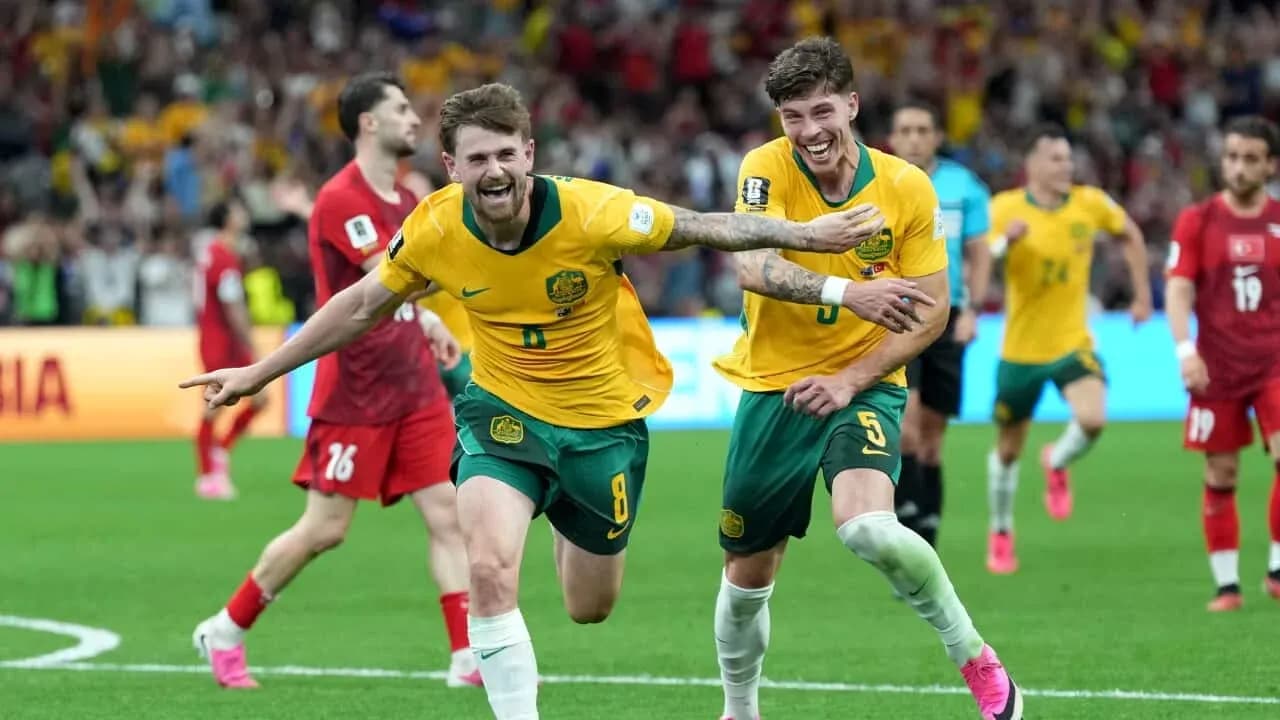
Under the roof of BC Place in Vancouver, Australia and Türkiye opened their World Cup 2026 stories with a clash that felt far more like a knockout rehearsal than a group-stage curtain-raiser. By the final whistle, the scoreboard read 2-0 to Australia, a result that now shapes the tactical narrative of Group D: Australia sitting 2nd with 3 points and a goal difference of 2, Türkiye 3rd with 0 points and a goal difference of -2, both having played 1 match.
I. The Big Picture – Structure and Intent
Tony Popovic set Australia up in a 5-4-1 that was anything but passive. The back five, anchored by Harry Souttar and Cameron Burgess with Jordan Bos and Jacob Italiano as wide defenders, gave them a solid shell to protect a young goalkeeper in Patrick Beach. Ahead of them, a narrow but energetic midfield line of Connor Metcalfe, Aiden O’Neill, Paul Okon-Engstler and Nestory Irankunda supported lone forward Mohamed Touré.
On the other side, Vincenzo Montella stayed true to his principles with a 4-2-3-1. Zeki Çelik, Merih Demiral, Abdülkerim Bardakcı and Ferdi Kadıoğlu formed the back four, shielded by the double pivot of İsmail Yüksek and Hakan Çalhanoğlu. Higher up, Arda Güler, Orkun Kökçü and Barış Alper Yılmaz operated behind Kerem Aktürkoğlu.
Heading into this game, Australia’s statistical profile was blank at tournament level, but following this result they immediately define themselves as a pragmatic, efficient side: in total this campaign they have played 1 match, winning 1, scoring 2 and conceding 0. At home (this match is logged as home), they average 2.0 goals for and 0.0 against, with 1 clean sheet from 1. Türkiye, conversely, begin their tournament on their travels with 1 defeat in 1, 0 goals scored and 2 conceded, an away average of 0.0 goals for and 2.0 against, and 1 failure to score.
II. Tactical Voids and Discipline
Neither side is flagged with confirmed absentees in the data, so the tactical voids here are structural rather than personnel-driven.
For Australia, the risk in a 5-4-1 is always the space between the lines and the potential isolation of the striker. Popovic mitigated that by pushing Irankunda and Okon-Engstler high in possession, often creating a 3-4-3 in attack. The wing-backs, Bos and Italiano, were crucial in stretching Türkiye’s back four horizontally and in pinning Ferdi Kadıoğlu and Zeki Çelik deeper than Montella would have liked.
Türkiye’s void emerged in the pivot. With İsmail Yüksek and Hakan Çalhanoğlu tasked with both progression and protection, Australia’s four-man midfield could outnumber them centrally, forcing Kökçü to drop deeper and blunting his influence between the lines. The 4-2-3-1 often flattened into a 4-3-3 in build-up, but without consistent penetration behind Australia’s wing-backs.
Disciplinary patterns underline the psychological arc of Türkiye’s performance. In total this campaign they have 1 yellow card, and it arrives entirely in a late-game surge of frustration: 100.00% of their yellows come in the 76-90’ window. Yunus Akgün embodies that edge; in his 35 minutes he collected 1 yellow, committed 1 foul and yet still managed 21 passes at 90% accuracy and 2 key passes. Australia, by contrast, have no cards recorded in any time range so far, reinforcing the sense of a controlled, low-risk defensive display.
III. Key Matchups – Hunter vs Shield, Engine Room
Hunter vs Shield
In pure scoring terms, Nestory Irankunda is Australia’s early “hunter”. He leads their scoring charts with 1 goal in 1 appearance, converting both of his 2 shots on target and posting a 7.5 rating from midfield. His directness – 1 successful dribble from 1 attempt, 1 foul drawn – gave Australia a vertical outlet whenever they broke Türkiye’s press.
Set against Türkiye’s defensive record, the clash is telling. On their travels this campaign, Türkiye have conceded 2 goals in 1 match, an away average of 2.0 goals against. The central pairing of Demiral and Bardakcı is physically imposing, but Australia’s threat didn’t come from aerial bombardment; it came from timing runs into half-spaces and exploiting the pockets around Türkiye’s full-backs. Irankunda, drifting inside from the right, repeatedly tested the channels between Ferdi Kadıoğlu and Bardakcı, a zone where Türkiye’s defensive shield was slow to compress.
Engine Room – Playmaker vs Enforcer
The true heartbeat of Australia’s plan was Paul Okon-Engstler. Across 84 minutes, he completed 32 passes with 81% accuracy, produced 2 key passes and delivered 1 assist. Defensively he was relentless: 3 tackles, 2 successful blocks and 3 interceptions. In total this campaign, he is already one of the competition’s standout two-way midfielders, ranked highly in the assists chart and embodying Popovic’s demand for aggression without chaos.
For Türkiye, Hakan Çalhanoğlu and Orkun Kökçü were supposed to be the creative axis. But with Australia’s midfield four compressing the central lanes, Hakan was often forced into deeper, more horizontal passing. Kökçü’s role as a connector between pivot and the trio behind Aktürkoğlu was disrupted by Okon-Engstler’s anticipation; those 3 interceptions were not incidental, they were the tactical fulcrum that turned Turkish possession into Australian counter-attacks.
Behind them, İsmail Yüksek had to act as Türkiye’s enforcer, but the double pivot rarely got the chance to step into aggressive counter-pressing zones. With Australia’s back five secure and O’Neill offering an extra layer in front of Souttar and Burgess, Türkiye’s attempts to overload the half-spaces around minute 31-60 never translated into sustained pressure.
IV. Statistical Prognosis – What This Match Tells Us
There is no explicit xG data in the snapshot, but the structural numbers and patterns are clear enough to sketch a prognosis.
Australia’s defensive solidity is not an illusion of sample size. In total this campaign they have 1 clean sheet from 1 match, 0.0 goals conceded on average, and have never trailed in their only fixture. Their biggest home win is already 2-0, and their only recorded lineup is this 5-4-1, suggesting tactical continuity rather than experimentation.
Türkiye’s profile is the mirror image: 1 defeat on their travels, 0.0 goals scored on average and 2.0 conceded, no clean sheets, and 1 match where they failed to score. Their biggest away loss is 2-0 – this very game – and their only recorded formation is the 4-2-3-1. The late spike in disciplinary trouble (100.00% of yellows in 76-90’) hints at a side that becomes stretched and emotional when chasing the game.
If we project forward within Group D, the intersection is stark: Australia’s compact 5-4-1, anchored by a disciplined midfield led by Okon-Engstler and lit up by Irankunda’s cutting edge, looks built to keep xG against low and to punish transitions. Türkiye, meanwhile, must solve their structural void in the pivot and find a way to get Güler and Kökçü receiving between lines earlier, before opponents can settle into a low block.
Following this result, the tactical verdict is that Australia have established a clear identity: defensively watertight, ruthlessly efficient, and emotionally composed. Türkiye still carry individual talent and a coherent shape on paper, but until their away defensive average drops from 2.0 conceded and their attack moves off 0.0 scored, they will remain a side whose xG potential is trapped behind a misfiring structure.
Related News
Brazil's First Post-World Cup Friendly: What Should the Lineup Be?
Harry Kane Calls England’s World Cup Exit to Argentina His Deepest International Pain
Estevao Opens Up on World Cup Heartbreak and His Unexpected Return to Brazil Under Ancelotti

Thomas Tuchel Shares Unusual Regret After England's 10-Man World Cup Victory Over Mexico
South Korea Names Robert Moreno as Interim Coach After World Cup Exit

Jude Bellingham Returns to Form at Real Madrid Following World Cup Success