
Bournemouth vs Manchester City: Tactical Analysis of a 1-1 Draw
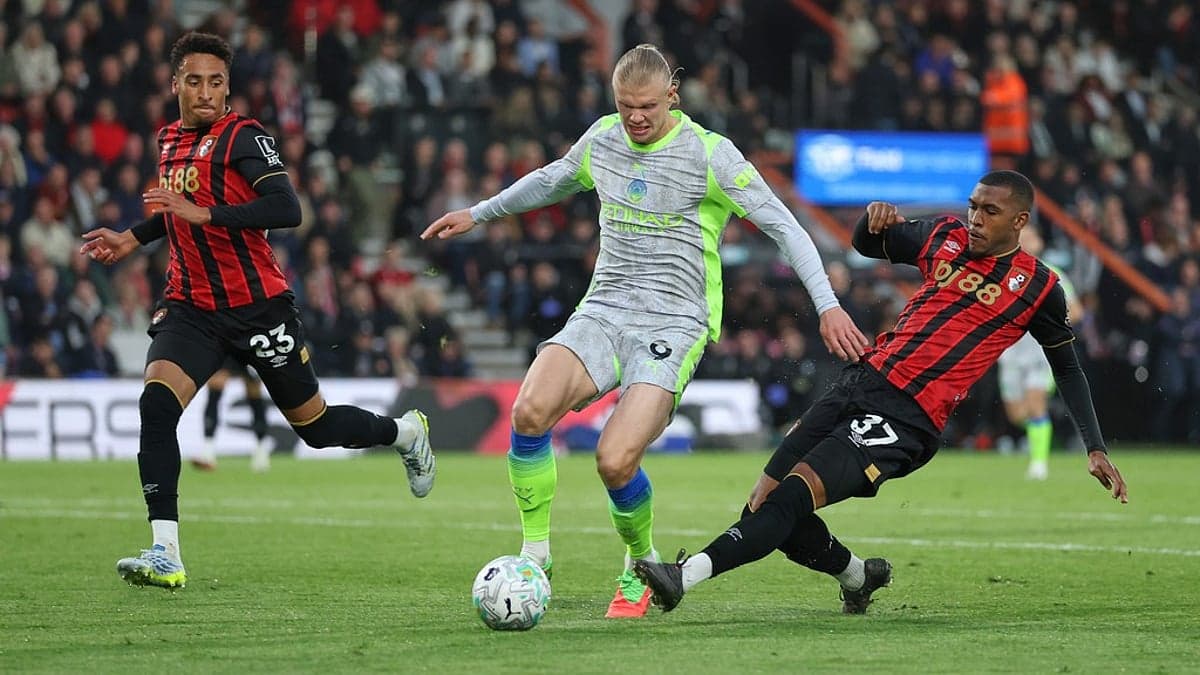
Bournemouth’s 1-1 draw with Manchester City at Vitality Stadium was a tactically disciplined, high‑intensity contest where structure and game state dictated almost every decision. In a Premier League Round 37 fixture, Andoni Iraola’s 4-2-3-1 was set up to compress central zones and counter quickly, while Pep Guardiola’s 4-1-4-1 sought to assert control through possession and late‑game pressure. The numbers – 45% vs 55% possession, xG 1.99 vs 1.68 – underline how closely matched the sides were despite City’s technical superiority on the ball.
I. Scoring sequence and disciplinary log
The first half pivoted around Bournemouth’s capacity to turn compact defending into direct threat. After an early spell of City possession, the game’s temperature rose on 37' when Tyler Adams received a yellow card for Argument, a clear sign of how emotionally charged the midfield battle had become.
Two minutes later, Bournemouth struck. On 39', E. J. Kroupi (Bournemouth) finished a well‑constructed move, assisted by A. Truffert, to give the hosts a 1-0 lead. The timing of the goal was crucial: it rewarded Bournemouth’s aggressive pressing and gave them a platform to lean into a more controlled, mid‑block approach without fully retreating.
The second half discipline narrative was almost entirely Bournemouth’s. On 59', James Hill (Bournemouth) was booked for Foul as the back line increasingly had to step out to meet City’s advancing midfield. Deep into added time, the tension spilled over. At 90+3', Justin Kluivert (Bournemouth) was shown a yellow card for Argument, with Rodri (Manchester City) also booked at 90+3' for Argument in the same emotional flashpoint. Finally, at 90+6', Adrien Truffert (Bournemouth) received a yellow card for Foul as Bournemouth desperately tried to see the game out under sustained pressure.
Crucially, City’s territorial dominance eventually told. On 90', Erling Haaland (Manchester City) scored a late equaliser with a Normal Goal, unassisted, to make it 1-1 and overturn Bournemouth’s hopes of a statement win. The halftime score had been 1-0 to Bournemouth; Haaland’s strike reshaped the tactical verdict at the last possible moment.
Card totals: Bournemouth 4 yellow cards, Manchester City 1 yellow card, total 5.
II. Tactical breakdown and personnel
Bournemouth’s 4-2-3-1 was built on a clear defensive spine and vertical transitions. D. Petrovic, in goal, delivered 3 saves and a goals prevented figure of 0.29, underscoring his importance in protecting a narrow lead for most of the match. The back four of A. Smith, James Hill, M. Senesi and A. Truffert operated relatively narrow, aiming to compress the central channels where City’s 4-1-4-1 typically does its damage.
In front, the double pivot of A. Scott and Tyler Adams was tasked with screening Rodri and blocking the lanes into B. Silva and M. Kovacic. Bournemouth’s 16 Fouls and 4 yellow cards reflect how physically they had to compete to disrupt City’s rhythm. Yet their structure allowed them to be dangerous: with 10 Total Shots (2 on target, 3 blocked) and 6 efforts inside the box, they created quality looks rather than speculative attempts, matching their xG of 1.99.
In possession, Bournemouth were tidy but not expansive: 431 passes, 346 accurate (80%), and 45% of the ball. The plan was clearly to use quick progression rather than long spells of circulation. E. J. Kroupi, operating as an advanced midfielder, became the symbol of this approach with his goal, fed by Truffert’s overlapping threat from left‑back. M. Tavernier and Rayan provided support between the lines, while Evanilson’s presence as the lone forward gave Bournemouth a focal point to pin City’s centre-backs.
Iraola’s substitutions were aimed at refreshing the front line and maintaining the out‑ball as City increased the pressure. At 76', Justin Kluivert (IN) came on for E. J. Kroupi (OUT), adding direct running in transition. Later, at 84', D. Brooks (IN) came on for Rayan (OUT), and at 89', E. Unal (IN) came on for Evanilson (OUT), signalling a shift towards deeper defending with fresh legs to chase lost causes. At 90', L. Cook (IN) came on for A. Smith (OUT), further reinforcing central stability for the final defensive stand.
City’s 4-1-4-1 was built around Rodri as the single pivot, with B. Silva and M. Kovacic initially operating ahead of him, and J. Doku and A. Semenyo wide, supporting Erling Haaland. With 527 passes, 458 accurate (87%), and 55% possession, City controlled the tempo for long stretches but often found Bournemouth’s block difficult to break.
The shot profile tells the story of persistent but not overwhelming pressure: 14 Total Shots, 5 on target, 6 blocked, and a heavy focus on high‑value areas with 10 shots inside the box. Their xG of 1.68 reflects sustained threat but also Bournemouth’s success in forcing City into crowded central zones.
Guardiola’s triple substitution on 56' was a major tactical inflection point. P. Foden (IN) came on for M. Kovacic (OUT), R. Cherki (IN) for B. Silva (OUT), and Savinho (IN) for A. Semenyo (OUT). This reconfigured the attacking line into a more aggressive, creative unit: Foden and Cherki between the lines, Savinho offering width and 1v1 threat. Later, at 76', O. Marmoush (IN) replaced J. Doku (OUT), adding a different type of forward movement from the flank.
G. Donnarumma, in City’s goal, made 2 saves with a goals prevented figure of 0.29, indicating he was reliable when called upon, though City’s higher line and dominance of the ball meant he was less frequently tested than Petrovic.
III. The statistical verdict
From a statistical perspective, the 1-1 scoreline mirrors the balance of chances more than the flow of possession. Bournemouth’s xG of 1.99 against City’s 1.68 suggests the hosts carved out slightly better quality opportunities, even with fewer shots and less of the ball. City’s 55% possession and superior passing accuracy (87% vs 80%) underline their territorial and technical control, but Bournemouth’s compact 4-2-3-1 and disciplined (if sometimes overzealous) defending – reflected in 16 Fouls and 4 yellow cards – successfully limited clear openings until Haaland’s late intervention.
The defensive indices of both goalkeepers were strong: each registering 0.29 goals prevented, reinforcing that this was not a game defined by poor finishing or goalkeeping errors, but by tactical resilience and marginal gains. Bournemouth’s 7 Corner Kicks to City’s 6 and identical Offsides count (2-2) show how evenly matched the territorial battle became, especially in the second half.
Ultimately, City’s structure and bench depth allowed them to sustain pressure long enough for Haaland to rescue a point, but Bournemouth’s tactical plan, execution, and defensive work at Vitality Stadium earned them a draw that the underlying numbers fully justify.
Related News

Premier League Managers Facing Potential Sackings During International Break
Arsenal's Myles Lewis-Skelly Names Unexpected Tottenham Rival as Toughest Premier League Opponent

Three Premier League Players Shining Early This Season

Premier League Early Season Reactions: Man City’s Strength, Arsenal’s Flaws, United’s Struggles

Premier League Returns October 10 After Extended September-October International Break

Fulham and Manchester United Share Points in 1-1 Draw