
Brazil and Morocco Draw 1-1 in Tactically Balanced World Cup Match
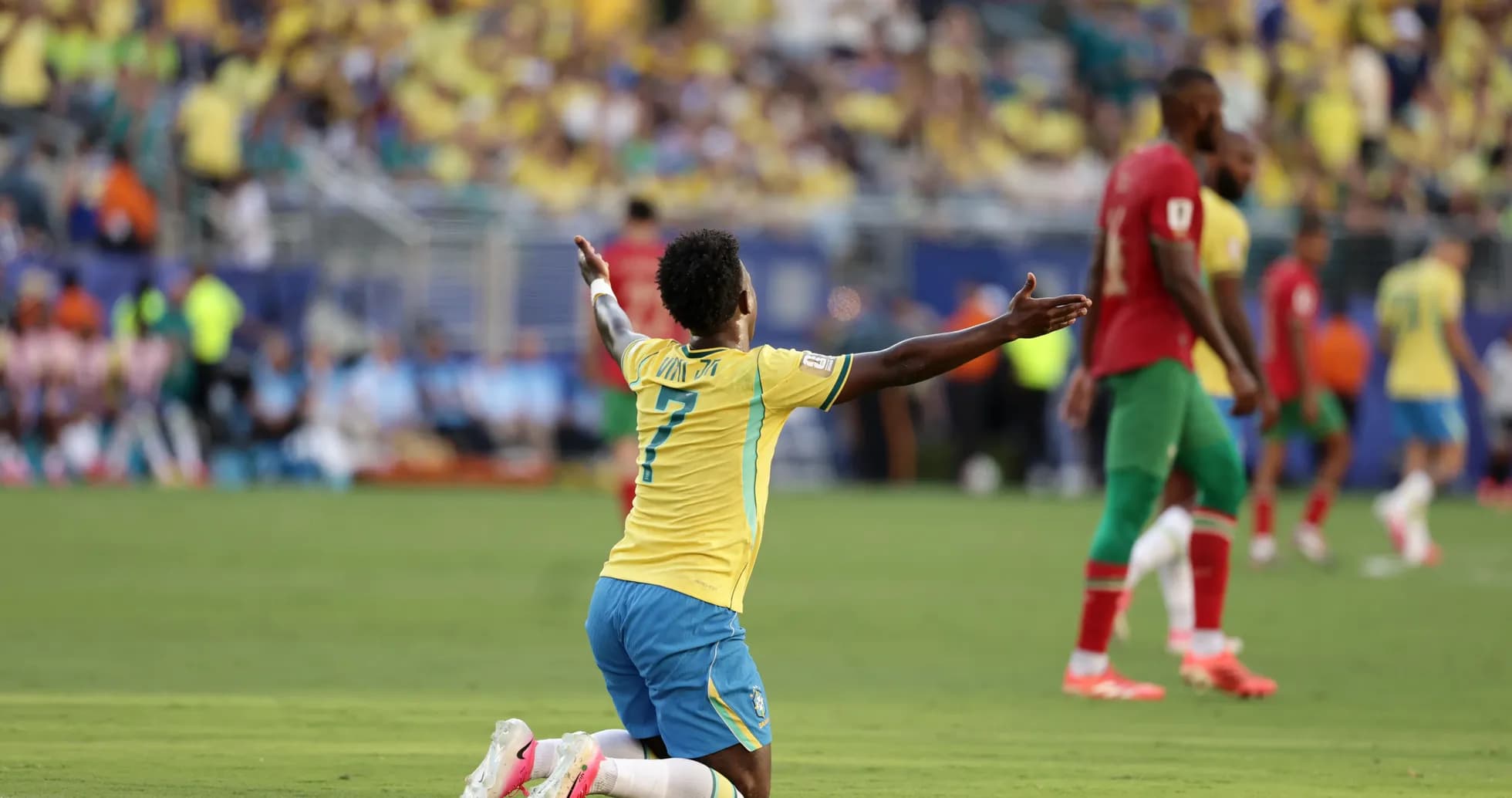
Brazil and Morocco opened their World Cup Group Stage campaigns at MetLife Stadium with a 1-1 draw that was tactically rich and finely balanced. Both sides mirrored each other structurally in a 4-2-3-1, yet interpreted the system very differently. Brazil, under Carlo Ancelotti, leaned on controlled possession and layered occupation of the half-spaces, while Mohamed Ouahbi’s Morocco prioritised verticality, compactness and sharp transitions through their advanced midfield line. The statistical profile – 54% possession for Brazil, identical 12 shots each, and near-identical xG (Brazil 1.24, Morocco 1.28) – underlined how even the contest was, with neither side able to fully impose its game for long stretches.
Ismael Saibari’s 21st-minute opener for Morocco, assisted by Brahim Díaz, showcased Ouahbi’s plan: rapid progression from a compact mid-block, using the 10 and wide attacking midfielders to overload the pockets behind Brazil’s double pivot. The goal came from precisely that zone, with Saibari arriving from the front line into a seam between Brazil’s centre-backs and holding midfielders. Brazil’s response on 32 minutes, a Vinícius Júnior equaliser from a Bruno Guimarães assist, reflected their own structural idea: circulating through the double pivot to free the left-sided playmaker in isolation or 2v1s. Vinícius’ positioning as a nominal midfielder on the left of the three allowed him to receive between Morocco’s full-back and centre-back, a recurring pattern throughout the first half.
Without the ball, Brazil’s 4-2-3-1 often flattened into a 4-4-1-1, with Raphinha and Vinícius tracking Morocco’s full-backs and Lucas Paquetá stepping out situationally onto the deepest Moroccan midfielder. Casemiro and Bruno Guimarães formed a tight double pivot, but Morocco’s advanced trio of Brahim Díaz, Azzedine Ounahi and Bilal El Khannouss (before and after substitutions) repeatedly tried to drag them out of shape with opposite movements: one dropping, one running beyond, one drifting wide. The yellow cards for Casemiro (37' — Foul) and Roger Ibañez (43' — Foul) reflected Brazil’s occasional need to break these rotations with tactical interventions when Morocco escaped pressure.
In possession, Brazil’s build-up was methodical. Marquinhos and Gabriel Magalhães split, Douglas Santos stayed slightly deeper on the left while Roger Ibañez (before his withdrawal) or later Danilo stepped higher on the right, effectively creating a 3+1 or 2+2 base in the first phase. Casemiro mostly held the central lane, with Bruno Guimarães sliding to connect to the left half-space and Paquetá higher between the lines. This structure supported their 501 passes (441 accurate, 88%), allowing them to control tempo and probe patiently. However, Morocco’s 4-2-3-1 out of possession was very compact centrally, funnelling Brazil wide and trusting the back four to defend crosses and cutbacks.
Morocco’s attacking structure depended heavily on Achraf Hakimi and Noussair Mazraoui advancing from full-back to provide width, freeing the three attacking midfielders to operate inside. With 12 total shots but only 2 on goal, their shot profile suggested that Brazil’s central defenders and holding midfielders were often able to get bodies in front of efforts, forcing attempts from less favourable positions or into blocks. The six blocked shots recorded for Morocco defensively also showed how committed they were to collapsing into their box once Brazil entered the final third, turning the area into a crowded zone where clear chances were hard to fashion.
The second-half substitutions altered Brazil’s internal dynamics more than the external shape. At 46', Danilo (IN) came on for Roger Ibañez (OUT), and Fabinho (IN) replaced Casemiro (OUT). Danilo’s introduction stabilised the right side defensively and gave a slightly more conservative interpretation of the full-back role, while Fabinho offered fresher legs and a marginally more mobile screen in front of the defence. These changes were clearly aimed at reducing Morocco’s transition threat, particularly after the warning signs around Saibari and Brahim Díaz in the first half.
On 61', Luiz Henrique (IN) came on for Igor Thiago (OUT) and Matheus Cunha (IN) for Lucas Paquetá (OUT), subtly shifting Brazil’s attacking reference points. Rather than a traditional central forward, Brazil now had more fluid movement across the front line, with Cunha comfortable dropping into pockets and Luiz Henrique stretching the last line. This helped Brazil increase the volume of attacks into Morocco’s box – they finished with 9 shots inside the area – but Bono (Morocco) and his back four managed the penalty-box defending with discipline, limiting Brazil to 4 shots on goal.
Morocco’s own substitution wave at 64' and 80' – Samir El Mourabet (IN) for Azzedine Ounahi (OUT), Chemsdine Talbi (IN) for Brahim Díaz (OUT), Ayoube Amaimouni Echghouyab (IN) for Bilal El Khannouss (OUT), and Anass Salah-Eddine (IN) for Noussair Mazraoui (OUT) – pointed to a clear priority: maintain the defensive structure and freshen legs in wide and half-space zones rather than radically alter the system. Soufiane Rahimi (IN) for Ismael Saibari (OUT) at 89' provided a late outlet for counters, but by then both teams were more concerned with not losing shape than with committing heavy numbers forward.
In goal, Alisson (Brazil) was statistically quiet with 1 save, which underlines how effectively Brazil kept Morocco’s attempts away from truly dangerous zones despite conceding 12 shots. The 0.46 goals prevented for Brazil’s goalkeeper unit indicates he dealt reliably with what did reach him. Bono (Morocco), with 3 saves and the same 0.46 goals prevented figure, had the heavier workload, particularly as Brazil’s possession and box entries increased after the hour. His interventions, combined with Morocco’s shot-blocking and compactness, were central to preserving the draw.
From a statistical verdict, the match was almost perfectly balanced. Brazil’s 54% possession and marginally higher passing volume (501 passes, 441 accurate, 88%) reflected their territorial and control-oriented approach, while Morocco’s 46% and 432 passes (375 accurate, 87%) showed they were comfortable playing with slightly less of the ball but using it efficiently. Both sides took 12 shots; Brazil were marginally more accurate (4 on goal to Morocco’s 2), yet Morocco’s xG of 1.28 narrowly eclipsed Brazil’s 1.24, suggesting that their best chances were of slightly higher quality even if fewer hit the target. Discipline also played a subtle role: Brazil’s 15 fouls and 2 yellow cards versus Morocco’s 14 fouls and clean card record hint at Brazil having to make more corrective actions against transitions.
Ultimately, this 1-1 at MetLife Stadium felt like a meeting of two well-drilled, tactically coherent teams whose game plans largely neutralised each other. Brazil’s structured possession and half-space manipulation produced sustained pressure but not overwhelming chances; Morocco’s compact block and vertical surges yielded a similar xG with fewer on-target efforts. The draw was a fair reflection of the tactical equilibrium, and both coaches will see clear foundations to build on for the remainder of the World Cup group stage.
Related News
Mbappe Faces Questions Over Real Madrid Focus Amid World Cup Priorities
Saudi Arabia Suspends $2.5bn Neom Stadium Project Amid Economic Strains Ahead of 2034 World Cup
The Rose Bowl Southampton Pitch Analysis for ICC Women's T20 World Cup 2026
Inter's Josep Martinez Confident in Italy’s Potential to Bounce Back After World Cup Setbacks
Dean Huijsen Reflects on World Cup Snub After Spain’s 4-1 Win Over Croatia
Ivan Rakitic Reveals He Still Avoids Watching Croatia’s 2018 World Cup Final Loss to France