
Brighton vs Manchester United: Tactical Analysis of 0-3 Defeat
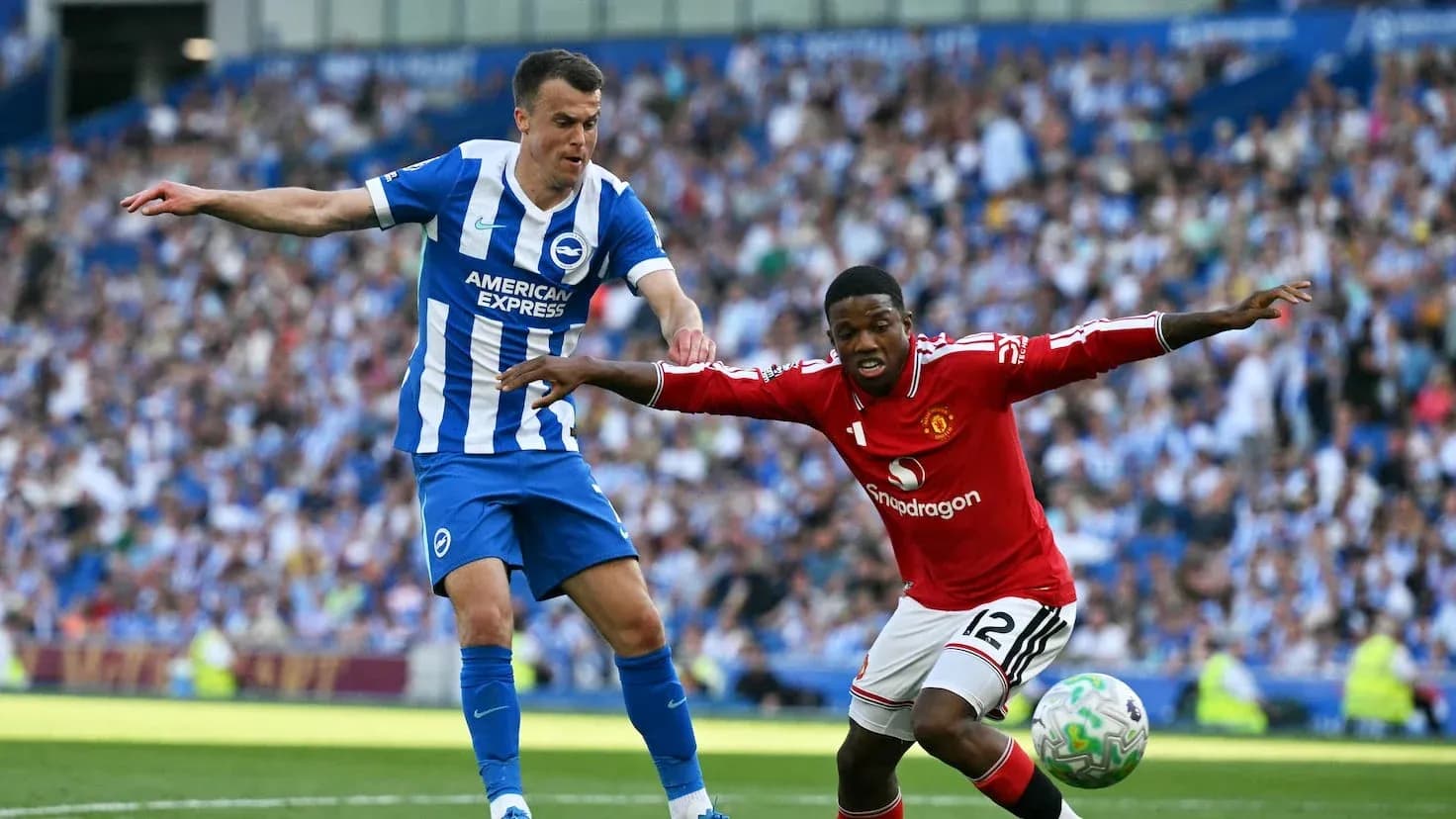
Brighton’s 0-3 home defeat to Manchester United at Amex Stadium was decided by United’s superior verticality and efficiency rather than territorial dominance. Both sides lined up in a 4-2-3-1 and finished almost level in possession (51% Brighton, 49% Manchester United), but Michael Carrick’s team turned their phases of control into clear chances, reflected in a 1.82 xG to 0.81 edge and a 7-2 advantage in shots on goal. Brighton circulated the ball with their usual composure, yet their structure repeatedly broke under United’s counter-press and direct running from the attacking midfield line.
I. EXECUTIVE SUMMARY OF THE GAME PLAN
Brighton, under Fabian Hurzeler, sought to build from the back with a high technical base and double pivot, using the back four plus the two holding midfielders to create a six-man first line. Manchester United mirrored the 4-2-3-1 shape but with a much more aggressive interpretation: the double pivot of M. Mount and K. Mainoo stepped high to press Brighton’s midfield, while B. Fernandes, A. Diallo and P. Dorgu supported B. Mbeumo in a narrow, fluid attacking box that constantly attacked the half-spaces. The match quickly became a contrast between Brighton’s controlled possession and United’s ruthless exploitation of transition moments.
II. STRUCTURAL BATTLES AND PRESSING DYNAMICS
Brighton’s 4-2-3-1 placed J. Milner and P. Gross as the central platform in front of a back four of M. Wieffer, J. P. van Hecke, L. Dunk and F. Kadioglu. The idea was clear: draw United’s first line onto them, then find the three advanced midfielders – D. Gomez, J. Hinshelwood and M. De Cuyper – between the lines to feed D. Welbeck. In practice, United’s press disrupted this pattern. Mount and Mainoo jumped aggressively onto Gross and Milner, while Fernandes locked onto Brighton’s deepest pivot option and Diallo and Dorgu squeezed inside to shut off central lanes.
Because of that, Brighton’s progression often defaulted to wide circulation rather than clean central entries. They managed 463 passes to United’s 447, and an impressive 397 accurate passes at 86%, but much of this was sterile possession in deeper zones. The lack of corner kicks (0 for Brighton versus 3 for United) underlined how rarely Hurzeler’s side sustained pressure in the final third. When Brighton did reach the box – 9 shots inside the box out of 13 total – United’s compact penalty-area block forced many efforts into traffic, as shown by Brighton’s 5 blocked shots.
United’s pressing was selective rather than constant. They allowed Brighton’s centre-backs to have the ball, then sprang traps when the pass was played into the double pivot. Mainoo’s single yellow card (for “Foul” at 45+3') came from one of these aggressive interventions, underlining how central his role was in disrupting Brighton’s rhythm. Once the ball was won, United transitioned at speed, using Fernandes as the main connector.
III. MANCHESTER UNITED IN POSSESSION: VERTICAL 4-2-3-1
In settled possession, United’s 4-2-3-1 often resembled a 2-3-5. Full-backs N. Mazraoui and L. Shaw pushed high and wide, Mount dropped to form a three with the centre-backs H. Maguire and L. Martinez, and Mainoo stayed slightly higher as a link. Fernandes operated between the lines, while Diallo and Dorgu attacked the half-spaces around Mbeumo.
The opening goal at 33' was the perfect illustration: P. Dorgu arrived from the left midfield line into the inside channel, exploiting the space behind Brighton’s advanced full-back. With Brighton’s double pivot pinned and their centre-backs occupied by Mbeumo and the threat of Diallo’s runs, Dorgu could receive and finish from a B. Fernandes assist. United’s second goal at 44', scored by B. Mbeumo and assisted by A. Diallo, again came from quick vertical combination play – Diallo moving inside to play the final pass and Mbeumo attacking the central corridor, punishing Brighton’s stretched defensive line.
After the break, United killed the contest early. At 48', B. Fernandes finished a move created by P. Dorgu’s involvement, underscoring how the left-sided midfielder repeatedly attacked Brighton’s right half-space. The goal was checked and then confirmed by VAR at 50', but tactically nothing changed: Brighton’s attempts to push higher simply opened more space behind their full-backs, which United’s attacking four continued to exploit.
IV. BRIGHTON’S ADJUSTMENTS AND LIMITATIONS
Hurzelers in-game changes were aggressive. At 46', Y. Minteh (IN) came on for M. De Cuyper (OUT), clearly aimed at adding direct one-v-one threat from wide areas. A triple substitution on 59' – S. March (IN) for D. Gomez (OUT), C. Baleba (IN) for J. Milner (OUT), and C. Kostoulas (IN) for D. Welbeck (OUT) – rebalanced the side with more athleticism in midfield and fresh movement up front. Later, G. Rutter (IN) for J. Hinshelwood (OUT) at 74' further tilted the structure toward attack.
These changes did increase Brighton’s shot volume and presence in the box, but the underlying issue remained: United’s central compactness. Despite 13 total shots, Brighton produced only 0.81 xG, which reflects the difficulty of generating truly clear chances. The lack of corner kicks and the relatively low shots on goal (2) for such possession dominance highlight how rarely Brighton broke United’s last line with clean, high-value entries.
V. DEFENSIVE PERFORMANCES AND GOALKEEPERS
In goal, B. Verbruggen (Brighton) was consistently exposed by high-quality United chances. He made 5 saves and, according to the data, had 0.32 goals prevented, which suggests he performed close to expectation given the quality of shots faced. United’s 7 shots on goal and 1.82 xG meant that the three goals conceded were more a product of systemic defensive issues – particularly the space between Brighton’s midfield and back line – than individual errors from the goalkeeper.
At the other end, S. Lammens (Manchester United) had a relatively controlled afternoon. Brighton managed only 2 shots on goal, and Lammens made 2 saves. United’s defensive block, anchored by Maguire and Martinez with strong support from the double pivot, forced Brighton to shoot under pressure or from less optimal angles, which is consistent with the modest xG total despite decent shot volume.
VI. STATISTICAL VERDICT AND SEASONAL CONTEXT
Statistically, the match was a classic case of one side controlling territory and the other controlling danger. Brighton edged possession (51% to 49%) and completed more passes (463 to 447) with better accuracy (86% to 83%), but United created more and better chances, led the shots on goal 7-2, and had fewer fouls (8 to 11), indicating a disciplined pressing scheme rather than reckless challenges. United also registered 3 corner kicks to Brighton’s 0, reinforcing their superior territorial threat in the final third.
The xG split of 1.82 for Manchester United against 0.81 for Brighton accurately reflects a game where United’s attacking structure – especially the Fernandes-Diallo-Dorgu-Mbeumo quartet – repeatedly carved out high-quality situations. Brighton’s 5 blocked shots show they were often shooting through traffic rather than from clean openings. With only one yellow card in the match (Kobbie Mainoo’s “Foul”), United managed to combine aggression off the ball with control, closing their league campaign with a tactically mature away performance that exposed the current ceiling of Brighton’s possession model against elite, vertically oriented opposition.
Related News

Premier League Managers Facing Potential Sackings During International Break
Arsenal's Myles Lewis-Skelly Names Unexpected Tottenham Rival as Toughest Premier League Opponent

Three Premier League Players Shining Early This Season
Premier League Early Season Reactions: Man City’s Strength, Arsenal’s Flaws, United’s Struggles

Premier League Returns October 10 After Extended September-October International Break

Fulham and Manchester United Share Points in 1-1 Draw