
France Dominates Senegal in 3-1 Victory at MetLife Stadium
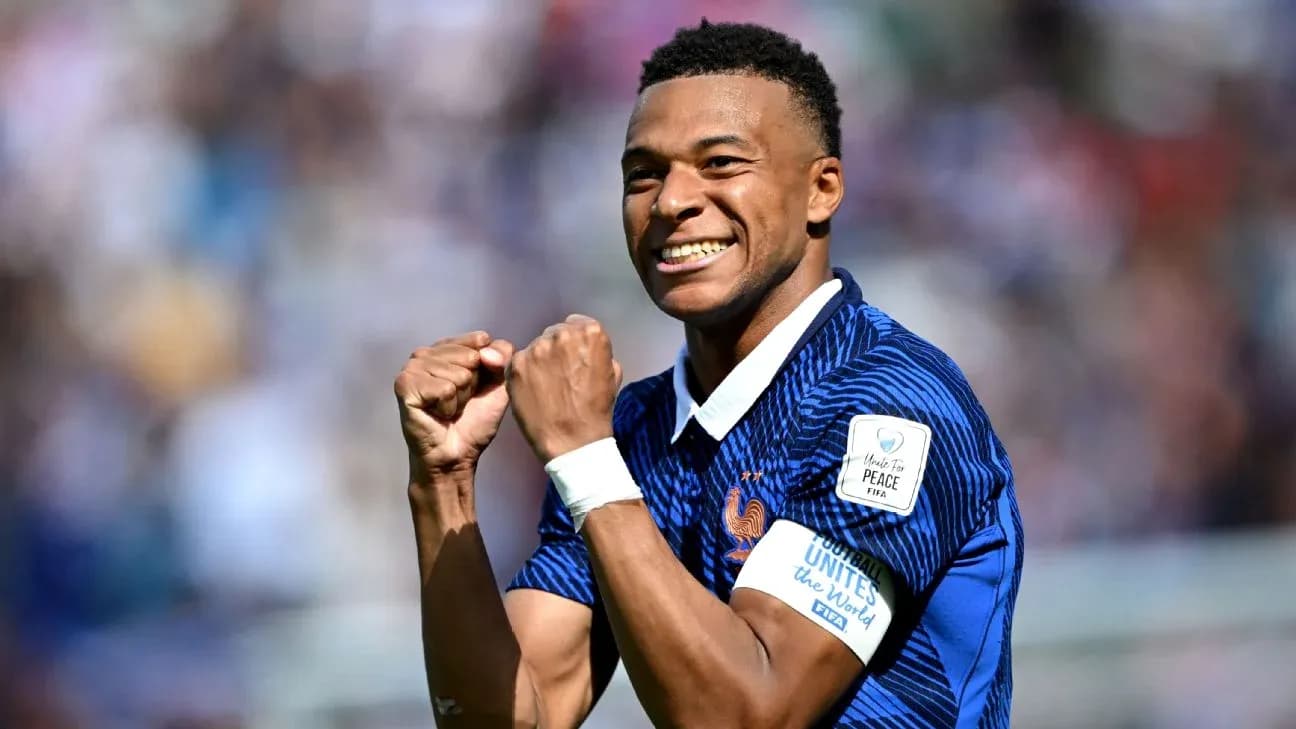
France’s 3-1 win over Senegal at MetLife Stadium unfolded as a controlled, structurally coherent performance built on a 4-2-3-1 that gradually squeezed the life out of Senegal’s own 4-2-3-1. The scoreline reflects France’s superiority in territory and chance quality, but also a clear tactical storyline: France’s positional play and wide dynamics wore Senegal down, and the African side’s late attacking switches came too late to alter the fundamental balance.
France’s Structure
France’s structure was classic Deschamps: Mike Maignan (France) behind a back four of Jules Koundé, Dayot Upamecano, William Saliba and Theo Hernández, with Aurélien Tchouaméni and Adrien Rabiot forming the double pivot. Ahead, Michael Olise and Ousmane Dembélé occupied the half-spaces and wings, Désiré Doué worked as the central link, and Kylian Mbappé led the line. Senegal mirrored the 4-2-3-1 with Edouard Mendy (Senegal) in goal, a back four anchored by Kalidou Koulibaly and Moussa Niakhaté, Idrissa Gana Gueye and Pape Gueye as the screening pair, and an attacking band of Ismaïla Sarr, Lamine Camara and Sadio Mané behind Nicolas Jackson.
Tactical Control
From a tactical-control perspective, the possession split – 53% France to 47% Senegal – understates how cleanly France managed the game. Their 575 passes, with 505 accurate (88%), point to a side circulating the ball with patience, using the double pivot to move Senegal’s first line and then accessing the half-spaces. Tchouaméni and Rabiot were key in this: dropping between or alongside the centre-backs in build-up, they created 3v2 overloads against Senegal’s first pressing line of Jackson plus one of the attacking midfielders stepping out.
Shot Profile
France’s shot profile underlines the effectiveness of this structure. They generated 11 total shots to Senegal’s 6, with 8 shots on goal versus only 2 for Senegal. Seven of those French attempts came inside the box, a sign that their positional attacks were ending in high-quality central or cut-back situations rather than speculative efforts. The xG gap – 1.79 for France against 0.53 for Senegal – confirms that this was not a finishing outlier but a reflection of consistent territorial and positional superiority.
Flanks and Breakthrough
The flanks were decisive. On the right, Koundé tended to hold a more conservative line, allowing Dembélé to stay high and wide to stretch El Hadji Malick Diouf and draw out Pape Gueye. On the left, Theo Hernández’s aggressive forward runs created an asymmetry: he often pushed into a winger’s lane, with Olise rolling inside into the right half-space or No.10 zone. That dynamic was central to the breakthrough: Mbappé’s 66' opener, assisted by Olise, fits the pattern of France using width to destabilize Senegal’s back four before finding Mbappé attacking the space between centre-back and full-back.
Senegal’s Defensive Plan
Senegal’s defensive plan was to keep a compact 4-4-2/4-4-1-1 mid-block, with Jackson working across the French centre-backs and one of the attacking midfielders stepping up situationally. Their 9 fouls to France’s 5 reflect a side that was often a half-step late to France’s circulation, forced into contact to break rhythm. Yet they did maintain a decent passing structure of their own: 502 passes, 430 accurate (86%) show that when they did have the ball, they could string sequences together. The issue was progression: only 6 total shots, 4 inside the box, and an xG of 0.53 suggest that France’s central block of Tchouaméni, Rabiot, Upamecano and Saliba largely denied access to dangerous zones.
Turning Point
The turning point phase came around the hour. At 60', a potential penalty for France was cancelled by VAR, a psychological test for both sides. Instead of destabilising France, it seemed to sharpen their focus. Mbappé’s opener at 66' was followed by a decisive substitution pattern from both benches. For Senegal, Bouna Thiaw Pape tried to inject directness and vertical threat: Ibrahim Mbaye (IN) came on for Ismaïla Sarr (OUT) at 75', Habib Diarra (IN) for Lamine Camara (OUT) at 76', then a double switch at 83' with Ahmadou Bamba Dieng (IN) for Nicolas Jackson (OUT) and Iliman Ndiaye (IN) for Pape Gueye (OUT). Later, Pathé Ismaël Ciss (IN) replaced Idrissa Gana Gueye (OUT) at 88'. Collectively, these moves tilted Senegal toward a more attacking 4-2-4/4-3-3 look, with fresh forwards and runners aiming to attack space behind France’s line.
Deschamps’ Response
Deschamps’ response was measured and targeted. Bradley Barcola (IN) replaced Dembélé (OUT) at 80', adding a more direct, vertical winger against a tiring Senegalese right side. That switch paid off immediately: Barcola’s 82' goal, assisted by Rabiot, embodied France’s capacity to exploit transition moments and second-phase chaos once Senegal committed more men forward. Later, Rayan Cherki (IN) came on for Désiré Doué (OUT) at 87', adding fresh technical security between the lines to help France manage possession in the closing stages.
Goalkeepers’ Performance
Defensively, both goalkeepers had relatively controlled evenings. Maignan (France) made 2 saves, reflecting how effectively France limited Senegal’s shot volume and shot quality. Mendy (Senegal) recorded 5 saves, underlining the pressure France created, particularly after the hour mark when spaces opened in transition. Notably, both keepers posted the same goals prevented figure (-0.94), indicating that each conceded slightly more than the post-shot models would predict – a sign that the finishing on both sides, especially Mbappé’s brace and Mbaye’s late goal, was clinically executed relative to the shot placements.
Set Plays and Territorial Indicators
Set plays and territorial indicators reinforce the broader tactical picture. France earned 6 corners to Senegal’s 4, another marker of sustained attacking presence. Their 2 blocked shots versus Senegal’s 1 suggest that Senegal’s last-ditch defending did intervene but not at a volume sufficient to stem the tide. The offside count – 1 for France, 3 for Senegal – is also telling: Senegal’s attempts to break quickly and more directly after going behind led them into France’s well-timed defensive line, while France’s attacks were more about controlled occupation of zones than gambling on runs in behind.
Late Goals
The late goals encapsulate the tactical arc. Mbappé’s second at 90+6' came with Senegal stretched and chasing, France exploiting the gaps in a game state they had engineered through earlier control. Mbaye’s 90+5' strike, assisted by Ndiaye, was a reward for Senegal’s late attacking reshuffle but arrived with the contest effectively decided. In sum, France’s 4-2-3-1 offered superior balance between control and verticality, while Senegal’s mirrored shape could not consistently disrupt French build-up or generate enough high-quality entries into the final third.
Related News
Brazil's First Post-World Cup Friendly: What Should the Lineup Be?
Harry Kane Calls England’s World Cup Exit to Argentina His Deepest International Pain
Estevao Opens Up on World Cup Heartbreak and His Unexpected Return to Brazil Under Ancelotti
Thomas Tuchel Shares Unusual Regret After England's 10-Man World Cup Victory Over Mexico

South Korea Names Robert Moreno as Interim Coach After World Cup Exit

Jude Bellingham Returns to Form at Real Madrid Following World Cup Success