
Hellas Verona vs AS Roma: Serie A Season Finale Analysis
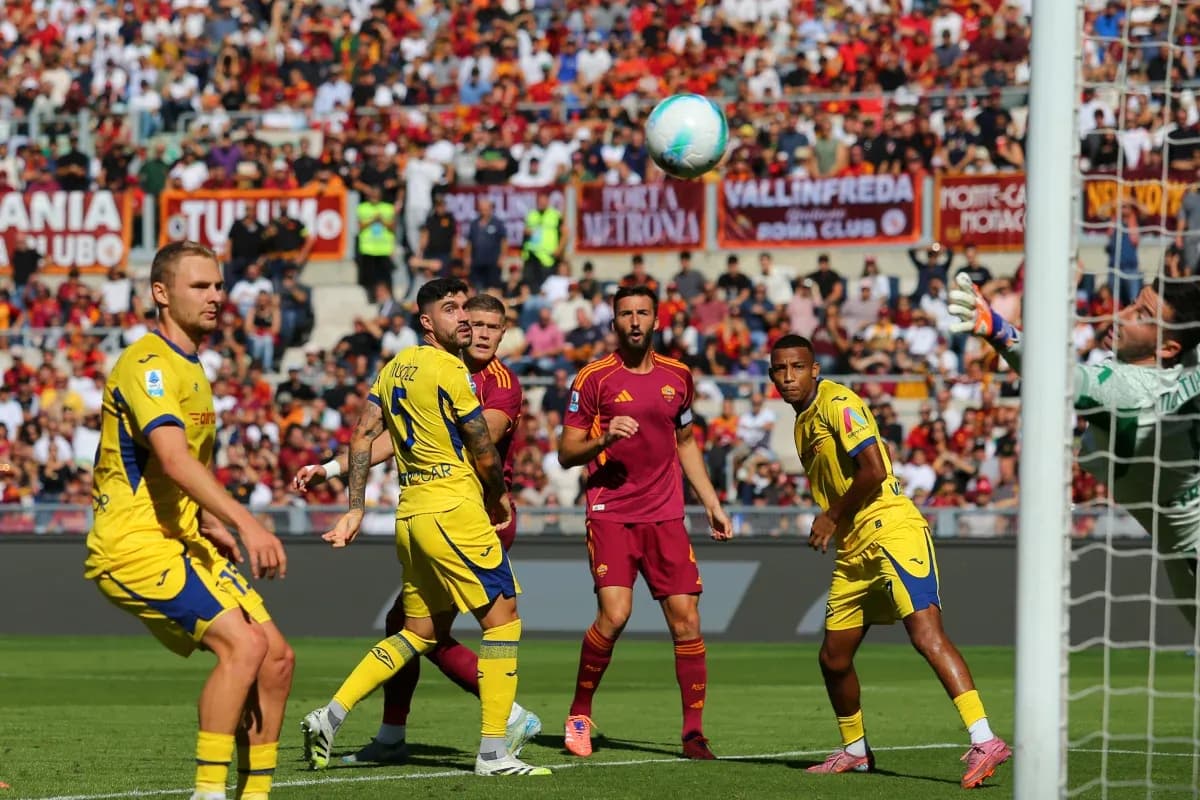
Under the evening lights of Stadio Marcantonio Bentegodi, the final chapter of Hellas Verona’s Serie A season closed with a familiar feeling: resistance without reward. AS Roma’s 2–0 away win sealed the contrast between a side slipping into Serie B and another striding into the Champions League, and the lineups told that story long before the first whistle.
I. The Big Picture – Structures that reveal a season
Following this result, Verona finish 19th on 21 points, with a goal difference of -36, the mathematical echo of a campaign defined by blunt attack and porous defence. Overall they scored 25 and conceded 61; at home they found the net only 12 times and shipped 28. Roma, by contrast, close in 3rd place on 73 points, with a goal difference of 28, built on 59 goals scored and 31 conceded. At home they averaged 1.7 goals for and just 0.5 against; on their travels they still produced 26 goals and allowed 21, a respectable away profile for a Champions League side.
The tactical shapes at Bentegodi felt like distilled season identities. Paolo Sammarco stayed loyal to Verona’s most-used structure, a 3-5-2 that has been deployed 26 times this campaign. L. Montipo anchored a back three of N. Valentini, A. Edmundsson and V. Nelsson, with M. Frese and R. Belghali as wide midfielders, S. Lovric, J. Akpa Akpro and A. Harroui forming the central band, and T. Suslov supporting K. Bowie up front.
On the opposite bench, Piero Gasperini Gian leaned into Roma’s dominant blueprint: a 3-4-2-1, used 30 times this season. M. Svilar stood behind a trio of M. Hermoso, D. Ghilardi and G. Mancini, with D. Rensch and Z. Celik as wing-backs, B. Cristante and N. Pisilli in central midfield, and a fluid attacking line of M. Soule and P. Dybala behind lone striker D. Malen.
II. Tactical Voids – Absences that shaped the contest
Verona entered this game shorn of some of their most defining profiles. R. Gagliardini, one of Serie A’s leading yellow-card collectors with 10 cautions, was suspended for accumulation. His absence removed a combative screen who had amassed 73 tackles, 13 successful blocks and 54 interceptions this season – exactly the sort of enforcer Verona needed against Roma’s between-the-lines creators.
Further back, the loss of D. Mosquera and S. Serdar to knee injuries, plus D. Oyegoke and J. Peci to fitness problems, stripped depth from a squad already stretched by a long relegation fight. G. Orban, both their most prolific scorer in the red-card rankings and a forward with 7 league goals, was also listed as inactive. Without his direct threat and penalty-box presence, Sammarco was forced into a more improvised front line with Suslov and Bowie.
Roma had their own voids, but from a position of strength. E. Ferguson (ankle), E. Ndicka and L. Pellegrini (both thigh injuries), K. Tsimikas (illness), B. Zaragoza (knee) and Wesley Franca (suspended after a red card) all missed out. The absence of Pellegrini removed a natural organiser in the half-spaces, while Ndicka’s injury reduced left-footed balance in the back line. Yet Roma’s squad depth allowed Hermoso and Mancini to absorb that responsibility, and Soule to assume more creative weight.
Disciplinary trends across the season framed the risk zones. Verona’s yellow-card pattern showed a pronounced surge between 31–45 minutes (21.35%) and 46–60 minutes (24.72%), with a late spike at 76–90 minutes (15.73%). Their reds clustered in the second half: 40.00% between 46–60 and another 40.00% between 76–90. Roma, meanwhile, saw their yellow accumulation peak between 61–75 and 76–90 minutes (both 23.53%), with reds concentrated from 46–75 minutes. This was always likely to be a match where control of the middle third in the second half would depend as much on discipline as on tactics.
III. Key Matchups – Hunter vs Shield, Engine Room vs Engine Room
Hunter vs Shield
D. Malen arrived as one of Serie A’s most efficient finishers: 14 goals from 18 appearances, 49 shots with 31 on target, and a rating of 7.23. His penalty record was strong but imperfect – 3 scored, 1 missed – an important detail in a league where margins are thin. Facing a Verona defence that, overall, conceded 1.6 goals per game and, at home, 1.5, Malen’s pace in behind and movement across the front line posed an obvious problem.
With Gagliardini absent, the burden of protecting Verona’s back three fell heavily on Akpa Akpro and Lovric. Akpa Akpro’s season numbers – 44 tackles, 7 successful blocks and 23 interceptions – underline his willingness to break play, but without Gagliardini’s positional discipline, Verona’s central block was more vulnerable to Malen’s diagonal runs and Roma’s third-man combinations.
On their travels, Roma averaged 1.4 goals for and 1.1 against. Against a Verona side that failed to score in 11 of 19 home games and only averaged 0.6 home goals, the “Hunter vs Shield” dynamic tilted decisively Roma’s way: the visitors’ attacking ceiling was simply higher than Verona’s defensive resilience.
The Engine Room
The creative axis belonged to Roma. P. Dybala, with 6 assists and 55 key passes in 22 appearances, is one of the league’s most incisive final-third playmakers, even if his own finishing has been modest (2 goals, and a blemish from the spot with 1 missed penalty). Alongside him, M. Soule has married end product with volume: 6 goals, 5 assists, 46 key passes, 95 dribble attempts with 35 successes, and a rating of 7.1. Together they form a double lens through which Roma focus their attacks.
Their opposite numbers in yellow and blue were more workmanlike. Lovric, Harroui and Akpa Akpro are industrious rather than visionary, tasked with compressing space rather than opening it. Without Gagliardini’s aerial presence and ball-winning, Verona’s midfield had to cover wider lanes, opening pockets for Dybala and Soule to receive between the lines and turn.
Behind them, Roma’s back three offered a platform of controlled aggression. G. Mancini’s campaign – 52 tackles, 14 successful blocks and 49 interceptions, plus 9 yellow cards – speaks of a defender who lives on the edge but reads danger early. Hermoso, with 36 tackles, 6 blocks and 29 interceptions, complements him as a calmer distributor, and both are comfortable stepping out to suffocate the kind of counter-attacks Verona rely on.
IV. Statistical Prognosis – Why this result felt inevitable
Following this result, the numbers align neatly with the narrative. Verona’s season-long attacking profile – 0.7 goals per game overall, failing to score in 20 of 38 matches – made it statistically probable that a well-drilled Roma, with 18 clean sheets across the campaign (11 at home, 7 away), would manage the shut-out.
Defensively, Verona’s concession rate of 1.6 goals per game overall mirrored almost exactly Roma’s scoring average of 1.6. With Roma riding into Bentegodi on a five-game winning streak (“WWWWW”) and Verona closing on a sequence that included long losing runs and only 3 wins in 38, the expected goals landscape was always going to lean towards the visitors: Roma’s structured 3-4-2-1, driven by Malen’s cutting edge and the creative weight of Dybala and Soule, against a Verona side stripped of its key ball-winner and main penalty-box finisher.
In tactical terms, Roma’s victory reads less like a surprise and more like a confirmation. The away side imposed the patterns that have defined their season – compact back three, aggressive wing-backs, dual creators behind a prolific striker – while Verona, faithful to their 3-5-2, again found that organisation alone is not enough without punch in both boxes.
The 2–0 scoreline at Bentegodi thus becomes a microcosm of the campaign: Roma efficient, layered and ruthless; Verona structured but short of quality and depth. The squads and their absences shaped the script long before kick-off – the numbers simply wrote the ending.
Related News

David Alaba Poised for Surprising Move to Udinese in Serie A
Milan Dominates Lecce: Tactical Analysis of a 3-0 Victory

Juventus Defeats Atalanta 2-0: Tactical Insights and Key Matchups
Frosinone's Tactical Mastery Shines in 2–0 Victory Over Como
Fiorentina and Napoli Share Points in Serie A Clash
AS Roma vs Inter: Tactical Insights from Serie A Clash